A Caribbean Enlightenment

-
Select format
-
- Publisher:
- Cambridge University Press
- Publication date:
- 14 September 2023
- 05 October 2023
- ISBN:
- 9781009360821
- 9781009360807
- 9781009360838
- Dimensions:
- (229 x 152 mm)
- Weight & Pages:
- 0.74kg, 406 Pages
- Dimensions:
- (229 x 152 mm)
- Weight & Pages:
- 0.585kg, 406 Pages
- Series:
- Ideas in Context (150)
Show more authors 
You may already have access via personal or institutional login
Book description
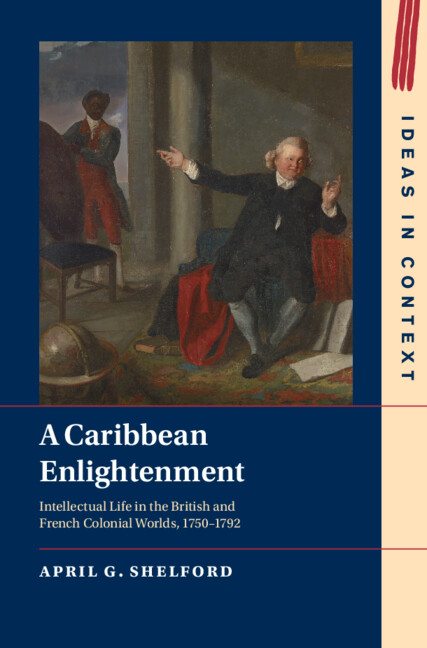
Exploring the intersection of Enlightenment ideas and colonial realities amongst White, male colonists in the eighteenth-century French and British Caribbean, A Caribbean Enlightenment recovers a neglected aspect of the region's history. Physicians to planters, merchants to publishing entrepreneurs were as inspired by ideologies of utility and improvement as their metropolitan counterparts, and they adapted 'enlightened' ideas and social practices to understand their place in the Atlantic World. Colonists collected botanical specimens for visiting naturalists and books for their personal libraries. They founded periodicals that created arenas for the discussion and debate of current problems. They picked up the pen to complain about their relationship with the home country. And they read to make sense of everything from parenting to personal salvation, to their new societies and the enslaved Africans on whom their prosperity depended. Ultimately, becoming 'enlightened' was a colonial identity that rejected metropolitan stereotypes of Caribbean degeneracy while validating the power to enslave on a cultural basis.
Awards
Winner, 2024 Louis Gottschalk Prize, American Society for Eighteenth-Century Studies
Winner, 2024 Kenshur Prize for best book in Eighteenth-Century Studies, Indiana University
Reviews
‘April G. Shelford’s engaging and well-written book … is one that scholars of the French and British Caribbean and Atlantic world will want on their shelves.’
Matthew Mulcahy Source: American Historical Review
‘In keeping with research on intellectual life in the Caribbean during the Enlightenment, A Caribbean Enlightenment demonstrates that plantation owners and their employees were not the narrow-minded philistines long believed before historians such as Trevor Burnard, François Regourd, James E. McClellan III, Jennifer Palmer, and Paul Cheney deconstructed this cliché in recent decades. April Shelford highlights the continuities between the culture of the metropolis and that of the colonists in Jamaica and Saint-Domingue. … The strength of this work lies in its detailed analysis of the practices of little-known figures.’
Damien Tricoire Source: Francia-Recensio
‘The analytical framework structuring A Caribbean Enlightenment is well defined and provides the reader with a clear sense of the book’s overarching aims: to identify and describe the existence of Enlightenment culture in eighteenth-century colonial Caribbean. … Shelford’s work offers notable insights …’
Lily R. Chadwick Source: Journal of World History
Contents
Contents
Metrics
Full text views
Full text views helpTotal number of HTML views: 0
Total number of PDF views: 0 *
 Loading metrics...
* Views captured on Cambridge Core between #date#. This data will be updated every 24 hours.
Usage data cannot currently be displayed.
Accessibility standard: Unknown
Why this information is here
This section outlines the accessibility features of this content - including support for screen readers, full keyboard navigation and high-contrast display options. This may not be relevant for you.
Accessibility Information
Accessibility compliance for the HTML of this book is currently unknown and may be updated in the future.