A History of Pisa

-
Select format
-
- Publisher:
- Cambridge University Press
- Publication date:
- 05 July 2011
- 26 August 2010
- ISBN:
- 9780511696862
- 9781108010139
- Dimensions:
- Weight & Pages:
- Dimensions:
- (216 x 140 mm)
- Weight & Pages:
- 0.42kg, 328 Pages
You may already have access via personal or institutional login
Show more authors 
You may already have access via personal or institutional login
Book description
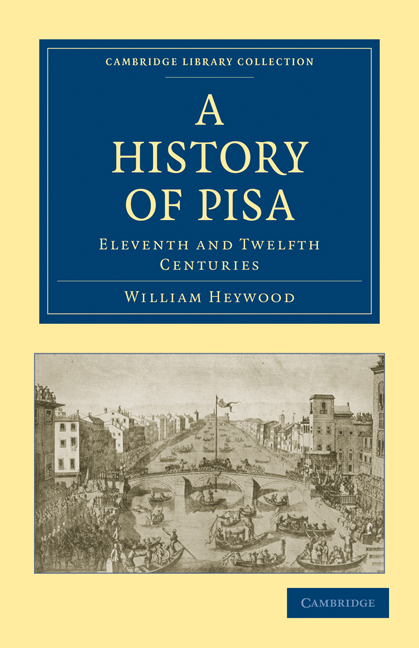
William Heywood (1857–1919) experiencd a variety of jobs, including working as a lawyer, a cowboy and a newspaper editor, before retiring to Siena in Italy in 1894 and becoming a specialist in medieval Italian history. His unorthodox background is shown in his holistic interpretation of the growth of Pisa in the eleventh and twelfth centuries, in contrast to the treatment of historical material by contemporary historians. Heywood examines the politics, society and religion of Pisa to chart the growth of the city from a small port at the end of the Roman period to a powerful city-state by the end of the twelfth century. He is also the first historian to recognise the importance of maritime power struggles between other city-states as an integral part of Pisa's rise to power. This volume provides a valuable addition to the study of the historiography of medieval Italy.
Contents
Contents
Metrics
Altmetric attention score
Full text views
Full text views helpTotal number of HTML views: 0
Total number of PDF views: 0 *
 Loading metrics...
* Views captured on Cambridge Core between #date#. This data will be updated every 24 hours.
Usage data cannot currently be displayed.
Accessibility standard: Unknown
Why this information is here
This section outlines the accessibility features of this content - including support for screen readers, full keyboard navigation and high-contrast display options. This may not be relevant for you.
Accessibility Information
Accessibility compliance for the PDF of this book is currently unknown and may be updated in the future.