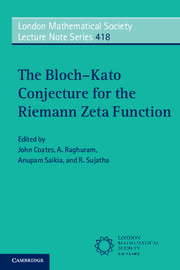
Book contents
- Frontmatter
- Contents
- List of contributors
- Preface
- 1Special Values of the Riemann Zeta Function: Some Results and Conjectures
- 2K-theoretic Background
- 3Values of the Riemann Zeta Function at the Odd Positive Integers and Iwasawa Theory
- 4Explicit Reciprocity Law of Bloch–Kato and Exponential Maps
- 5The Norm Residue Theorem and the Quillen-Lichtenbaum Conjecture
- 6Regulators and Zeta-functions
- 7Soulé's Theorem
- 8Soulé's Regulator Map
- 9On the Determinantal Approach to the Tamagawa Number Conjecture
- 10Motivic Polylogarithm and Related Classes
- 11The Comparison Theorem for the Soulé–Deligne Classes
- 12Eisenstein Classes, Elliptic Soulé Elements and the ℓ-Adic Elliptic Polylogarithm
- 13Postscript
- References
12 - Eisenstein Classes, Elliptic Soulé Elements and the ℓ-Adic Elliptic Polylogarithm
Published online by Cambridge University Press: 05 March 2015

Book contents
- Frontmatter
- Contents
- List of contributors
- Preface
- 1Special Values of the Riemann Zeta Function: Some Results and Conjectures
- 2K-theoretic Background
- 3Values of the Riemann Zeta Function at the Odd Positive Integers and Iwasawa Theory
- 4Explicit Reciprocity Law of Bloch–Kato and Exponential Maps
- 5The Norm Residue Theorem and the Quillen-Lichtenbaum Conjecture
- 6Regulators and Zeta-functions
- 7Soulé's Theorem
- 8Soulé's Regulator Map
- 9On the Determinantal Approach to the Tamagawa Number Conjecture
- 10Motivic Polylogarithm and Related Classes
- 11The Comparison Theorem for the Soulé–Deligne Classes
- 12Eisenstein Classes, Elliptic Soulé Elements and the ℓ-Adic Elliptic Polylogarithm
- 13Postscript
- References
Summary
Abstract
In this paper we study systematically the ℓ-adic realization of the elliptic polylogarithm in the context of sheaves of Iwasawa modules. This leads to a description of the elliptic polylogarithm in terms of elliptic units. As an application we prove a precise relation between ℓ-adic Eisenstein classes and elliptic Soulé elements. This allows to give a new proof of the formula for the residue of the ℓ-adic Eisenstein classes at the cusps and the formula for the cup-product construction in [HK99], which relies only on the explicit description of elliptic units. This computation is the main input in the proof of Bloch–Kato's compatibility conjecture 6.2 needed in the proof of Tamagawa number conjecture for the Riemann zeta function.
Introduction
The purpose of this paper is twofold: on the one hand we prove a new and precise relation between ℓ-adic Eisenstein classes and elliptic Soulé elements using a description of the integral ℓ-adic elliptic polylogarithm in terms of elliptic units. On the other hand this relation will be used to give a new proof for the cup-product construction formula, which is the main result of [HK99] and is the main input in [Hu15] to obtain a proof of Bloch–Kato's compatibility conjecture 6.2. This new proof uses only elementary properties of elliptic units.
The explicit description of the integral ℓ-adic elliptic polylogarithm in terms of elliptic units was already one of the main results in the paper [Ki01]. There we used an approach via one-motives to treat the logarithm sheaf. But the main application of the ℓ-adic elliptic polylogarithm is in the context of Iwasawa theory, which makes it desirable to approach the elliptic polylogarithm systematically in this context. That such an approach is possible is already suggested in the ground-breaking paper [BL94].
In Iwasawa theory Kato, Perrin-Riou and Colmez pointed out the usefulness to work with ‘Iwasawa cohomology’, which is continuous Galois cohomology with values in an Iwasawa algebra.
Information
- Type
- Chapter
- Information
- The Bloch–Kato Conjecture for the Riemann Zeta Function , pp. 239 - 296Publisher: Cambridge University PressPrint publication year: 2015
References
[BK90] , and 1990. L-functions and Tamagawa numbers of motives. The Grothendieck Festschrift, Vol. I. Progr. Math., 86, 333–400. Birkhäuser Boston, Boston, MA.
[Bl15] 2015. Motivic Polylogarithm and related classes, in The Bloch-Kato Conjecture for the Riemann Zeta Function, LMS Lecture Note Series 418. Cambridge University Press. 193–209.
[Co98] 1998. Théorie d'Iwasawa des représentations de de Rham d'un corps local. Ann. of Math., 148, no. 2, 485–571.Google Scholar
[De89] 1989. Le groupe fondamental de la droite projective moins trois points. In Galois groups over ℚ. Math. Sci. Res. Inst. Publ. 16 79–297. Springer.
[GRR72] , , and 1972. Groupes de monodromie en géométrie algébrique. I. Lect. Notes in Math., 288, Springer-Verlag.
[HK99] , and 1999. Degeneration of l-adic Eisenstein classes and of the elliptic polylog. Invent. Math., 135, 545–594.Google Scholar
[HK06] , and 2006. On non-commutative twisting in étale and motivic cohomology. Ann. Inst. Fourier (Grenoble), 56, 1257–1279.Google Scholar
[Hu15] 2015. A Motivic Construction of the Soulé Deligne Classes, in The Bloch-Kato Conjecture for the Riemann Zeta Function, LMS Lecture Note Series 418. Cambridge University Press. 210–238.
[Kt04] 2004. p-adic Hodge theory and values of zeta functions of modular forms. Astérisque, ix, 117–290.Google Scholar
[Ki01] 2001. The Tamagawa number conjecture for CM elliptic curves. Invent. Math., 143, 571–627.Google Scholar
[La90] 1990. Cyclotomic fields I and II. Graduate Texts in Mathematics., 121, Springer-Verlag, New York, second edition, 1990. With an appendix by Karl Rbun.
[So81] 1981. On higher p-adic regulators. Lect. Notes in Math., 854, 372–401. Springer-Verlag.
Accessibility standard: Unknown
Why this information is here
This section outlines the accessibility features of this content - including support for screen readers, full keyboard navigation and high-contrast display options. This may not be relevant for you.Accessibility Information
Accessibility compliance for the PDF of this chapter is currently unknown and may be updated in the future.
- 12
- Cited by