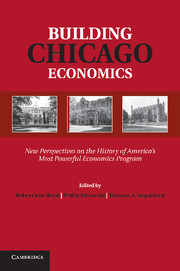
 Building Chicago Economics
New Perspectives on the History of America's Most Powerful Economics Program
Book contents
- Frontmatter
- Contents
- Figures and Tables
- Contributors
- Blueprints
- Orientation: In Search of the Chicago School
- Part OneEconomics Built for Policy: the Legacy of Milton Friedman
- Part TwoConstructing the Institutional Foundations of the Chicago School
- ThreeThe Price Is Not Right
- FourSharpening Tools in the Workshop
- FiveGeorge Stigler, the Graduate School of Business, and the Pillars of the Chicago School
- Part ThreeImperial Chicago
- Part FourDebating “Chicago Neoliberalism”
- Index
- References
Three - The Price Is Not Right
Theodore W. Schultz, Policy Planning, and Agricultural Economics in the Cold-War United States
from Part Two - Constructing the Institutional Foundations of the Chicago School
Published online by Cambridge University Press: 05 November 2011

Book contents
- Frontmatter
- Contents
- Figures and Tables
- Contributors
- Blueprints
- Orientation: In Search of the Chicago School
- Part OneEconomics Built for Policy: the Legacy of Milton Friedman
- Part TwoConstructing the Institutional Foundations of the Chicago School
- ThreeThe Price Is Not Right
- FourSharpening Tools in the Workshop
- FiveGeorge Stigler, the Graduate School of Business, and the Pillars of the Chicago School
- Part ThreeImperial Chicago
- Part FourDebating “Chicago Neoliberalism”
- Index
- References
Summary
In the early winter of 1945, the Committee for Economic Development (CED) met to discuss the wording of their new pamphlet, “Agriculture in an Expanding Economy,” with University of Chicago economist Theodore Schultz. The arguments under discussion were his and would be featured in his forthcoming book, Agriculture in an Unstable Economy, published with the support of the CED by McGraw-Hill. In attendance were other members of the CED Advisory Board: Sumner Slichter, a professor at the Harvard Business School, William Benton, vice president of the University of Chicago, and Beardsley Ruml, former head of the Laura Spelman Rockefeller Fund, policy advisor to FDR, and Treasurer of Macy’s. Schultz attempted to put his associates at ease: They were mindful of how the mandate of their organization – the promotion of free enterprise – would fit into a discussion about heavily subsidized American agriculture.
Several of the members were unclear about Schultz’s vision. According to his rationale, government planning could help those farmers on the cusp of modernizing their operations to do so, as well as help those who lacked the education and resources to take advantage of agricultural modernization to migrate to the cities. When several members questioned how this proposal might be received by the public, given that it could be construed as another move toward socialism, Schultz reduced his grand program to its lowest common denominator: “It is based on classical economics – if earnings are too low then there are too many people and some must get out.” Finally, Schultz boldly stated that it was possible to plan to facilitate a relatively free market, at least given the recalcitrance of the large farm organizations: “There is a great amount of government control and a great amount of individual freedom in the farm picture at the present time. We may need more government to give the farmer greater freedom.”
Information
- Type
- Chapter
- Information
- Building Chicago EconomicsNew Perspectives on the History of America's Most Powerful Economics Program, pp. 67 - 92Publisher: Cambridge University PressPrint publication year: 2011
References
1984 Statistics: An Appraisal. Proceedings of the 50th Anniversary of the Iowa State Statistical LaboratoryAmesIowa State University PressGoogle Scholar
2006 An Opportunity Lost: The Truman Administration and the Farm Policy DebateColumbiaUniversity of Missouri PressGoogle Scholar
2000
2001 Markets and the States in the Evolution of the Prebisch ManifestoCEPAL Review 75 99Google Scholar
1933 Economic Bases for the Agricultural Adjustment ActWashington, DCGovernment Printing OfficeGoogle Scholar
1966 Social Scientists and Farm Politics in the Age of RooseveltAmesIowa State University PressGoogle Scholar
1950
1987 Corporate Liberalism in the American Business Community, 1920–40Business History Review 52 342CrossRefGoogle Scholar
1999 Transforming Economics: Theodore W. Schultz, 1902–1998: In MemoriamThe Economic Journal 109 F730CrossRefGoogle Scholar
2009 The Road from Mont Pelerin: The Making of the Neoliberal Thought CollectiveCambridge, MAHarvard University PressGoogle Scholar
1949 The Economic Development of Latin America and its Principal Problems, United Nations PublicationNYUnited NationsGoogle Scholar
1984 Social Science Knowledge and Institutional ChangeAmerican Journal of Agricultural Economics 66 549CrossRefGoogle Scholar
1933 Testing the Significance of Mean Values Drawn from Stratified SamplesJournal of Farm Economics 15 452CrossRefGoogle Scholar
1960 Business Comes of Age: The Story of the Committee for Economic Development and Its Impact upon the Economic Policies of the United States, 1942–1960NYHarper and BrothersGoogle Scholar
1951 The ECLA/ ECE/ FAO Report on Trade Between Latin America and EuropeNew YorkUnited NationsGoogle Scholar
1943
2009 The Road from Mont Pelerin: The Making of the Neoliberal Thought CollectiveCambridge, MAHarvard University PressGoogle Scholar
2007 The Chicago School: How the University of Chicago Assembled the Thinkers Who Revolutionized Economics and BusinessChicagoAgateGoogle Scholar
1932 The Origin and Development of Farm Economics in the United StatesJournal of Farm Economics 14 6CrossRefGoogle Scholar
2010 The Politics of Food Supply: U.S. Agricultural Policy in the World EconomyNew HavenYale University PressGoogle Scholar
Accessibility standard: Unknown
Why this information is here
This section outlines the accessibility features of this content - including support for screen readers, full keyboard navigation and high-contrast display options. This may not be relevant for you.Accessibility Information
Accessibility compliance for the PDF of this chapter is currently unknown and may be updated in the future.