Book contents
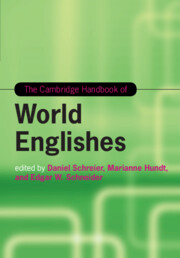
- The Cambridge Handbook of World Englishes
- Cambridge Handbooks in Language and Linguistics
- The Cambridge Handbook of World Englishes
- Copyright page
- Dedication
- Contents
- Figures
- Maps
- Tables
- Notes on Contributors
- 1 World Englishes: An Introduction
- Part I The Making of Englishes
- Part II World Englishes Old and New
- Part III Linguistics and World Englishes
- Part IV Current Challenges
- 25 Norms and Standards in World Englishes
- 26 Identity and Indexicality in the Study of World Englishes
- 27 The Politics of World Englishes
- 28 World Englishes in the Media
- 29 World Englishes and Transnationalism
- Index
- References
28 - World Englishes in the Media
from Part IV - Current Challenges
Published online by Cambridge University Press: 16 December 2019
By

Book contents
- The Cambridge Handbook of World Englishes
- Cambridge Handbooks in Language and Linguistics
- The Cambridge Handbook of World Englishes
- Copyright page
- Dedication
- Contents
- Figures
- Maps
- Tables
- Notes on Contributors
- 1 World Englishes: An Introduction
- Part I The Making of Englishes
- Part II World Englishes Old and New
- Part III Linguistics and World Englishes
- Part IV Current Challenges
- 25 Norms and Standards in World Englishes
- 26 Identity and Indexicality in the Study of World Englishes
- 27 The Politics of World Englishes
- 28 World Englishes in the Media
- 29 World Englishes and Transnationalism
- Index
- References
Summary
Media, especially those that are free, represent an important site for Englishes to display tension between local and global identities. There is a preference for international media standards, and these are closely associated in name with media (“broadcast standard English,” “BBC English,” etc.). At the same time, media providers attempt to localize English usage for various effects, including identity formation. Media Englishes, therefore, adopt and codify much of the “authority” of standard English and, at the same time, use nonstandard Englishes to construct “authenticity” within media performances. The chapter surveys the large number of media studies conducted from the World Englishes perspectives and identifies common themes running through them – most notably, the expression of popular culture identities in various media Englishes and the use of English as a linguistic resource within other media languages. It considers sociolinguists’ traditional rejection of the media as a motivating factor in language change and considers more recent evidence that the media provide positive norms for the acquisition of English across the Inner, Outer, and Expanding Circles of users.
Information
- Type
- Chapter
- Information
- The Cambridge Handbook of World Englishes , pp. 652 - 675Publisher: Cambridge University PressPrint publication year: 2020
References
Abbas, Shemeem. 1993. The power of English in Pakistan. World Englishes 12(2): 147–156.Google Scholar
Adekunle, Mobolaji. 1997. English in Nigeria: Attitudes, policy and communicative realities. In Bamgbose, Ayo, Banjo, Ayo and Thomas, Andrew, eds. New Englishes: A West African Perspective. Trenton, NJ: Africa World Press, 57–86.Google Scholar
Agheyisi, Rebecca N. 1984. Linguistic implications of the changing role of Nigerian Pidgin English. English World-Wide 5(2): 211–233.Google Scholar
Agheyisi, Rebecca N. 1988. The standardization of Nigerian Pidgin English. English World-Wide 9(2): 227–241.Google Scholar
Aguilar-Sanchez, Jorge. 2005. English in Costa Rica. World Englishes 24(2): 161–172.CrossRefGoogle Scholar
Alm, Cecilia Ovesdotter. 2003. English in the Ecuadorian commercial context. World Englishes 22(2): 143–158.Google Scholar
Alvaro, Joseph James. 2015. Analysing China’s English-language media. World Englishes 34(2): 260–77.Google Scholar
Alvaro, Joseph James. 2016. Political discourse in China’s English language press. World Englishes 32(2): 147–168.CrossRefGoogle Scholar
Baratta, Alex. 2014. The use of English in Korean TV drama to signal a modern identity. English Today 30(3): 54–60.Google Scholar
Barker, Hugh and Taylor, Yuval. 2007. Faking It: The Quest for Authenticity in Popular Music. London: Faber & Faber.Google Scholar
Battenburg, John. 1997. English versus French: Language rivalry in Tunisia. World Englishes 16(2): 281–290.Google Scholar
Bauman, Richard. 2011. The remediation of storytelling: Narrative performance on early commercial sound recordings. In Schiffrin, Deborah, De Fina, Anna and Nylund, Anastasia, eds. Telling Stories: Language, Narrative, and Social Life, Washington, DC: Georgetown University Press, 23–43.Google Scholar
Baumgardner, Robert J. 1987. Utilizing Pakistani newspaper English to teach grammar. World Englishes 6(3): 241–252.CrossRefGoogle Scholar
Baumgardner, Robert J. 1990. The indigenization of English in Pakistan. English Today 6(1): 59–65.Google Scholar
Baumgardner, Robert J. 1997. English in Mexican Spanish. English Today 13(4): 27–35.CrossRefGoogle Scholar
Baumgardner, Robert J. and Brown, Kimberley. 2012. English in Iranian magazine advertising. World Englishes 31(3): 292–311.Google Scholar
Bhatia, Tej K. 1987. English in advertising: Multiple mixing and media. World Englishes 6(1): 33–48.Google Scholar
Bhatia, Tej K. 1992. Discourse functions and pragmatics of mixing: Advertising across cultures. World Englishes 11(2–3): 195–215.Google Scholar
Bhatia, Tej K. 2000. Advertising in Rural India: Language, Marketing Communication and Consumerism. Tokyo: Tokyo University of Foreign Studies.Google Scholar
Bhatia, Tej K. 2006. World Englishes in global advertising. In Kachru, Braj B., Kachru, Yamuna and Nelson, Cecil L., eds. The Handbook of World Englishes, Oxford: Blackwell, 609–619.Google Scholar
Bhatia, Tej K. and Ritchie, William C.. 2004. Bilingualism in the global media and advertising. In Bhatia, Tej K. and Ritchie, William C., eds. The Handbook of Bilingualism. Oxford: Blackwell, 513–546.Google Scholar
Bolton, Kingsley. 2010. Constructing the global vernacular: American English and the media. In Bolton, Kingsley and Olsson, Jan, eds. Media, Popular Culture, and the American Century. Stockholm: National Library of Sweden, 125–153.Google Scholar
Bolton, Kingsley. 2012. World Englishes and linguistic landscapes. World Englishes 31(1): 30–33.Google Scholar
Britton, Luke Morgan. 2015. Drake finally addresses ghostwriter claims: “Music can be a collaborative process.” NME, September 25. www.nme.com/news/music/drake-133–1222920Google Scholar
Bucholtz, Mary. 2003. Sociolinguistic nostalgia and the authentication of identity. Journal of Sociolinguistics 7(3): 398–416.Google Scholar
Bucholtz, Mary and Hall, Kira. 2004. Language and identity. In Duranti, Alessandro, ed. A Companion to Linguistic Anthropology. Oxford: Basil Blackwell, 268–294.Google Scholar
Chambers, J. K. 1993. Sociolinguistic dialectology. In Preston, Dennis R., ed. American Dialect Research. Amsterdam: John Benjamins, 133–164.Google Scholar
Chambers, J. K. 1995. Sociolinguistic Theory: Linguistic Variation and Its Social Significance. Oxford: Blackwell.Google Scholar
Chambers, J. K. 1998. Myth 15: TV makes people sound the same. In Bauer, Laurie and Trudgill, Peter, eds. Language Myths. London: Penguin Books, 123–131.Google Scholar
Chan, Brian Hok-Shing. 2009. English in Hong Kong Cantopop: Language choice, code-switching and genre. World Englishes 28(1): 107–129.Google Scholar
Chan, Brian Hok-Shing. 2012. English in Cantopop: Code-switching, pop songs and the local identity of Hong Kong Chinese. In Lee, Jamie Shinhee and Moody, Andrew, eds. English and Asian Popular Culture. Hong Kong: Hong Kong University Press. 35–57.Google Scholar
Chan, Yuen-Ying. 2000. The English-language media in Hong Kong. World Englishes 19(3): 323–335.Google Scholar
Chen, Cheryl Wei-Yu. 2006. The mixing of English in magazine advertisements in Taiwan. World Englishes 25(3–4): 467–478.Google Scholar
Chik, Alice. 2010. Creative multilingualism in Hong Kong popular music. World Englishes 29(4): 508–522.Google Scholar
Coupland, Nikolas. 2001. Dialect stylization in radio talk. Language in Society 30(3): 345–375.Google Scholar
Coupland, Nikolas. 2003. Sociolinguistic authenticities. Journal of Sociolinguistics 7(3): 417–431.Google Scholar
Dayag, Danilo T. 2004. The English-language media in the Philippines. World Englishes 23(1): 33–45.Google Scholar
Demont-Heinrich, Christof. 2008. American “prestige press” representations of the global hegemony of English. World Englishes 27(2): 161–180.CrossRefGoogle Scholar
Deuber, Dagmar. 2002. “First Year of Nation’s Return to Government of Make You Talk Your Own Make I Talk My Own”: Anglicisms versus Pidginization in news translations into Nigerian Pidgin. English World-Wide 23(2): 195–222.CrossRefGoogle Scholar
Dimova, Slobodanka. 2008. English in Macedonian commercial nomenclature. World Englishes 27(1): 83–100.Google Scholar
Dimova, Slobodanka. 2012. English in Macedonian television commercials. World Englishes 31(1): 15–29.CrossRefGoogle Scholar
Dissanayake, Wimal. 1986. Exotic Other: Western representation of India in English literature and film. World Englishes 5(2–3): 177–187.CrossRefGoogle Scholar
Dogancay-Aktuna, Seran and Kiziltepe, Zeynep. 2005. English in Turkey. World Englishes 24(2): 253–265.Google Scholar
Dolphyne, Florence. 1997. A note on the English language in Ghana. In Bamgbose, Ayo, Banjo, Ayo and Thomas, Andrew, eds. New Englishes: A West African Perspective, Trenton, NJ: Africa World Press, 27–33.Google Scholar
Donlan, Lisa. 2016. Researching the etymology of Australian English colloquialisms in the digital age: Implications for 21st century lexicography. English Today 32(3): 40–44.Google Scholar
Drum, Kevin. 2011. Oh, that old-timey movie accent! Mother Jones, August 9. www.motherjones.com/kevin-drum/2011/08/oh-old-timey-movie-voice/Google Scholar
Dubey, Vinod S. 1991. The lexical style of Indian English newspapers. World Englishes 10(1): 19–32.Google Scholar
Ezejideaku, Emma and Ugwu, Esther N.. 2009. Igbo English in the Nigerian video film. English World-Wide 30(1): 52–67.Google Scholar
Fallows, James. 2015. That weirdo announcer-voice accent: Where it came from and why it went away. The Atlantic, June 7. www.theatlantic.com/national/archive/2015/06/that-weirdo-announcer-voice-accent-where-it-came-from-and-why-it-went-away/395141/Google Scholar
Fitzmaurice, Susan. 2000. The Spectator, the politics of social networks, and language standardisation in eighteenth century England. In Wright, Laura, ed. The Development of Standard English 1300–1800, Cambridge: Cambridge University Press, 195–218.Google Scholar
Geist, Kathe. 1991. English in Non-English-language films. World Englishes 10(3): 263–274.Google Scholar
Gerritsen, Marinel, Nickerson, Catherine, van Hooft, Andreu, van Meurs, Frank, Nederstigt, Ulrike, Starren, Marianne and Crijns, Rogier. 2007. English in product advertisements in Belgium, France, Germany, the Netherlands and Spain. World Englishes 26(3): 291–315.Google Scholar
Grant, Lynn E. 2012. Culturally motivated lexis in New Zealand English. World Englishes 31(2): 162–176.Google Scholar
Grau, Maike. 2009. Worlds apart? English in German youth cultures and in educational settings. World Englishes 28(2): 160–174.Google Scholar
Guo, Zhongshi and Huang, Yu. 2002. Hybridized discourse: Social openness and functions of English media in post-Mao China. World Englishes 21(2): 217–230.Google Scholar
Haarmann, Harold. 1989. Symbolic Values of Foreign Language Use: From the Japanese Case to a General Sociolinguistic Perspective. Berlin: Mouton de Gruyter.Google Scholar
Hamdan, Jihad M. and Abu Hatab, Wafa A.. 2009. English in the Jordanian context. World Englishes 28(3): 394–405.Google Scholar
Hill, Jane H. 1999. Styling locally, styling globally: What does it mean? Journal of Sociolinguistics 3(4): 542–556.Google Scholar
Howse, Hugh. 1979. BBC English by television and radio-news developments and new materials. English Around the World 20: 6–7.Google Scholar
Huber, Magnus and Görlach, Manfred. 1996. West African Pidgin English. English World-Wide 17(2): 239–258.Google Scholar
Jacobs, Greg. 1998. The struggle over naming: A case study of “queer” in Toronto, 1990–1994. World Englishes 17(2): 193–201.CrossRefGoogle Scholar
James, Allan. 2016. From code-mixing to mode-mixing in the European context. World Englishes 35(2): 259–275.Google Scholar
Kachru, Braj B. 1985. Standards, codification and sociolinguistic realism: The English language in the outer circle. In Quirk, Randolph and Widdowson, H.G., eds. English in the World: Teaching and Learning the Language and Literatures. Cambridge: Cambridge University Press, 11–30.Google Scholar
Kachru, Braj. B. 1986. The Alchemy of English: The Spread, Functions, and Models of Non-native Englishes. Urbana: University of Illinois Press.Google Scholar
Kachru, Yamuna. 2006. Mixers lyricing in Hinglish: Blending and fusion in Indian pop culture. World Englishes 25(2): 223–233.Google Scholar
Kasztalska, Aleksandra. 2014. English in contemporary Poland. World Englishes 33(2): 242–262.CrossRefGoogle Scholar
Kathpalia, Sujata S. and Wee Ong, Kenneth Keng. 2015. The use of code-mixing in Indian billboard advertising. World Englishes 34(4): 557–575.Google Scholar
Kirkpatrick, Andy and Moody, Andrew. 2009. A tale of two songs: Singapore versus Hong Kong. ELT Journal 63(3): 265–271.Google Scholar
Kouega, Jean-Paul. 1999. Forty years of official bilingualism in Cameroon. English Today 15(4): 38–43.Google Scholar
Krishnasamy, Kanthimathi. 2007. English in Tamil: The language of advertising. English Today 23(3–4): 40–49.Google Scholar
Labov, William. 1972. Sociolinguistic Patterns. Philadelphia: University of Pennsylvania Press.Google Scholar
Labov, William. 1998. The three dialects of English. In Linn, Michael D., ed. Handbook of Dialects and Language Variation (2nd ed.). San Diego: Academic Press, 39–81.Google Scholar
Lawson, Robert. 2014. “Don’t even [(theta)/f/h]ink aboot it”: An ethnographic investigation of social meaning, social identity and ((theta)) variation in Glasgow. English World-Wide 35(1): 68–93.Google Scholar
Lee, Jamie Shinhee. 2004. Linguistic hybridization in K-pop: Discourse of self-assertion and resistance. World Englishes 23(3): 429–450.Google Scholar
Lee, Jamie Shinhee. 2006. Crossing and crossers in East Asian pop music: Korea and Japan. World Englishes 25(2): 235–250.Google Scholar
Lee, Jamie Shinhee. 2007. I’m the illest fucka: An analysis of African American English in South Korean hip hop. English Today 23(2): 54–60.Google Scholar
Lee, Jamie Shinhee and Moody, Andrew. 2012a. Sociolinguistics and the study of English in popular culture. In Lee, Jamie Shinhee and Moody, Andrew, eds. English in Asian Popular Culture (Asian Englishes Today Series). Hong Kong: Hong Kong University Press, 1–11.Google Scholar
Lee, Jamie Shinhee and Moody, Andrew, eds. 2012b. English in Asian Popular Culture. Hong Kong: Hong Kong University Press.Google Scholar
Leith, Dick. 1983. A Social History of English (Language and Society Series). London: Routledge and Kegan Paul.Google Scholar
Leitner, G. 1984. Australian English or English in Australia-Linguistic identity or dependence in broadcast language. English World-Wide 5(1): 55–85.Google Scholar
Leppanen, Sirpa. 2007. Youth language in media contexts: insights into the functions of English in Finland. World Englishes 26(2): 149–169.Google Scholar
Li, David C. S. 1999. The functions and status of English in Hong Kong: A post-1997 update. English World-Wide 20(1): 67–110.Google Scholar
Li, Songqing. 2012. The use of English in China’s real estate advertising. English Today 28(3): 53–59.Google Scholar
Lin, Angel. 2012. The hip hop music scene in Hong Kong: Hybridity and identity in youth culture. In Lee, Jamie Shinhee and Moody, Andrew, eds. English in Asian Popular Culture. Hong Kong: Hong Kong University Press, 59–73.Google Scholar
Lippi-Green, Rosina. 1997. English with an Accent: Language, Ideology and Discrimination in the United States. London: Routledge.Google Scholar
Loveday, Leo. 1996. Language Contact in Japan: A Socio-Linguistic History. New York: Oxford University Press.CrossRefGoogle Scholar
Lujan-Garcia, Carmen. 2011. “English invasion” in Spain: An analysis of toys leaflets addressed to young children: Do toy advertisements introduce Spanish children to English? English Today 27(1): 3–9.CrossRefGoogle Scholar
Luke, Kang-kwong and Richards, Jack C.. 1982. English in Hong Kong: Functions and Status. English World-Wide 3(1): 47–64.Google Scholar
Makalela, Leketi. 2013. Black South African English on the radio. World Englishes 32(1): 93–107.Google Scholar
Martin, Elizabeth. 1998. The use of English in written French advertising: A study of code- switching, code-mixing, and borrowing in a commercial context. Studies in the Linguistic Science 28(1): 159–184.Google Scholar
Martin, Elizabeth. 2002a. Cultural images and different varieties of English in French television commercials. English Today 18(4): 8–20.Google Scholar
Martin, Elizabeth. 2002b. Mixing English in French advertising. World Englishes 21(3): 375–401.Google Scholar
Martin, Elizabeth. 2006. Marketing Identities Through Language: English and Global Imagery in French Advertising. Basingstoke: Palgrave Macmillan.Google Scholar
Martinez, Francia. 2015. English in advertising in Colombia. World Englishes 34(4): 600–619.CrossRefGoogle Scholar
Masavisut, Nitaya, Sukwiwat, Mayuri, and Wongmontha, Seri. 1986. The power of the English language in Thai media. World Englishes 5(2–3): 197–207.Google Scholar
Matiki, Alfred J. 2001. The social significance of English in Malawi. World Englishes 20(2): 201–218.Google Scholar
McArthur, Tom. 1997. The printed word in the English-speaking world. English Today 13(1): 10–16.Google Scholar
McArthur, Tom. 1999. English in the World, in Africa, and in South Africa. English Today 15(1): 11–16.Google Scholar
Mesthrie, Rajend. 2002. Mock languages and symbolic power: The South African radio series “Applesammy and Naidoo.” World Englishes 21(1): 99–112.Google Scholar
Millar, Robert McColl. 2012. English Historical Sociolinguistics (Edinburgh Textbooks on the English Language – Advanced Series). Edinburgh: Edinburgh University Press.Google Scholar
Milroy, Leslie. 2000. Britain and the United States: Two nations divided by the same language (and different language ideologies). Journal of Linguistic Anthropology 10(1): 56–89.Google Scholar
Milroy, James and Milroy, Lesley. [1985] 1999. Authority in Language: Investigating Standard English (3rd ed.). London: Routledge.Google Scholar
Moody, Andrew. 2006. English in Japanese popular culture and J-pop Music. World Englishes 25(2): 209–222.Google Scholar
Moody, Andrew. 2010. The Englishes of popular cultures. In Kirkpatrick, Andy, ed. The Handbook of World Englishes. London: Routledge, 535–549.Google Scholar
Moody, Andrew. 2011. Englishization in Japanese popular culture: Representation of ethnicity. In Tam, Kwok-kan, ed., Englishization in Asia: Language and Cultural Issues. Hong Kong: Open University of Hong Kong Press, 183–206.Google Scholar
Moody, Andrew. 2012a. Authenticity of English in Asian popular music. In Kirkpatrick, Andy and Sussex, Roland, eds., English as an International Language in Asia: Implications for Language Education. New York: Springer Science and Business Media Dordrecht, 209–222.Google Scholar
Moody, Andrew. 2012b. English in Southeast Asian pop culture. In Low, Ee-Ling and Hashim, Azirah, eds. English in Southeast Asia: Features, Policy and Language in Use. Amsterdam: John Benjamins, 307–324.Google Scholar
Moody, Andrew. 2013. Language ideology in the discourse of popular culture. In Chapelle, Carol A., ed. The Encyclopedia of Applied Linguistics, Vol. 5. Oxford: Wiley-Blackwell, 3009–3011.Google Scholar
Moody, Andrew and Matsumoto, Yuko. 2003. “Don’t touch my moustache”: Language blending and code ambiguation by two J-pop artists. Asian Englishes 6(1): 4–33.Google Scholar
Moody, Andrew and Matsumoto, Yuko. 2011. The ideal speaker of Japanese English as portrayed in “language entertainment” television. In Seargeant, P., ed. English in Japan in the Era of Globalisation. Houndmills: Palgrave Macmillan, 166–186.Google Scholar
Munzali, Jibril. 1997. The elaboration of the functions of Nigerian Pidgin. In Bamgbose, Ayo, Banjo, Ayo and Thomas, Andrew, eds. New Englishes: A West African Perspective, Trenton, NJ: Africa World Press, 232–247.Google Scholar
Nwoye, Onuigbo. 1992. Obituary announcements as communicative events in Nigerian English. World Englishes 11(1): 15–27.Google Scholar
Omoniyi, Tope. 2006. Hip-hop through the world Englishes lens: A response to globalization. World Englishes 25(2): 195–208.Google Scholar
O’Sullivan, Joan. 2013. Advanced Dublin English in Irish radio advertising. World Englishes 32(3): 358–376.Google Scholar
Pandharipande, Rajeshwari. 2013. The language of Hinduism in the US diaspora. World Englishes 32(3): 417–428.Google Scholar
Park, Joseph Sung-Yul, . 2004. “Baby, darling, honey!”: Constructing a competence of English in South Korean TV shows. Texas Linguistic Forum 47: 143–154.Google Scholar
Park, Joseph Sung-Yul, . 2009. The Local Construction of a Global Language: Ideologies of English in South Korea. Berlin: Mouton de Gruyter .Google Scholar
Park, Joseph Sung-Yul and Wee, Lionel. 2012. Markets of English: Linguistic Capital and Language Policy in a Globalizing World. London: Routledge.Google Scholar
Pennycook, Alastair. 2003. Global Englishes, Rip Slyme and performativity. Journal of Sociolinguistics 7(4): 513–533.Google Scholar
Petery, Dorottya. 2011. English in Hungarian advertising. World Englishes 30(1): 21–40.Google Scholar
Petzold, Ruth and Berns, Margie. 2000. Catching up with Europe: Speakers and functions of English in Hungary. World Englishes 19(1): 113–124.Google Scholar
Phillipson, Robert and Skutnabb-Kangas, Tove. 1996. Is India throwing away its language resources? English Today 12(1): 23–27.CrossRefGoogle Scholar
Queen, Robin. 2015. Vox Popular: The Surprising Life of Language in the Media. Chichester: Wiley Blackwell.Google Scholar
Raedts, Mariet, Dupre, Natalie, Hendrickx, Jef and Debrauwere, Sophie. 2015. English in television commercials in Belgium, France, Italy, the Netherlands and Spain. World Englishes 34(4): 576–599.CrossRefGoogle Scholar
Rampton, Ben. 1995. Crossing: Language and Ethnicity among Adolescents. London: Longman.Google Scholar
Rampton, Ben. 1999. Styling the other: Introduction. Journal of Sociolinguistics 3(4): 421–427.CrossRefGoogle Scholar
Rindal, Ulrikke. 2013. Being “neutral”? English pronunciation among Norwegian learners. World Englishes 32(2): 211–229.Google Scholar
Rose, Kenneth R. 2001. Compliments and compliment responses in film: Implications for pragmatics research and language teaching. IRAL: International Review of Applied Linguistics in Language Teaching 39(4): 309–326.Google Scholar
Rubdy, Rani. 2001. Creative destruction: Singapore’s Speak Good English Movement. World Englishes 20(3): 341–355.Google Scholar
Ruellot, Viviane. 2011. English in French print advertising from 1999 to 2007. World Englishes 30(1): 5–20.Google Scholar
Sala, Bonaventure M. 2009. Writing in Cameroon Pidgin English: Begging the question. English Today 25(2): 11–17.Google Scholar
Schmied, Josef and Hudson-Ettle., Diana 1996. Analyzing the style of East African newspapers in English. World Englishes 15(1): 103–113.Google Scholar
Schneider, Edgar W. 2007. Postcolonial English: Varieties Around the World. Cambridge: Cambridge University Press.Google Scholar
Schwyter, Jürg R. 2016. Dictating to the Mob: The History of the BBC Advisory Committee on Spoken English. Oxford: Oxford University Press.Google Scholar
Seargeant, Philip. 2005. Globalisation and reconfigured English in Japan. World Englishes 24(3): 309–319.Google Scholar
Sharbawi, Salbrina and Deterding, David. 2010. Rhoticity in Brunei English. English World-Wide 31(2): 121–137.Google Scholar
Shim, Rosa Jinyoung. 1994. Englishized Korean: Structure, status, and attitudes. World Englishes 13(2): 225–244.CrossRefGoogle Scholar
Shytex BookVideo Training. 2014. Video Course: Do You Speak American? Part 1. www.youtube.com/watch?v=kcx7khan180Google Scholar
Silverstein, Michael. 1979. Language structure and linguistic ideology. In Clyne, Paul R., Hanks, William F. and Hofbauer, Carol L., eds., The Elements: A Parasession on Linguistic Units and Levels, April 20–21, 1979: Including Papers from the Conference on Non-Slavic Languages of the USSR, April 18, 1979. Chicago: Chicago Linguistic Society, 193–247.Google Scholar
Skinner, Edith. 1990. Speak with Distinction (rev. ed.; with new material added by Timothy Monich and Lilene Mansell). New York: Applause Theatre and Cinema Books.Google Scholar
Snodin, Navaporn Sanpresert. 2014. English naming and code-mixing in Thai mass media. World Englishes 33(1): 100–11.Google Scholar
Staczek, John J. 1993. The English language and the Gulf War: Corpus linguistics, variations, and word-formation. World Englishes 12(1): 15–24.Google Scholar
Stadler, Stefanie. 2016. Televised political discourse in New Zealand. World Englishes 32(2): 243–260.Google Scholar
Stanlaw, James. 2004. Japanese English: Language and Culture Contact. Hong Kong: Hong Kong University Press.Google Scholar
Stuart-Smith, Jane, Pryce, Gwilym, Timmins, Claire and Gunter, Barrie. 2013. Television can also be a factor in language change: Evidence from an urban dialect. Language 89(3) 501–536.Google Scholar
Swan, Michael and Urdang, Laurence. 1985. Where is the language going? English Today 3: 6–10.Google Scholar
Taavitsainen, Irma and Pahta, Paivi. 2008. From global language use to local meanings: English in Finnish public discourse. English Today 24(3): 25–38.Google Scholar
Tagliamonte, Sali A. 2006. Analysing Sociolinguistic Variation. Cambridge: Cambridge University Press.Google Scholar
Takashi, Kyoko. 1990. A sociolinguistic analysis of English borrowings in Japanese advertising texts. World Englishes 9(3): 327–341.Google Scholar
Tanaka, Sachiko Oda. 1995. The Japanese media and English. World Englishes 14(1): 37–53.Google Scholar
Thompson, Roger M. 2012. Colliding world-views: A night with Philippine television. In Lee, Jamie Shinhee and Moody, Andrew, eds. English in Asian Popular Culture. Hong Kong: Hong Kong University Press, 77–102.Google Scholar
Ustinova, Irina P. and Bhatia, Tej K.. 2005. Convergence of English in Russian TV commercials. World Englishes 24(4): 495–508.Google Scholar
Vettorel, Paola. 2016. English in Italian advertising. World Englishes 32(2): 261–278.Google Scholar
Wang, B. P. Y. 2006. English mixing in the lyrics of mandarin pop songs in Taiwan: A functional approach. NCYU Inquiry of Applied Linguistics: 211–240.Google Scholar
Yong, Zhao and Campbell, Keith P.. 1995. English in China. World Englishes 14(3): 377–390.Google Scholar
Zhou, Sijing and Moody, Andrew. 2017. English in The Voice of China. World Englishes 36(4): 554–570.Google Scholar
Accessibility standard: Unknown
Why this information is here
This section outlines the accessibility features of this content - including support for screen readers, full keyboard navigation and high-contrast display options. This may not be relevant for you.Accessibility Information
Accessibility compliance for the HTML of this chapter is currently unknown
and may be updated in the future.
- 2
- Cited by