Book contents
- Frontmatter
- Contents
- Contributors
- Introduction
- PART IEXPANDING JUDICIAL ROLES IN NEW OR RESTORED DEMOCRACIES
- Part IIEXPANDING JUDICIAL ROLES IN ESTABLISHED DEMOCRACIES
- 6Courts Enforcing Political Accountability
- 7The Dutch Hoge Raad
- 8A Consequential Court
- 9Judicial Constitution Making in a Divided Society
- 10Public Interest Litigation and the Transformation of the Supreme Court of India
- 11The Judicial Dynamics of the French and European Fundamental Rights Revolution
- 12Constitutional Courts as Bulwarks of Secularism
- PART IIIFOUR “PROVOCATIONS”
- ConclusionOf Judicial Ships and Winds of Change
- Index
- References
9 - Judicial Constitution Making in a Divided Society
The Israeli Case
Published online by Cambridge University Press: 05 April 2013

Book contents
- Frontmatter
- Contents
- Contributors
- Introduction
- PART IEXPANDING JUDICIAL ROLES IN NEW OR RESTORED DEMOCRACIES
- Part IIEXPANDING JUDICIAL ROLES IN ESTABLISHED DEMOCRACIES
- 6Courts Enforcing Political Accountability
- 7The Dutch Hoge Raad
- 8A Consequential Court
- 9Judicial Constitution Making in a Divided Society
- 10Public Interest Litigation and the Transformation of the Supreme Court of India
- 11The Judicial Dynamics of the French and European Fundamental Rights Revolution
- 12Constitutional Courts as Bulwarks of Secularism
- PART IIIFOUR “PROVOCATIONS”
- ConclusionOf Judicial Ships and Winds of Change
- Index
- References
Summary
During the mid-1990's, Israel experienced a legal and political transformation known as “the constitutional revolution” (Gavison 1997: 27; Hirschl 1997: 136; Salzberger & Voigt 2002: 490; Edrey 2005: 78; Sapir 2008: 4). In essence, this “revolution” entailed the empowerment of the judiciary to exercise constitutional judicial review over primary legislation when such legislation does not comply with the requirements set forth in Israel's Basic Laws. This revolution, although on the basis of two Basic Laws enacted by the Knesset in 1992 (and amended in 1994), was nonetheless Court driven in the sense that the Justices of the Supreme Court in the Bank Hamizrachi United v. Migdal Communal Village (1995) significantly expanded the rather modest mandate given in these two Basic Laws (Gavison 1997: 95). The Supreme Court elevated the status of all Basic Laws to the constitutional sphere and denied the power of the Knesset to exempt a statute from judicial review unless it explicitly amends the Basic Laws themselves.
In this chapter, I will provide the historical background in a nutshell and then briefly sketch the legal contours of the revolution (i.e., what happened), analyze the judicial moves that brought this change about (i.e., how it happened), and hypothesize on the forces that brought this change about (i.e., why it happened the way it happened). I will then examine in brief some of the possible ramifications of the revolution for the political and legal landscape in Israel. Throughout the chapter, I will point to some general lessons that may be gleaned from the Israeli story and highlight the importance of a number of specific dynamics including the relationship between the judiciary and the legal academy; the relative prestige bestowed by the media on justices and the Supreme Court compared to the treatment of the legislature and politicians; the fragmentation of the political system; particular aspects of Israel's political economy; and of course, the attitudes and leadership of the political and legal leaders. All of these are variables worthy of examination in any country undergoing a constitutional transformation that is not a consequence of an acute crisis (such as the foundation of a state or the conclusion of a serious civil struggle).
Information
- Type
- Chapter
- Information
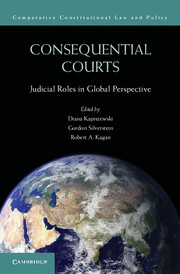
- Consequential CourtsJudicial Roles in Global Perspective, pp. 233 - 261Publisher: Cambridge University PressPrint publication year: 2013
References
2005. “When Roni Daniel is Angry,” Haaretz, October 9, viewed December 27, 2011, retrieved from .
2006. “Shneler: H.C.J is Harming the Core of Democracy,” Arutz 7, December 12, viewed December 27, 2011, retrieved from .
1992/3. “The Constitutional Revolution: Protected Human Rights,” Mishpat Umimshal 1: 9.Google Scholar
1993. “The Supreme Court and Basic-Law: Human Dignity and Liberty,” Hamishpat 2: 15–21.Google Scholar
1994. Interpretation in Law Volume III Constitutional Interpretation. Jerusalem: Nevo Publishing.Google Scholar
2000a. “Human Dignity as a Constitutional Right,” in and (eds.), Aharon Barak Selected Essays, Vol. A. Jerusalem: Nevo Publishing, pp. 417–445.Google Scholar
2000b. “The Constitutional Revolution,” in and (eds.), Aharon Barak Selected Essays, Vol. A. Jerusalem: Nevo Publishing, pp. 349–355.Google Scholar
2010. “Symbolic Constitutionalism: On Sacred Cows and Abominable Pigs,” Law, Culture and The Humanities 6: 420–435.CrossRefGoogle Scholar
2003. “A Decade after the Constitutional Revolution – A View on the Constitutional Process in Israel Thru a Comparative Historic Prism,” Mishpat U’Mimshal 6(2): 495–509.Google Scholar
2000. “The Legal Status of the Basic Laws” in Barak, Aharon and Berenson Haim (eds.), Berenson Book, Vol. 2, Jerusalem: Nevo Publishing, pp. 119–181.
, Protocols of the 13th Knesset, 17 March 1992, viewed November 10, 2012, retrieved from .
, Protocols of the 13th Knesset, 9 March 1994, viewed November 10, 2012, retrieved from .
, . 2005. “The Israeli Constitutional Revolution/Evolution, Models of Constitutions, and a Lesson from Mistakes and Achievements,” The American Journal of Comparative Law 53: 77–123.CrossRefGoogle Scholar
1998. The Rights Revolution: Lawyers, Activists and Supreme Courts in Comparative Perspective. Chicago: University of Chicago Press.Google Scholar
1997. “The Constitutional Revolution: A Reality or a Self-Fulfilling Prophecy?” Mishpatim 28: 21–147.Google Scholar
2003. Judicial Review in New Democracies: Constitutional Courts in Asian Cases. New York: Cambridge University Press.CrossRefGoogle Scholar
2009. “The Judicialization of Administrative Governance,” in & (eds.), Administrative Law and Governance in Asia, New York: Routledge, pp. 1–20.Google Scholar
1993. “You don't Need a Constitution to Plant Trees: On State-Building and Constitution Framing,” State, Government and International Relation 38: 29–48.Google Scholar
& 1941. “The Special Competence of the Supreme Court,” Yale Law Journal 50: 1319–1375.CrossRefGoogle Scholar
1997. “The ‘Constitutional Revolution’ and the Emergence of a New Economic Order in Israel,” Israel Studies 2: 136–155.Google Scholar
2004. Towards Juristocracy: The Origins and Consequences of the New Constitutionalism. Cambridge: Harvard University Press.Google Scholar
2009. “The Socio-Political Origins of Israel's Juristocracy,” Constellations 16(3): 476–492.CrossRefGoogle Scholar
1996. “The Unintended Consequences of Unplanned Constitutional Reform: Constitutional Politics in Israel,” The American Journal of Comparative Law 44(4): 584–604.CrossRefGoogle Scholar
1990. “The Legislative Council: The Beginning of the Legislative Tale,” in and (eds.), Ori Yadin Book, Vol. B. Jerusalem: Bursi Publishing Co., pp. 209–255.Google Scholar
Ben-Gurion and the Constitution: on Constitutionalism, Democracy and Law in David Ben-Gurion's Policy (forthcoming, 2012), chapter 5.
2009. Mamlakhtiut David Ben-Gurion Civic Thought. Jerusalem: Yad Yitzhak Ben-Zvi and Ben-Gurion University.Google Scholar
2007. “Because of the Standing Requirements,” nrg, July 25, viewed December 27, 2011, retrieved from .
2011. Making Constitutions in Deeply Divided Societies. New York: Cambridge University Press.CrossRefGoogle Scholar
1999. “Democracy and New Constitutionalism in Israel,”Israel Law Review 33(2): 259.CrossRefGoogle Scholar
2008. Law and Culture in Israel at the Threshold of the Twenty First Century. Tel Aviv: Am Oved.Google Scholar
1994. “The Puzzling (in)Dependence of Courts: A Comparative Approach,” The Journal of Legal Studies 23(2): 721–747.CrossRefGoogle Scholar
and Barak Medina 2005. The Constitutional Law of the State of Israel. Tel Aviv and Jerusalem: Nevo.Google Scholar
& 1998. “The Quiet Revolution: More on Judicial Review in Accordance to the New Basic Laws,” Mishpat U’Mimshal 4: 489–520.Google Scholar
. & 2002. “On Constitutional Processes and the Delegation of Power, with Special Emphasis on Israel and Central and Eastern Europe,” Theoretical Inquiries in Law 3(1): 1–57.CrossRefGoogle Scholar
2008. “The Israeli Constitutional Revolution – How did it Happen?” viewed December 27, 2011, retrieved from .
2010. Constitutional Revolution in Israel. Tel Aviv: Miskal & Bar-Ilan University & University of Haifa Press.Google Scholar
2007. “Who Needs a Constitution? In Defense of the Non-decision Constitution-Making Tactic in Israel,” Alb. L. Rev. 70: 409–491.Google Scholar
2007. “Beinish has some ‘soldiers’ in the Battle Against Daniel Friedman – but Most Won't Sacrifice Themselves for Her,” Globes, December 30, viewed December 27, 2011, retrieved from .
2007. “Danziger Appointed to High Court of Justice,” The Jerusalem Post, July 30, viewed December 27, 2011, retrieved from .
1990. “The Transition to a State of Israel: Politics and Establishment of a Constitution,” in (ed.), Transition from “Yishuv” to State 1947–1949: Continuity and Change, Haifa: University of Haifa Press, pp. 23–37.Google Scholar
H.C. 2605/05, Academic Center of Law and Business v. Minister of Finance, (Nevo) (2009).
H.C. 7052/03, Adallah the Legal Center for the Rights of the Arab Minority v. Minister of Interior, P.D. 51(2) 202 (2006).
H.C. 8276/05, Adallah the Legal Center for the Rights of the Arab Minority v. Minister of Defence, (Nevo) (2006).
H.C. 246/81, Agudat Derech Eretz v. The Broadcasting Authority, P.D. 35(4) 1 (1981).
Cr.A. 8823/07, Anonymous v. The State of Israel, (Nevo) (2010).
H.C. 1/49, Bajerano v. Minister of Police, P.D. 2 80 (1949).
C.A. 6821/93, Bank Hamizrachi united v. Migdal Communal Village, P.D. 49(4) 221 (1995).
H.C. 188/63, Bazul v. Minister of Interior, P.D. 19(1) 337 (1963).
H.C. 98/69, Bergman v. Minister of Finance, P.D. 23(1) 693 (1969).
H.C. 726/94, Clal Insurance Company Ltd. v. Minister of treasury, P.D. 48(5) 441 (1994).
H.C. 366/03, Commitment to Peace and Social Justice v. Minister of Finance, IsrLR 355 (2005).
H.C. 389/80, Dapey Zahav Ltd. v. Broadcasting Authority, P.D 35(1) 421 (1980).
H.C. 8397/06, Eduardo v. Minister of Defense, (Nevo) (2007).
H.C. 466/07, Galon v. Attorney General (Nevo) (2012).
H.C. 10203/03, Hamifkad Haleumi Ltd. v. Attorney General, (Nevo) (2008).
H.C. 5757/04, Hess v. Deputy Chief of Staff, P.D. 59(6) 97 (2005).
H.C. 10662/04, Hassan v. National Insurance Institute (Nevo, decided Feb. 28, 2012).
H.C. 1715/97, Investment Managers’ Committee v. Minister of Treasury, P.D. 51(4) 367 (1997).
H.C. 148/73, Kaniel v. Minister of Justice, P.D. 27(1) 794 (1973).
H.C. 73/53, Kol Ha'am Co. Ltd. v. Minister of Interior, P.D. 7 871 (1953).
H.C. 142/89, Laor Movement v Chair of the Knesset, P.D. 44(3) 529 (1990).
H.C. 5578/02, Manor v. Minister of Finance, P.D. 59(1) 729 (2004).
H.C. 3872/93, Meatrael Ltd. v. The Prime Minster, P.D. 47(5) 485 (1992).
H.C. 6427/02, The Movement for Quality Government in Israel v. The Knesset, (2)Tak-SC 1559 (2006).
Cr.A. 107/73, “Negev” Automobile Services Station Ltd. v. State of Israel, P.D. 28(1) 640 (1983).
H.C. 1030/99, MK Oron v. Chairman of the Knesset, P.D. 56(3) 640 (2002).
H.C. 2994/90, Poraz v. State of Israel, P.D. 44(3) 317 (1990).
H.C. 1661/05, Regional Municipality Hof Aza v. Knesset of Israel, P.D. 59(2) 481 (2005).
H.C. 60/77, Ressler v. Chairman of Elections Committee, P.D. 31(2) 556 (1977).
H.C. 6298/07, Ressler v. The Knesset (Nevo, decided Feb.21, 2012).
H.C. 141/82, Rubinstein v. Chairman of the Knesset, P.D. 37(3) 141 (1982).
H.C. 3267/97, Rubinstein v. Minister of Defense, P.D. 52(5) 481 (1998).
H.C. 1554/95, Shoharey Gila”t Association v. Minister of Education and Culture, P.D. 50(3) 2 (1995).
H.C. 6055/95, Tzemach v. Minister of Defence, P.D. 33(5) 241 (1999).
H.C. 1635/90, ZarZevsky v. Prime Minister of Israel, P.D. 45(1) 749 (1991).
H.C. 10/48, Ziv v. Gubernick, P.D. 1 85 (1948).
The Law of Equal Rights for Women, 1951, S.H. 248.
Basic-Law: The Government, 1992, S.H. 14.
Basic-Law: Haknesset, 1958, S.H. 69.
Draft Bill of Basic Law: The Legislation, 2009. Viewed December 27, 2011, retrieved from .
Law of Rabbinic Courts Judging (Marriage and Divorce), 1953, S.H. 165.
Law of Rabbinic Courts (Enforcement of Rulings of Divorce), 1995, S.H. 139.
The Law of Transition, 1949, S.H. 1.
Regional Municipality Hof Aza v. Knesset of Israel 2005)
Accessibility standard: Unknown
Why this information is here
This section outlines the accessibility features of this content - including support for screen readers, full keyboard navigation and high-contrast display options. This may not be relevant for you.Accessibility Information
Accessibility compliance for the PDF of this chapter is currently unknown and may be updated in the future.