Book contents
- Frontmatter
- Contents
- Contributors
- Foreword
- Acknowledgments
- 1Middle Childhood: Contexts of Development
- 2The Significance of Middle Childhood Peer Competence for Work and Relationships in Early Adulthood
- 3Aggression and Insecurity in Late Adolescent Romantic Relationships: Antecedents and Developmental Pathways
- 4Middle Childhood Family-Contextual and Personal Factors as Predictors of Adult Outcomes
- 5Genetic and Environmental Influences on Continuity and Change in Reading Achievement in the Colorado Adoption Project
- 6Reciprocal Effects of Mothers' Depression and Children's Problem Behaviors from Middle Childhood to Early Adolescence
- 7Middle Childhood Life Course Trajectories: Links Between Family Dysfunction and Children's Behavioral Development
- 8The Contribution of Middle Childhood Contexts to Adolescent Achievement and Behavior
- 9Educational Tracking Within and Between Schools: From First Grade Through Middle School and Beyond
- 10School Environments and the Diverging Pathways of Students Living in Poverty
- 11The Relations of Classroom Contexts in the Early Elementary Years to Children's Classroom and Social Behavior
- 12Out-of-School Time Use During Middle Childhood in a Low-Income Sample: Do Combinations of Activities Affect Achievement and Behavior?
- 13Low-Income Children's Activity Participation as a Predictor of Psychosocial and Academic Outcomes in Middle Childhood and Adolescence
- 14Healthy Mind, Healthy Habits: The Influence of Activity Involvement in Middle Childhood
- 15Media Effects in Middle Childhood
- 16Continuity and Discontinuity in Middle Childhood: Implications for Adult Outcomes in the UK 1970 Birth Cohort
- 17Mandatory Welfare-to-Work Programs and Preschool-Age Children: Do Impacts Persist into Middle Childhood?
- 18Effects of Welfare and Employment Policies on Middle-Childhood School Performance: Do They Vary by Race/Ethnicity and, If So, Why?
- 19Effects of a Family Poverty Intervention Program Last from Middle Childhood to Adolescence
- 20Experiences in Middle Childhood and Children's Development: A Summary and Integration of Research
- Author Index
- Subject Index
- References
15 - Media Effects in Middle Childhood
Published online by Cambridge University Press: 16 September 2009

Book contents
- Frontmatter
- Contents
- Contributors
- Foreword
- Acknowledgments
- 1Middle Childhood: Contexts of Development
- 2The Significance of Middle Childhood Peer Competence for Work and Relationships in Early Adulthood
- 3Aggression and Insecurity in Late Adolescent Romantic Relationships: Antecedents and Developmental Pathways
- 4Middle Childhood Family-Contextual and Personal Factors as Predictors of Adult Outcomes
- 5Genetic and Environmental Influences on Continuity and Change in Reading Achievement in the Colorado Adoption Project
- 6Reciprocal Effects of Mothers' Depression and Children's Problem Behaviors from Middle Childhood to Early Adolescence
- 7Middle Childhood Life Course Trajectories: Links Between Family Dysfunction and Children's Behavioral Development
- 8The Contribution of Middle Childhood Contexts to Adolescent Achievement and Behavior
- 9Educational Tracking Within and Between Schools: From First Grade Through Middle School and Beyond
- 10School Environments and the Diverging Pathways of Students Living in Poverty
- 11The Relations of Classroom Contexts in the Early Elementary Years to Children's Classroom and Social Behavior
- 12Out-of-School Time Use During Middle Childhood in a Low-Income Sample: Do Combinations of Activities Affect Achievement and Behavior?
- 13Low-Income Children's Activity Participation as a Predictor of Psychosocial and Academic Outcomes in Middle Childhood and Adolescence
- 14Healthy Mind, Healthy Habits: The Influence of Activity Involvement in Middle Childhood
- 15Media Effects in Middle Childhood
- 16Continuity and Discontinuity in Middle Childhood: Implications for Adult Outcomes in the UK 1970 Birth Cohort
- 17Mandatory Welfare-to-Work Programs and Preschool-Age Children: Do Impacts Persist into Middle Childhood?
- 18Effects of Welfare and Employment Policies on Middle-Childhood School Performance: Do They Vary by Race/Ethnicity and, If So, Why?
- 19Effects of a Family Poverty Intervention Program Last from Middle Childhood to Adolescence
- 20Experiences in Middle Childhood and Children's Development: A Summary and Integration of Research
- Author Index
- Subject Index
- References
Summary
The telecommunications revolution of the twentieth century has created a new environment for our children. Radio, television, movies, videos, video games, and computer networks have assumed central roles in socializing our children while parents may have lost influence. For better or worse, the mass media have an enormous impact on our children's values, beliefs, and behaviors. No examination of middle childhood environments can be complete without understanding the influences of the mass media.
Of course, it is beyond the scope of this chapter to review all of the effects that the mass media have on youth in middle childhood. Excellent recent reviews of media effects on children are available (Anderson et al., 2003; Comstock & Paik, 1991; Huston & Wright, 1997; Palmer & Young, 2003; Singer & Singer, 2001). Instead, in this chapter, we will first elaborate the theory that has developed to explain the different ways in which media exert both short- and long-term influences on children's behaviors and cognitions. We will also review some of the characteristics of media presentations and some of the individual differences in children that have been shown to moderate these effects. Finally, we will review the empirical evidence on the effects of the exposure to the mass media in childhood on four dimensions of behavior and beliefs: (a) violent and aggressive behavior, (b) body image and obesity, (c) stereotype formation, and (d) learning and academic achievement.
Information
- Type
- Chapter
- Information
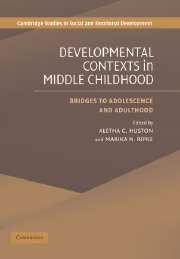
- Developmental Contexts in Middle ChildhoodBridges to Adolescence and Adulthood, pp. 303 - 326Publisher: Cambridge University PressPrint publication year: 2006
References
, , , , & (1998). Relationship of physical activity and television watching with body weight and level of fatness among children. JAMA, 279(12), 938–942.CrossRefGoogle ScholarPubMed
, , , , , . (2003). The influence of media violence on youth. Psychological Science in the Public Interest, 4(3), 81–110.CrossRefGoogle ScholarPubMed
Anderson, C. A., & Huesmann, L. R. (2003). Human aggression: A social-cognitive view (pp. 296–323). In & (Eds.), Handbook of social psychology. Thousand Oaks, CA: Sage Publications.Google Scholar
, & (1978). The effect of TV viewing on the educational performance of elementary school children. Alberta Journal of Educational Research, 24(3), 156–163.Google Scholar
(1986). Television viewing at home: Age trends in visual attention and time with TV. Child Development, 57(4), 1024–1033.CrossRefGoogle ScholarPubMed
Anderson, D. R., & Burns, J. (1991). Paying attention to television. In & (Eds.), Responding to the screen: Reception and reaction processes (pp. 3–25). Hillsdale, NJ: Lawrence Erlbaum Associates.Google Scholar
, , , , & (1998). Children's television viewing, body fat, and physical fitness. American Journal of Health Promotion, 12(6), 363–368.CrossRefGoogle ScholarPubMed
(1986). Social foundations of thought and action: A social cognitive theory. Upper Saddle River, NJ: Prentice-Hall, Inc.Google Scholar
Bandura, A. (1994). Social cognitive theory of mass media. In & (Eds.), Media effects: Advances in theory and research (pp. 61–90). Hillsdale, NJ: Lawrence Erlbaum Associates.Google Scholar
, , & (1963). Imitation of film-mediated aggressive models. Journal of Abnormal and Social Psychology, 66, 3–11.CrossRefGoogle Scholar
, , , , , . (1988). Psychological and social adjustment of obese children and their families. Child: Care, Health, and Development, 14, 157–173.Google ScholarPubMed
, & (1967). Weapons as aggression-eliciting stimuli. Journal of Personality and Social Psychology, 7(2), 202–207.CrossRefGoogle Scholar
(1985). Violent films, anxiety, and aggression. Helsinki: Finnish Society of Sciences and Letters.Google Scholar
(1979). Effect of intensification of annoyance through unrelated residual excitation on substantially delayed hostile behavior. Journal of Experimental Social Psychology, 15(5), 470–480.CrossRefGoogle Scholar
Bushman, B. J., & Huesmann, L. R. (2001). Effects of televised violence on aggression. In & (Eds.), Handbook of children and the media (pp. 223–254). Thousand Oaks, CA: Sage Publications.Google Scholar
, , , & (2002). Variations in the gender-stereotyped content of children's television cartoons across genres. Journal of Applied Social Psychology, 32(8), 1653–1662.Google Scholar
Cantor, J. (1994). Confronting children's fright responses to mass media. In & (Eds.), Media, children, and the family: Social scientific, psychodynamic, and clinical perspectives (pp. 139–150). Hillsdale, NJ: Lawrence Erlbaum Associates.Google Scholar
Cantor, J. (2002). Fright reactions to mass media. In & (Eds.), Media effects: Advances in theory and research (2nd ed., pp. 287–306). Mahwah, NJ: Lawrence Erlbaum Associates.Google Scholar
Chaiken, S., Lieberman, A., & Eagly, A. H. (1989). Heuristic and systematic processing within and beyond the persuasion context. In & (Eds.), Unintended thought (pp. 212–252). New York: Guilford Press.Google Scholar
, , & (1995). Television and children: Program evaluation, comprehension, and impact. Hillsdale, NJ: Lawrence Erlbaum Associates.Google Scholar
, , & (1973). Desensitization of children to television violence. Journal of Personality & Social Psychology, 27(3), 360–365.CrossRefGoogle ScholarPubMed
, & (2000). The perpetuation of subtle prejudice: Race and gender imagery in 1990s television advertising. Sex Roles, 42(5/6), 363–389.CrossRefGoogle Scholar
Dates, J. L., & Stroman, C. A. (2001). Portrayals of families of color on television. In (Ed.), Television and the American family, (pp. 207–228). Mahwah, NJ: Lawrence Erlbaum Associates.Google Scholar
, , & (1979). The effects of television cartoons on sex-role stereotyping in young girls. Child Development, 50, 597–600.Google Scholar
, & (1985). Do we fatten our children at the television set? Obesity and television viewing in children and adolescents. Pediatrics, 75, 807–812.Google ScholarPubMed
, & (2000). Overrepresentation and underrepresentation of African Americans and Latinos as lawbreakers on television news. Journal of Communication, 50(2), 131–154.CrossRefGoogle Scholar
, , , & (1994). The relationship among television watching, physical activity, and body composition of young children. Pediatrics, 94, 449–455.Google ScholarPubMed
(1985). Television and sex-role acquisition 1: Content. British Journal of Social Psychology, 24, 101–113.CrossRefGoogle ScholarPubMed
, , , & (1990). Five-year follow-up of family-based treatments for childhood obesity. Journal of Consulting and Clinical Psychology, 58, 661–664.CrossRefGoogle ScholarPubMed
, , , & (1972). Does television violence cause aggression?American Psychologist, 27(4), 253–263.CrossRefGoogle ScholarPubMed
, & (1989). The young child's gender schema: Environmental input, internal organization. Child Development, 60, 663–672.CrossRefGoogle Scholar
, & (1999). Television situation comedies: Female body images and verbal reinforcements. Sex roles, 40(5), 473–481.CrossRefGoogle Scholar
, & (1975). Traditional sex role development and amount of time spent watching television. Developmental Psychology, 11, 109.CrossRefGoogle Scholar
, & (2000). Household, parent, and child contributions to childhood obesity. Family Relations, 49(3), 293–300.CrossRefGoogle Scholar
, & (1969). Activation of cue-elicited aggression by general arousal. Journal of Personality & Social Psychology, 11(3), 289–292.CrossRefGoogle ScholarPubMed
, & (1986). The immediate effects of media violence on behavior. Journal of Social Issues, 42(3), 7–27.CrossRefGoogle Scholar
, , , , , & (1996). Television viewing as a cause of increasing obesity among children in the United States, 1986–1990. Archives of Pediatrics & Adolescent Medicine. 150(4), 356–362.CrossRefGoogle ScholarPubMed
, , , & (1990). The impact of television viewing on mental aptitude and achievement: A longitudinal study. Public Opinion Quarterly, 54(4), 594–604.CrossRefGoogle Scholar
, , & (1990). Television and children's problem-solving behavior: A synopsis of an evaluation of the effects of Square One TV. Journal of Mathematical Behavior, 9(2), 161–174.Google Scholar
(1994). A cognitive psychology of mass communication. Hillsdale, NJ: Lawrence Erlbaum Associates.Google Scholar
(2000). Television viewing, fat stereotyping, body shape standards, and eating disorder symptomatology in grade school children. Communication Research, 27(5), 617–640.CrossRefGoogle Scholar
, & (1999). Tales from the screen: Enduring fright reactions to scary media. Media Psychology, 1(2), 97–116.CrossRefGoogle Scholar
Harrison, K., Taylor, L. D., & Marske, A. L. (2004, May). Never say diet (in front of the guys): Women's and men's eating behavior following exposure to ideal-body images and text. Paper presented at the annual meeting of the International Communication Association, New Orleans, LA.
Hearold, S. (1986). A synthesis of 1043 effects of television on social behaviour. In (Ed.), Public communications and behaviour: Vol. I. New York: Academic Press.Google Scholar
Herrett-Skjellum, J., & Allen, M. (1996). Television programming and sex stereotyping: A meta-analysis. In (Ed), Communication yearbook 19 (pp. 157–185). Thousand Oaks, CA: Sage Publications.Google Scholar
(1988). An information processing model for the development of aggression. Aggressive Behavior, 14(1), 13–24.3.0.CO;2-J>CrossRefGoogle Scholar
Huesmann, L. R. (1998). The role of social information processing and cognitive schema in the acquisition and maintenance of habitual aggressive behavior. In & (Eds.), Human aggression: Theories, research, and implications for social policy (73–109). San Diego, CA: Academic Press.Google Scholar
Huesmann, L. R. (2005). Imitation and the effects of observing media violence on behavior. In & (Eds.), Perspectives on imitation: From mirror neurons to memes. Cambridge, MA: MIT Press.Google Scholar
, & (Eds.). (1986). Television and the aggressive child: A cross national perspective. Hillsdale, NJ: Lawrence Erlbaum Associates.Google Scholar
, & (1997). Children's normative beliefs about aggression and aggressive behavior. Journal of Personality and Social Psychology, 72(2), 408–419.CrossRefGoogle ScholarPubMed
, , & (1984). Intervening variables in the TV violence-aggression relation: Evidence from two countries. Developmental Psychology, 20(5), 746–775.CrossRefGoogle Scholar
Huesmann, L. R., & Miller, L. S. (1994). Long-term effects of repeated exposure to media violence in childhood. In (Ed.), Aggressive behavior: Current perspectives (pp. 153–186). New York: Plenum Press.CrossRefGoogle Scholar
Huesmann, L. R., Moise-Titus, J., & Podolski, C. (1997). The effects of media violence on the development of antisocial behavior. In , , & (Eds.), Handbook of antisocial behavior (pp. 181–193). New York: John Wiley.Google Scholar
, , , & (2003). Longitudinal relations between children's exposure to TV violence and their aggressive and violent behavior in young adulthood: 1977–1992. Developmental Psychology, 39(2), 201–221.CrossRefGoogle Scholar
Huston, A. C. (1983). Sex-typing. In (Ed.), Handbook of child psychology: Vol 4. Socialization, personality, and social development (4th ed.) (pp. 387–467). New York: Wiley.Google Scholar
Huston, A. C., & Wright, J. C. (1997). Mass media and children's development. In (Series Ed.), , & (Vol. Eds.), Handbook of child psychology: Vol 4. Child psychology in practice (5th ed., pp. 999–1058). New York: Wiley.Google Scholar
Huston, A. C., & Wright, J. C. (1989). The forms of television and the child viewer. In (Ed.), Public communication and behavior: Vol. 2 (pp. 103–158). New York: Academic Press.Google Scholar
, , , , & (2002). Television viewing and aggressive behavior during adolescence and adulthood. Science, 295, 2468–2471.CrossRefGoogle ScholarPubMed
, & (1982). Positive images: Breaking stereotypes with children's television. Beverly Hills, CA: Sage.Google Scholar
(1987). Television violence and children's aggression: Testing the priming, social script, and disinhibition predictions. Journal of Personality & Social Psychology, 53(5), 882–890.CrossRefGoogle ScholarPubMed
, & (1994). Food advertisements during children's Saturday morning television programming: Are they consistent with dietary recommendations?Journal of the American Dietetic Association, 94(11), 1296–1300.CrossRefGoogle ScholarPubMed
, & (1973). Identification with the winner of a fight and name mediation: Their differential effects upon subsequent aggressive behaviour. British Journal of Social & Clinical Psychology, 12(4), 374–377.CrossRefGoogle ScholarPubMed
, , & (1979). Biased assimilation and attitude polarization: The effects of prior theories on subsequently considered evidence. Journal of Personality & Social Psychology, 37(11), 2098–2109.CrossRefGoogle Scholar
, & (1997). Stuck in the model trap: The effects of beautiful models in ads on female pre-adolescents and adolescents. The Journal of Advertising, 26(2), 19–33.CrossRefGoogle Scholar
McDermott, S., & Greenberg, B. S. (1984). Black children's esteem: Parents, peers, and television. In (Ed.), Communication yearbook 8 (pp. 164–177). Beverly Hills, CA: Sage.Google Scholar
, & (1980). Television viewing and the learning of sex-role stereotypes. Sex Roles, 6(2), 179–188.CrossRefGoogle Scholar
(1980). The development of girls' sex-role attitudes. Child Development, 51, 508–514.CrossRefGoogle ScholarPubMed
Moise-Titus, J. (1999). The role of negative emotions in the media violence-aggression relation. Unpublished dissertation, University of Michigan, Ann Arbor.
(1999). Identifying and explaining the relationship between parental mediation and children's aggression. Communication Research, 26(2), 124–143.CrossRefGoogle Scholar
(1988). The displacement effect: Assessing the relation between television viewing and reading performance. Reading Research Quarterly, 23(4), 414–440.CrossRefGoogle Scholar
(1995). Literacy in the television age: The myth of the TV effect (2nd ed.). Norwood, NJ: Ablex.Google Scholar
, & (1994). The effects of television violence on antisocial behavior: A meta-analysis. Communication Research, 21(4), 516–546.CrossRefGoogle Scholar
, & (Eds.). (2003). The faces of televisual media: Teaching, violence, selling to children (2nd ed.). Mahwah, NJ: Lawrence Erlbaum Associates.Google Scholar
(1977). Some antecedents of children's sex-role stereotypes. Psychological Reports, 40, 947–955.CrossRefGoogle Scholar
(1978). The effects of nonsexist television commercials and perceptions of reality on children's attitudes about women. Psychology of Women Quarterly, 2(3), 262–277.CrossRefGoogle Scholar
(2001). The complex model of television viewing and educational achievement. The Journal of Educational Research, 94(6), 371–379.CrossRefGoogle Scholar
, , & (1983). The relation of children's television viewing to school achievement and I. Q. Journal of Educational Research, 76(5), 294–297.CrossRefGoogle Scholar
(1999). Reducing children's television viewing to prevent obesity: A randomized controlled trial. JAMA, 282(16), 1561–1567.CrossRefGoogle ScholarPubMed
, , , , , , & (1993). Does television viewing increase obesity and reduce physical activity? Cross-sectional and longitudinal analyses among adolescent girls. Pediatrics, 91, 273–280.Google ScholarPubMed
(1986). Media violence, antisocial behavior, and the social consequences of small effects. Journal of Social Issues, 42(3), 141–154.CrossRefGoogle Scholar
, , , & (1981). Nutritional misinformation of children: A developmental and experimental analysis of the effects of televised food commercials. Journal of Applied Developmental Psychology, 1(4), 329–347.CrossRefGoogle Scholar
, , & (1981). Gender constancy and the effects of sex-typed televised toy commercials. Child Development, 52, 667–673.CrossRefGoogle ScholarPubMed
Ruble, D. N., & Frey, K. S. (1991). Changing patterns of comparative behavior as skills are acquired: A functional model of self-evaluation. In & (Eds.), Social comparison: Contemporary theory and research (pp. 79–116). Hillsdale, NJ: Lawrence Erlbaum Associates.Google Scholar
, , & (1961). Television in the lives of our children. Stanford, CA: Stanford University Press.Google Scholar
, , & (2000). Film-induced sadness as a trigger for disinhibited eating. International Journal of Eating Disorders, 28(2), 215–220.3.0.CO;2-J>CrossRefGoogle ScholarPubMed
(1989). Television and conceptions about sex roles: Maintaining conventionality and the status quo. Sex Roles, 21(5/6), 341–360.CrossRefGoogle Scholar
(1990). Children, television, and gender roles: Messages and impact. Journal of Adolescent Health Care, 11(1), 50–58.CrossRefGoogle ScholarPubMed
, & (1992a). Children, television, and conceptions about chores: Attitudes and behaviors. Sex Roles, 27(3/4), 157–170.CrossRefGoogle Scholar
, & (1992b). Television and children's conceptions of nutrition: Unhealthy messages. Health Communication, 4, 245–257.CrossRefGoogle Scholar
, & (1997). Television and children's conceptions of nutrition. Health Communication, 9(4), 289–301.CrossRefGoogle Scholar
, , , & (1986). The role of mass media in promoting a thin standard of bodily attractiveness for women. Sex Roles, 14, 519–532.CrossRefGoogle Scholar
, & (Eds.). (2001). Handbook of children and the media. Thousand Oaks, CA: Sage Publications.Google Scholar
, , , & (2003). Violent media content and aggressiveness in adolescents: A downward spiral model. Communication Research, 30(6), 713–736.CrossRefGoogle Scholar
, & (1988). Risk in childhood of development of severe adult obesity: Retrospective, population-based case-cohort study. American Journal of Epidemiology, 127(1), 104–113.CrossRefGoogle ScholarPubMed
, & (1985). Children's concepts of cross-gender activities. Child Development, 56, 1241–1252.CrossRefGoogle Scholar
(1986). Television viewing and self-concept among Black children. Journal of Broadcasting and Electronic Media, 30(1), 87–93.CrossRefGoogle Scholar
, & (1995). Advertised foods on children's television. Archives of Pediatric and Adolescent Medicine, 149, 649–652.CrossRefGoogle ScholarPubMed
, & (2003). Food messages on African American television shows. American Journal of Public Health, 93(3), 439–441.CrossRefGoogle ScholarPubMed
, , & (2002). Group cues and ideological constraint: A replication of political advertising effects studies in the lab and in the field. Political Communication, 19(1), 29–48.CrossRefGoogle Scholar
Williams, D. (2004). Trouble in River City: The social life of video games. Dissertation Abstracts. AAT3122072, PROQUEST.UMI.COM.
, & (1999). Recent advances in basic obesity research. JAMA, 282(16), 1504–1506.CrossRefGoogle ScholarPubMed
, , & (1989). Feeling and facial efference: Implications of the vascular theory of emotion. Psychological Review, 96, 395–416.CrossRefGoogle ScholarPubMed
, , & (1980). Children's television viewing, racial and sex-role attitudes. Journal of Applied Social Psychology, 10(4), 281–294.CrossRefGoogle Scholar
Accessibility standard: Unknown
Why this information is here
This section outlines the accessibility features of this content - including support for screen readers, full keyboard navigation and high-contrast display options. This may not be relevant for you.Accessibility Information
Accessibility compliance for the PDF of this chapter is currently unknown and may be updated in the future.