Book contents
- Frontmatter
- Contents
- Preface
- List of abbreviations
- Part oneCorporate ideal and partisan reality
- Part twoThe King and his corporations, 1660–1688
- Part threePartisan conflict and the law in a dynamic society
- Appendix ARoyal charters of incorporation, 1660–1727
- Appendix BEnforcement of the Corporation Act, 1662–1663
- Select bibliography
- Index
- Titles in the series
Preface
Published online by Cambridge University Press: 10 November 2009

Book contents
- Frontmatter
- Contents
- Preface
- List of abbreviations
- Part oneCorporate ideal and partisan reality
- Part twoThe King and his corporations, 1660–1688
- Part threePartisan conflict and the law in a dynamic society
- Appendix ARoyal charters of incorporation, 1660–1727
- Appendix BEnforcement of the Corporation Act, 1662–1663
- Select bibliography
- Index
- Titles in the series
Summary
… and every city or house divided against itself shall not stand.
Matthew, chapter 12, verse 25From the 1640s on, England's cities divided against themselves, yet they stood. That is the point of this book.
This book answers two questions about the transformation of political culture. Where and how did partisan politics evolve? And what was its impact? The answers are as simple as these questions. Partisan politics evolved in England's borough corporations in the wake of the Civil Wars. And the impact of partisan conflict was not to create instability but to create the means for achieving stability. Throughout, a third question constantly arises. What was the relationship between center and locality, that is, between the crown and the borough corporations? The answer: each needed the other because each was made of the other. The most significant change in this relationship was the rapid development of one royal institution, the court of King's Bench, in response to the demands of hundreds of other royal institutions, the corporations governing 200 towns.
The genesis of political parties has long fascinated historians, but the historiography has been vexed by the problem of definition. No one has given a compelling reason to choose one definition of party over another, nor do I imagine that anyone could. What counts as a party keeps shifting so the desired object slips from our grasp. This might be because there was no such object at all, certainly not in the seventeenth century. Before there could be a thing we could call a “party,” there had to be a kind of behavior that did not in its earliest manifestations create such things.
Information
- Type
- Chapter
- Information
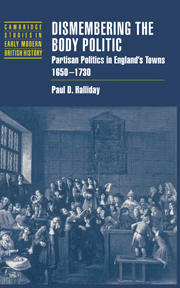
- Dismembering the Body PoliticPartisan Politics in England's Towns, 1650–1730, pp. xi - xviPublisher: Cambridge University PressPrint publication year: 1998
Accessibility standard: Unknown
Why this information is here
This section outlines the accessibility features of this content - including support for screen readers, full keyboard navigation and high-contrast display options. This may not be relevant for you.Accessibility Information
Accessibility compliance for the PDF of this chapter is currently unknown and may be updated in the future.