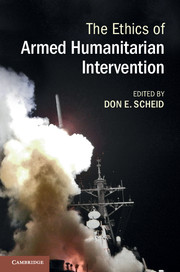
Book contents
- Frontmatter
- Contents
- Notes on contributors
- Preface and acknowledgments
- List of abbreviations and acronyms
- Part IIntervention and debate
- 1Introduction to armed humanitarian intervention
- 2Revisiting armed humanitarian intervention
- 3The responsibility to protect and the war in Libya
- Part IIMoral perspectives
- Part IIIIdeas and reconsiderations
- Select bibliography
- Index
- References
2 - Revisiting armed humanitarian intervention
A 25-year retrospective
Published online by Cambridge University Press: 05 June 2014

Book contents
- Frontmatter
- Contents
- Notes on contributors
- Preface and acknowledgments
- List of abbreviations and acronyms
- Part IIntervention and debate
- 1Introduction to armed humanitarian intervention
- 2Revisiting armed humanitarian intervention
- 3The responsibility to protect and the war in Libya
- Part IIMoral perspectives
- Part IIIIdeas and reconsiderations
- Select bibliography
- Index
- References
Summary
The use of military forces either for the purpose of halting or impeding a humanitarian disaster, or for providing relief and restoring order in the aftermath of one, is hardly a new phenomenon. What is genuinely new about the recent record of humanitarian military interventions during the past 25 years, however, is that such efforts have become the principal justification (beyond national self-defense) for maintaining and deploying national military forces. The militaries of Canada, Australia, and the United Kingdom, as well as of France, and the combined forces of the NATO alliance (under the lead of Danish, Dutch, and Belgian forces), all have such peacekeeping and stabilization operations among their core missions (alongside defense of the homeland). The United States, meanwhile, since 1991, has increasingly defined its role in international relations in terms of such missions, while sequestering an astonishingly large, and ever-increasing logistical stockpile to support them. Although armed humanitarian intervention (AHI) in fact has a relatively long and somewhat blinkered history, merely reciting that history is of little but mild antiquarian interest, however, unless something substantive can be learned from it concerning what this recent and dramatic inversion or re-ordering of conventional military priorities portends for the future of international conflict and military professionalism.
In this chapter, accordingly, I propose to examine the dramatic transformation of international priorities governing the purpose and principal uses of military force over the past 25 years. I will first distinguish the broader historical background of armed humanitarian intervention prior to 1989 (what we might term “first-wave” AHI) from two subsequent, distinctive phases: a “second wave” of humanitarian crises and responses during the 1990s, and a more recent “third wave” of ethical analysis, dominated by proposals for new political arrangements that would govern collective decision-making by the international community when faced with the question of whether to deploy their military forces for the prevention or cessation of humanitarian crises.
Keywords
Information
- Type
- Chapter
- Information
- The Ethics of Armed Humanitarian Intervention , pp. 26 - 45Publisher: Cambridge University PressPrint publication year: 2014
References
, At Home in the World: Canada’s Global Vision for the 21st Century (New York: HarperCollins, 2004)Google Scholar
, “Humanitarian Logistics: A New Field of Research and Action,” Foundations and Trends in Technology, Information and OM 3, no. 1 (2009), 1–100CrossRefGoogle Scholar
and , “Stochastic Optimization for Natural Disaster Asset Prepositioning,” Production and Operations Management 19, no. 5 (2010), 561–575CrossRefGoogle Scholar
, “Humanitarian Intervention: The Early Years,” Symposium on the Norms and Ethics of Humanitarian Intervention, Center for Global Peace and Conflict Studies (Irvine, California: University of California-Irvine, May 2000)Google Scholar
, “Constructing Norms of Humanitarian Intervention,” in (ed.), The Culture of National Security: Norms and Identity in World Politics (New York: Columbia University Press, 1996), 161–172.Google Scholar
, The Ethics and Politics of Humanitarian Intervention (South Bend: Notre Dame University Press, 1996)Google Scholar
, Humanitarian Intervention: An Inquiry into Law and Morality (New York: Transnational Publishers, 1997)Google Scholar
, “Is Armed Humanitarian Intervention to Stop Mass Killing Morally Obligatory?” Public Affairs Quarterly (July 2001), 173–192Google Scholar
, “Intervention and Civilization: Some Unhappy Lessons of the Kosovo War,” in and (eds.), Global Justice and Transnational Politics: Essays on the Moral and Political Challenges of Globalization (Cambridge, Massachusetts: MIT Press 2002), 79–115Google Scholar
, The Ethics of Armed Humanitarian Intervention, no. 45 (Washington, DC: United States Institute of Peace, 2002)Google Scholar
, “‘Let Whatever Is Smoldering Erupt’? Conditional Sovereignty, Reviewable Intervention, and Rwanda 1994,” in , , and (eds.), Between Sovereignty and Global Governance: The State, Civil Society and the United Nations (New York: St. Martin’s, 1998), 60–84CrossRefGoogle Scholar
“Eroding Sovereignty: The Advance of Principle,” in and (eds.), The Morality of Nationalism (New York: Oxford University Press, 1997), 340–359Google Scholar
and , “The Preventive Use of Force: A Cosmopolitan Institutional Proposal,” Ethics & International Affairs 18, no. 1 (2004), 1–22CrossRefGoogle Scholar
, USMC (ret.), “The Case of Somalia,” in , Jr., Perspectives on Humanitarian Intervention (Berkeley Public Policy Institute, 2001), 53–63Google Scholar
, Shake Hands with the Devil: the Failure of Humanity in Rwanda (New York: Carroll & Graf Publishers, 2003)Google Scholar
and (eds.), Case Studies in Military Ethics, 3rd edn. (Upper Saddle River, New Jersey: Pearson, 2010)Google Scholar
, US Army (ret.), Waging Modern War: Bosnia, Kosovo, and the Future of Combat (New York: Public Affairs Press, 2001)Google Scholar
and , Learning from Somalia: The Lessons of Armed Humanitarian Intervention (Lexington, Massachusetts: Westview Press, 1997)Google Scholar
and , Operationalizing the Responsibility to Prevent (Oxford Institute for Ethics, Law and Armed Conflict, April 2012)Google Scholar
and (co-chairs), The Responsibility to Protect, Report of the International Commission on Intervention and State Sovereignty (Ottawa: International Development Research Centre, December 2001)Google Scholar
and , “The Responsibility to Protect,” Foreign Affairs 81, no. 6 (November/December 2002), 99–110Google Scholar
(ed.), Humanitarian Intervention and International Relations (Oxford University Press, 2003)CrossRefGoogle Scholar
, “The Responsibility to Protect and the Logic of Rights,” in and (eds.), From Rights to Responsibilities: Rethinking Interventions for Humanitarian Purposes, PSIS Special Study 7 (Geneva: Programme for Strategic and International Security Studies, 2006)Google Scholar
, Humanitarian Intervention and the Responsibility to Protect (Oxford University Press, 2010)CrossRefGoogle Scholar
, Jr., “Moral Order and the Constraints of Agency: Toward a New Metaphysics of Morals,” in (ed.) New Essays in Metaphysics (Albany, New York: State University of New York Press, 1987), 117–39Google Scholar
, Jr., “Agency After Virtue: A Defense of Kantian Constructivism,” International Philosophical Quarterly 28, no. 3 (September, 1988), 293–311CrossRefGoogle Scholar
, “Immaculate War: Constraints on Humanitarian Intervention,” Ethics & International Affairs 14 (2000), 55–65CrossRefGoogle Scholar
, , and , Army Professionalism, Military Ethics, and Officership in the 21st Century (Carlisle, Pennsylvania: Army War College Strategic Studies Institute, 1999)CrossRefGoogle Scholar
Accessibility standard: Unknown
Why this information is here
This section outlines the accessibility features of this content - including support for screen readers, full keyboard navigation and high-contrast display options. This may not be relevant for you.Accessibility Information
Accessibility compliance for the PDF of this chapter is currently unknown and may be updated in the future.