Book contents
- Frontmatter
- Contents
- List of Illustrations
- Contributors
- Preface
- Explaining Institutional Change
- 1A Theory of Gradual Institutional Change
- 2Infiltrating the State: The Evolution of Health Care Reforms in Brazil, 1964–1988
- 3The Contradictory Potential of Institutions: The Rise and Decline of Land Documentation in Kenya
- 4Policymaking as Political Constraint: Institutional Development in the U.S. Social Security Program
- 5Altering Authoritarianism: Institutional Complexity and Autocratic Agency in Indonesia
- 6Rethinking Rules: Creativity and Constraint in the U.S. House of Representatives
- 7Historical Institutionalism in Rationalist and Sociological Perspective
- Index
- References
7 - Historical Institutionalism in Rationalist and Sociological Perspective
Published online by Cambridge University Press: 05 June 2012

Book contents
- Frontmatter
- Contents
- List of Illustrations
- Contributors
- Preface
- Explaining Institutional Change
- 1A Theory of Gradual Institutional Change
- 2Infiltrating the State: The Evolution of Health Care Reforms in Brazil, 1964–1988
- 3The Contradictory Potential of Institutions: The Rise and Decline of Land Documentation in Kenya
- 4Policymaking as Political Constraint: Institutional Development in the U.S. Social Security Program
- 5Altering Authoritarianism: Institutional Complexity and Autocratic Agency in Indonesia
- 6Rethinking Rules: Creativity and Constraint in the U.S. House of Representatives
- 7Historical Institutionalism in Rationalist and Sociological Perspective
- Index
- References
Summary
Some of the most fruitful insights generated by social science in recent decades flow from explorations of how institutions, understood as sets of regularized practices with a rule-like quality, structure the behavior of political and economic actors. It is not surprising that attention has now turned to the second-order problem of explaining when and how institutions change. In conceptual terms, however, this task is intrinsically difficult. By their nature, analyses designed to explain why institutions have a persistent impact on behavior tend to overstate the solidity of institutions. Acknowledging their plasticity raises questions about when institutions should be seen as determinants of behavior and when as objects of strategic action themselves.
This problem afflicts rational-choice approaches to institutions with particular intensity because of the elegant solutions such analyses have devised to explain the force and persistence of institutions. Typically, they see institutions as patterns of regularized behavior that reflect Pareto-optimal equilibria or subgame perfect solutions to collective actions dilemmas, stable because the actors cannot improve their positions by defecting from the pattern of behavior (Shepsle 1989; Koremenos et al. 2003; Greif and Laitin 2004). Therefore, institutional change happens only when ceteris is no longer paribus, that is, when shocks exogenous to the system of institutions alter the context. Institutional change becomes a response to shocks. Such analyses posit a radical separation between periods of institutional stability and periods of change (often labeled “critical junctures”) that rarely explain well how institutions emerge from disequilibrium at such junctures (see Thelen 2004; the introduction to this volume).
Information
- Type
- Chapter
- Information
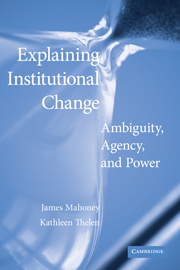
- Explaining Institutional ChangeAmbiguity, Agency, and Power, pp. 204 - 224Publisher: Cambridge University PressPrint publication year: 2009
References
. 1988. “Contra Contractarianism: Some Reflections on the New Institutionalism.” Politics and Society 16 (2): 387–401.CrossRefGoogle Scholar
. 1995a. “Rational Actors, Equilibrium and Institutions.” In Explaining Social Institutions, ed. and , 57–94. Ann Arbor: University of Michigan Press.Google Scholar
. 1995b. “The Rational Choice Theory of Social Institutions: Cooperation, Coordination, and Communication.” In Modern Political Economy: Old Topics, New Directions, ed. and , 216–268. Cambridge: Cambridge University Press.CrossRefGoogle Scholar
. 1994a. Forging Industrial Policy: The United States, Britain, and France in the Railway Age. New York: Cambridge University Press.CrossRefGoogle Scholar
. 1994b. “Cultural Models of Organization: The Social Construction of Rational Organizing Principles.” In The Sociology of Culture, ed. , 117–191. Oxford: Blackwell.Google Scholar
, and . 2003. Recognition or Redistribution? A Political-Philosophical Exchange. London: Verso Books.Google ScholarPubMed
, and , eds. 1993. Ideas and Foreign Policy. Ithaca, NY: Cornell University Press.
. 2006 “The Transformation of Corporate Governance in France.” In Changing France: The Politics that Markets Make, ed. , , and , 80–104. London: Palgrave-Macmillan.Google Scholar
, and . 2004. “A Theory of Endogenous Institutional Change,” American Political Science Review 98:633–652.CrossRefGoogle Scholar
. 2000. Ruling the World: Power Politics and the Rise of Supranational Institutions. Princeton: Princeton University Press.CrossRefGoogle Scholar
. 1992. “Introduction: Epistemic Communities and International Policy Coordination.” International Organization 46 (1) (Winter): 1–35.CrossRefGoogle Scholar
, ed. 1989. The Political Power of Economic Ideas: Keynesianism across Nations. Princeton: Princeton University Press.
2005. “Preference Formation as a Political Process: The Case of Monetary Union in Europe.” In Preferences and Situations, ed. and , 129–160. New York: Russell Sage Foundation.Google Scholar
, and , eds. 2001. Varieties of Capitalism: The Institutional Foundations of Comparative Advantage. Oxford: Oxford University Press.CrossRef
, and . 1996. “Political Science and the Three ‘New Institutionalisms,’” Political Studies 44 (December): 936–957.CrossRefGoogle Scholar
. 1992. Health Politics: Interests and Institutions in Western Europe. New York: Oxford University Press.Google Scholar
, and . 2006. “Electoral Institutions and the Politics of Coalitions: Why Some Democracies Redistribute More than Others,” American Political Science Review 100 (2): 165–181.CrossRefGoogle Scholar
. 2009. “How Do Ideas Matter? Mental Models and Attention in German Pension Politics.” Comparative Political Studies 42 (2): 252–279.CrossRefGoogle Scholar
. 1990. “On the Cultural Dimensions of Rational Choice Theory.” Paper presented at the Mid-West Political Science Association. Chicago, IL.
. 2005. The Liberty of Strangers: Building the American Nation. Oxford: Oxford University Press.Google Scholar
. 1992. Institutions and Social Conflict. New York: Cambridge University Press.CrossRefGoogle Scholar
. 1995. “Models, Interpretation and Theories: Constructing Explanations of Institutional Emergence and Change.” In Explaining Social Institutions, ed. and , 95–120. Ann Arbor: University of Michigan Press.Google Scholar
, and , eds. 2003. The Rational Design of International Institutions. New York: Cambridge University Press.CrossRef
. 1991. Information and Legislative Organization. Ann Arbor: University of Michigan Press.CrossRefGoogle Scholar
. 2007. “Diffusion of Social Policies across OECD Countries.” PhD diss., Harvard University.
. 1978. “Is a Science of Comparative Politics Possible?” In The Practice of Comparative Politics, ed. et al., 266–284. New York: Longman.Google Scholar
. 2000. “Path Dependence in Historical Sociology,” Theory and Society 29:507–548.CrossRefGoogle Scholar
, and . 1989. Rediscovering Institutions: The Organizational Basis of Politics. New York: Free Press.Google Scholar
, and . 1987. Social Movements in an Organizational Society: Collected Essays. New York: Transaction Publishers.Google Scholar
. 2005. “Power and Political Institutions,” Perspectives on Politics 3 (2) (June): 215–234.CrossRefGoogle Scholar
, and . 1986. “Two Logics of Collective Action: Theoretical Notes on Social Class and Political Form.” In Disorganized Capitalism, ed. , 170–220. Cambridge, MA: MIT Press.Google Scholar
. 2005. “Ambiguous Agreement, Cumulative Change: French Social Policy in the 1990s.” In Beyond Continuity: Institutional Change in Advanced Political Economies, ed. and , 127–144. Oxford: Oxford University Press.Google Scholar
. 2000. “Increasing Returns, Path Dependence and the Study of Politics.” American Political Science Review 94 (2): 251–267.CrossRefGoogle Scholar
. 1999. In the Shadow of Power: States and Strategies in International Politics. Princeton: Princeton University Press.Google Scholar
. 1980. “Implications from the Disequilibrium of Majority Rule for the Study of Institutions.” American Political Science Review 74 (2): 432–446.CrossRefGoogle Scholar
, and . 1997. World of Possibilities: Flexibility and Mass Production in Western Industrialization. New York: Cambridge University Press.CrossRefGoogle Scholar
. 1986. “Institutional Equilibrium and Equilibrium Institutions.” In Political Science: The Science of Politics, ed. , 51–81. New York: Agathon.Google Scholar
. 1989. “Studying Institutions: Some Lessons from the Rational Choice Approach.” Journal of Theoretical Politics, 1:131–149.CrossRefGoogle Scholar
. 1997. “The German Economic Model: Does It Exist? Can It Survive?” In The Political Economy of Modern Capitalism, ed. and , 33–54. London: Sage.Google Scholar
. 2005. “Rejoinder: On Terminology, Functionalism, (Historical) Institutionalism and Liberalism,” Socio-Economic Review 3:577–587.CrossRefGoogle Scholar
, and , eds. 2005. Beyond Continuity: Institutional Change in Advanced Political Economies. Oxford: Oxford University Press.
1996. “Firm Organization, Industrial Structure and Technological Innovation.” Journal of Economic Behavior and Organization 31 (2) (November): 193–224.CrossRefGoogle Scholar
. 1999. “Historical Institutionalism in Comparative Politics.” Annual Review of Political Science 2:369–404.CrossRefGoogle Scholar
. 2004. How Institutions Evolve: The Political Economy of Skills in Germany, Britain, the United States, and Japan. New York: Cambridge University Press.CrossRefGoogle Scholar
, and . 1999. “The Effects of Globalization on Labor Revisited: Lessons from Germany and Japan.” Politics and Society 27 (December): 477–505.CrossRefGoogle Scholar
and , 1988. “The Industrial Organization of Congress, or Why Legislatures, Like Firms, Are Not Organized as Markets.” Journal of Political Economy 96 (1) (February): 132–163.CrossRefGoogle Scholar
. 2000. Social Theory of International Politics. New York: Cambridge University Press.Google Scholar
Accessibility standard: Unknown
Why this information is here
This section outlines the accessibility features of this content - including support for screen readers, full keyboard navigation and high-contrast display options. This may not be relevant for you.Accessibility Information
Accessibility compliance for the PDF of this chapter is currently unknown and may be updated in the future.
- 69
- Cited by