Book contents
- Forensic Aspects of Neurodevelopmental Disorders
- Forensic Aspects of Neurodevelopmental Disorders
- Copyright page
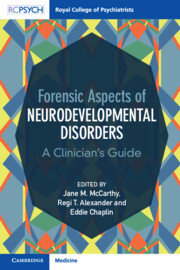
- About the Cover Page
- Contents
- Contributors
- Foreword by the Rt Hon Lord Bradley
- Terminology Used in the Book
- Section 1An Overview: Definitions, Epidemiology and Policy Issues
- Section 2Assessment and Therapeutic Approach
- Chapter 11Attention Deficit Hyperactivity Disorder: Assessment and Therapeutic Approaches within Forensic Settings
- Chapter 12Autism Spectrum Disorder: Assessment and Therapeutic Approaches within Forensic Settings
- Chapter 13Intellectual Disability: Assessment and Therapeutic Approaches within Forensic Settings
- Chapter 14Risk Assessments in People with Neurodevelopmental Disorders
- Chapter 15Assessment and Treatment of Young Offenders
- Section 3Criminal Justice Pathways and Legal Issues
- Index
- References
Chapter 11 - Attention Deficit Hyperactivity Disorder: Assessment and Therapeutic Approaches within Forensic Settings
from Section 2 - Assessment and Therapeutic Approach
Published online by Cambridge University Press: 18 May 2023

Book contents
- Forensic Aspects of Neurodevelopmental Disorders
- Forensic Aspects of Neurodevelopmental Disorders
- Copyright page
- About the Cover Page
- Contents
- Contributors
- Foreword by the Rt Hon Lord Bradley
- Terminology Used in the Book
- Section 1An Overview: Definitions, Epidemiology and Policy Issues
- Section 2Assessment and Therapeutic Approach
- Chapter 11Attention Deficit Hyperactivity Disorder: Assessment and Therapeutic Approaches within Forensic Settings
- Chapter 12Autism Spectrum Disorder: Assessment and Therapeutic Approaches within Forensic Settings
- Chapter 13Intellectual Disability: Assessment and Therapeutic Approaches within Forensic Settings
- Chapter 14Risk Assessments in People with Neurodevelopmental Disorders
- Chapter 15Assessment and Treatment of Young Offenders
- Section 3Criminal Justice Pathways and Legal Issues
- Index
- References
Summary
The significantly high prevalence of attention deficit hyperactivity disorder (ADHD) in prison populations raises the importance of assessment and treatment. Identification of prisoners for ADHD using screening tools is helpful. Those who are screened positive for ADHD can then undergo a full psychiatric assessment to confirm the diagnosis. The assessment also needs to focus on other potential comorbid mental disorders given the high prevalence of autism, intellectual disability, mental illness and personality disorders in prison/forensic population. Presence of comorbid mental disorders can also complicate the diagnostic process for ADHD. Treatment of ADHD is important given the strong evidence base for pharmacological treatment outcomes. Treatment needs to be personalised, taking into account many different factors. Stimulant or non-stimulant medications can be used, non-pharmacological interventions need to be offered alongside pharmacological treatments. Treatment of other comorbid mental disorders is equally important to achieve better outcomes. These may include pharmacological, psychological and social interventions within and when released from prison/forensic settings.
Information
- Type
- Chapter
- Information
- Forensic Aspects of Neurodevelopmental DisordersA Clinician's Guide, pp. 125 - 136Publisher: Cambridge University PressPrint publication year: 2023
References
Young, SJ, Adamou, M, Bolea, B, Gudjonsson, G, Müller, U, Pitts, M, et al. The identification and management of ADHD offenders within the criminal justice system: a consensus statement from the UK Adult ADHD Network and criminal justice agencies. BMC Psychiatry 2011; 11: 32.CrossRefGoogle ScholarPubMed
Ginsberg, Y, Hirvikoski, T, Lindefors, N. Attention deficit hyperactivity disorder (ADHD) among longer-term prison inmates is a prevalent, persistent and disabling disorder. BMC Psychiatry 2010; 10(1): 112.Google Scholar
Kessler, RC, Adler, L, Ames, M, Demler, O, Faraone, S, Hiripi, E, et al. The World Health Organization Adult ADHD Self-Report Scale (ASRS): a short screening scale for use in the general population. Psychological Medicine 2005; 35(2): 245–56.Google Scholar
American Psychiatric Association. Diagnostic and Statistical Manual of Mental Disorders, 5th edition: DSM-5. American Psychiatric Association, 2013.Google Scholar
Ustun, B, Adler, LA, Rudin, C, Faraone, SV, Spencer, TJ, Berglund, P, et al. The World Health Organization Adult Attention-Deficit/Hyperactivity Disorder Self-Report Screening Scale for DSM-5. JAMA Psychiatry 2017; 74(5): 520–7.Google Scholar
Young, S, González, RA, Mutch, L, Mallet-Lambert, I, O’Rourke, L, Hickey, N, et al. Diagnostic accuracy of a brief screening tool for attention deficit hyperactivity disorder in UK prison inmates. Psychological Medicine 2021; 46(7): 1449–58.Google Scholar
World Health Organization. International Classification of Diseases 11th revision. 2022. Available at: www.who.int/standards/classifications/classification-of-diseases.Google Scholar
Kessler, RC, Green, JG, Adler, LA, Barkley, RA, Chatterji, S, Faraone, SV, et al. Structure and diagnosis of adult attention-deficit/hyperactivity disorder: analysis of expanded symptom criteria from the Adult ADHD Clinical Diagnostic Scale. Archives of General Psychiatry 2010; 67(11): 1168–78.Google Scholar
Katzman, MA, Bilkey, TS, Chokka, PR, Fallu, A, Klassen, LJ. Adult ADHD and comorbid disorders: clinical implications of a dimensional approach. BMC Psychiatry 2017; 17(1): 302.Google Scholar
Das, D, Cherbuin, N, Butterworth, P, Anstey, KJ, Easteal, S. A population-based study of attention deficit/hyperactivity disorder symptoms and associated impairment in middle-aged adults. PLOS One 2012 ;7(2): e31500.Google Scholar
Storebø, OJ, Simonsen, E. The association between ADHD and antisocial personality disorder (ASPD): a review. Journal of Attention Disorders 2016; 20(10): 815–24.Google Scholar
Mordre, M, Groholt, B, Kjelsberg, E, Sandstad, B, Myhre, AM. The impact of ADHD and conduct disorder in childhood on adult delinquency: a 30 years follow-up study using official crime records. BMC Psychiatry 2011; 11: 57.Google Scholar
Young, S, Thome, J. ADHD and offenders. World Journal of Biological Psychiatry 2011; 12(sup1): 124–8.CrossRefGoogle ScholarPubMed
Shiroma, EJ, Ferguson, PL, Pickelsimer, EE. Prevalence of traumatic brain injury in an offender population: a meta-analysis. Journal of Correctional Health Care 2010; 16(2): 147–59.Google Scholar
Baranyi, G, Scholl, C, Fazel, S, Patel, V, Priebe, S, Mundt, AP. Severe mental illness and substance use disorders in prisoners in low-income and middle-income countries: a systematic review and meta-analysis of prevalence studies. Lancet Global Health 2019; 7(4): e461–71.Google Scholar
McGough, JJ, Smalley, SL, McCracken, JT, Yang, M, Del’Homme, M, Lynn, DE, et al. Psychiatric comorbidity in adult attention deficit hyperactivity disorder: findings from multiplex families. American Journal of Psychiatry 2005; 162(9): 1621–7. DOI: https://doi.org/10.1176/appi.ajp.162.9.1621.CrossRefGoogle ScholarPubMed
Sandstrom, A, Perroud, N, Alda, M, Uher, R, Pavlova, B. Prevalence of attention-deficit/hyperactivity disorder in people with mood disorders: A systematic review and meta-analysis. Acta Psychiatrica Scandinavica; 2021; 143(5): 380–91.Google Scholar
Lichtenstein, P, Halldner, L, Zetterqvist, J, Sjölander, A, Serlachius, E, Fazel, S, et al. Medication for attention deficit–hyperactivity disorder and criminality. New England Journal of Medicine 2012; 367(21): 2006–14.CrossRefGoogle ScholarPubMed
Hollis, C, Chen, Q, Chang, Z, Quinn, PD, Viktorin, A, Lichtenstein, P, et al. Methylphenidate and the risk of psychosis in adolescents and young adults: a population-based cohort study. Lancet Psychiatry; 2019 6(8): 651–8.CrossRefGoogle Scholar
Kooij, JJS, Bijlenga, D, Salerno, L, Jaeschke, R, Bitter, I, Balázs, J, et al. Updated European Consensus Statement on diagnosis and treatment of adult ADHD. European Psychiatry 2019; 56: 14–34.Google Scholar
Young, S, Khondoker, M, Emilsson, B, Sigurdsson, JF, Philipp-Wiegmann, F, Baldursson, G, et al. Cognitive–behavioural therapy in medication-treated adults with attention-deficit/hyperactivity disorder and co-morbid psychopathology: a randomized controlled trial using multi-level analysis. Psychological Medicine 2015; 45(13): 2793–804.Google Scholar
National Institute for Health and Care Excellence. British National Formulary 2021. Available at: hhtps://bnf.nice.org.uk.Google Scholar
National Institute for Health and Care Excellence. Attention deficit hyperactivity disorder: diagnosis and management. NICE guideline [NG87]. 2018. Available at: www.nice.org.uk/guidance/ng87.Google Scholar
Chaplin, E, Rawat, A, Perera, B, McCarthy, J, Courtenay, K, Forrester, A, et al. Prisoners with attention deficit hyperactivity disorder: co-morbidities and service pathways. International Journal of Prisoner Health 2021; 18(3): 245–58.Google Scholar
Accessibility standard: Unknown
Why this information is here
This section outlines the accessibility features of this content - including support for screen readers, full keyboard navigation and high-contrast display options. This may not be relevant for you.Accessibility Information
Accessibility compliance for the HTML of this chapter is currently unknown and may be updated in the future.