Book contents
- Forensic Aspects of Neurodevelopmental Disorders
- Forensic Aspects of Neurodevelopmental Disorders
- Copyright page
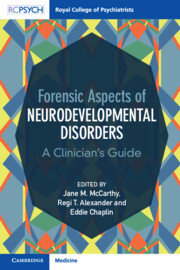
- About the Cover Page
- Contents
- Contributors
- Foreword by the Rt Hon Lord Bradley
- Terminology Used in the Book
- Section 1An Overview: Definitions, Epidemiology and Policy Issues
- Section 2Assessment and Therapeutic Approach
- Chapter 11Attention Deficit Hyperactivity Disorder: Assessment and Therapeutic Approaches within Forensic Settings
- Chapter 12Autism Spectrum Disorder: Assessment and Therapeutic Approaches within Forensic Settings
- Chapter 13Intellectual Disability: Assessment and Therapeutic Approaches within Forensic Settings
- Chapter 14Risk Assessments in People with Neurodevelopmental Disorders
- Chapter 15Assessment and Treatment of Young Offenders
- Section 3Criminal Justice Pathways and Legal Issues
- Index
- References
Chapter 12 - Autism Spectrum Disorder: Assessment and Therapeutic Approaches within Forensic Settings
from Section 2 - Assessment and Therapeutic Approach
Published online by Cambridge University Press: 18 May 2023

Book contents
- Forensic Aspects of Neurodevelopmental Disorders
- Forensic Aspects of Neurodevelopmental Disorders
- Copyright page
- About the Cover Page
- Contents
- Contributors
- Foreword by the Rt Hon Lord Bradley
- Terminology Used in the Book
- Section 1An Overview: Definitions, Epidemiology and Policy Issues
- Section 2Assessment and Therapeutic Approach
- Chapter 11Attention Deficit Hyperactivity Disorder: Assessment and Therapeutic Approaches within Forensic Settings
- Chapter 12Autism Spectrum Disorder: Assessment and Therapeutic Approaches within Forensic Settings
- Chapter 13Intellectual Disability: Assessment and Therapeutic Approaches within Forensic Settings
- Chapter 14Risk Assessments in People with Neurodevelopmental Disorders
- Chapter 15Assessment and Treatment of Young Offenders
- Section 3Criminal Justice Pathways and Legal Issues
- Index
- References
Summary
Whilst representing a relatively small proportion of the overall offender population, individuals with autism spectrum disorder (ASD) present with diverse needs and issues that can challenge mainstream forensic services. The specific topics discussed in this chapter focus on those related to the assessment of individuals withASD in forensic settings, notably obtaining a diagnosis of ASD, completing a forensic risk formulation and therapeutic needs profile, the assessment of psychopathy in ASD and presence of any co-occurring neurodevelopmental and/or psychiatric disorders. Therapeutic approaches within forensic settings in the form of psychological and pharmacological interventions are also reviewed, including the role of organisational and staff training in ASD. A case example is also provided. The potential additional needs that women with ASD who offend present with are discussed. A final summary is provided including potential research targets to inform the future direction of assessments and therapeutic approaches for people with ASD within forensic settings.
Keywords
Information
- Type
- Chapter
- Information
- Forensic Aspects of Neurodevelopmental DisordersA Clinician's Guide, pp. 137 - 147Publisher: Cambridge University PressPrint publication year: 2023
References
King, C, Murphy, G. A systematic review of people with autism spectrum disorder and the criminal justice system. Journal of Autism and Developmental Disorders 2014; 44(1): 2717–33.Google Scholar
Baird, G, Simonoff, E, Pickles, A, Chandler, S, Loucas, T, Meldrum, D, et al. Prevalence of disorders of the autism spectrum in a population cohort of children in South Thames: the Special Needs and Autism Project (SNAP). Lancet 2006; 368: 210–15.Google Scholar
Woodbury-Smith, M. Conceptualising social and communication vulnerabilities among detainees in the criminal justice system. Research in Developmental Disabilities 2020; 100: 103611.Google Scholar
Lord, C, Rutter, M, DiLavore, P, Risi, S, Gotham, K, Bishop, S. Autism Diagnostic Observation Schedule – second edition (ADOS 2). Available at: https://pdfs.semanticscholar.org/1fbb/3f886a582ec19c0db48721a6dc8241a8ce78.pdf.Google Scholar
Grochowska, A. P02-62: autism spectrum disorder and ethnicity in a forensic psychiatric assessment. European Psychiatry 2010; 25(S1): DOI: https://doi.org/10.1016/S0924-9338(10)70676-3.Google Scholar
Murphy, D. Risk assessment of offenders with an autism spectrum disorder. Journal of Intellectual Disabilities and Offending Behaviour 2013; 4(2): 33–41.Google Scholar
Shine, J, Cooper-Evans, S. Developing an autism specific framework for forensic case formulation. Journal of Intellectual Disabilities and Offending Behaviour 2016; 7(3): 127–39.Google Scholar
Im, D. Trauma as a contributor to violence in autism spectrum disorder. Journal of the Academy of Psychiatry 2016; 44(2): 184–92.Google Scholar
Fitzgerald, M. Callous/unemotional traits and Asperger’s syndrome? Journal of the American Academy of Child and Adolescent Psychiatry 2003; 42(9): 1011.Google Scholar
Murphy, D. Brief communication: Hare PCL-R profiles of male patients with Asperger’s syndrome detained in high security psychiatric care. Journal of Forensic Psychiatry and Psychology 2007; 18(1): 120–6.Google Scholar
Rogers, J, Viding, E, Blair, J, Frith, U, Happé, F. Autism spectrum disorder and psychopathy: shared cognitive underpinnings or double hit? Psychological Medicine 2006; 36: 1789–98.Google Scholar
Frick, P, Hare, RD. The Anti-Social Process Screening Device. Multi-Health Systems Inc., 2001.Google Scholar
Bjørkly, S. Risk and dynamics of violence in Asperger’s syndrome: a systematic review of the literature. Aggression and Violent Behaviour 2009; 14: 306–12.Google Scholar
Murphy, D. Interviewing individuals with an autism spectrum disorder in forensic settings. International Journal of Forensic Mental Health 2019; 17(4): 310–20.Google Scholar
Haw, C, Radley, J, Cooke, L. Characteristics of male autistic spectrum patients in low security: are they different from non-autistic low secure patients? Journal of Intellectual Disabilities and Offending Behaviour 2013; 4: 24–32.Google Scholar
Esan, F, Chester, V, Gunaratna, IJ, Hoare, S, Alexander, ST. The clinical, forensic and treatment outcome factors of patients with autistic spectrum disorder treated in a forensic intellectual disability service. Journal of Applied Research in Intellectual Disabilities 2015; 28: 193–200.Google Scholar
Gillberg, C, Billstedt, E. Autism and Asperger syndrome: coexistence with other clinical disorders. Acta Psychiatrica Scandinavica 2000; 102(5): 321–30.Google Scholar
Matson, J, Rieske, R, Williams, L. The relationship between autism spectrum disorders and attention deficit hyperactivity disorder: an overview. Research in developmental Disabilities 2013; 34(9): 2475–84.Google Scholar
Matson, J, Shoemaker, M. Intellectual disability and its relationship to autism spectrum disorders. Research in Developmental Disabilities 2009; 30(6): 1107–14.Google Scholar
Joshi, G, Wozniak, J, Petty, C, Martelon, M, Fried, R, Bolfek, A, et al. Psychiatric comorbidity and functioning in a clinically referred population of adults with autism spectrum disorders: a comparative study. Journal of Autism and Developmental Disorders 2013; 43(6): 1314–25.Google Scholar
Russell, A, Murphy, C, Wilson, E, Gillan, N, Brown, C, Robertson, D, et al. The mental health of individuals referred for assessment of autism spectrum disorder in adulthood: a clinic report. Autism 2016; 20(5): 623–7.Google Scholar
Spain, D, O’Neil, L, Harwood, L, Chaplin, E. Psychological interventions for adults with ASD: clinical approaches. Advances in Autism 2016; 2(1): 24–30.Google Scholar
Higgs, T, Carter, A. Autism spectrum disorder and sexual offending: responsivity in forensic interventions. Aggression and Violent Behaviour 2015; 22: 112–19.Google Scholar
Robertson, C, McGillivray, J. Autism behind bars: a review of the research literature and discussion of key issues. Journal of Forensic Psychiatry and Psychology 2015; 2(6), 719–36.Google Scholar
Sex Offender Treatment Services Collaborative – Intellectual Disabilities (SOTSEC-ID). Effectiveness of group cognitive behavioural treatment for men with intellectual disabilities at risk of sexual offending. Journal of Applied Research in Intellectual Disabilities 2010; 23: 537–51.Google Scholar
Haaven, J. Suggested treatment outline using the old me/new me model. In Blasingame, G, ed., Practical Treatment Strategies for Forensic Clients with Severe and Sexual Behaviour Problems Among Persons with Developmental Disabilities. Wood N Barnes/Safer Society Press, 2006: 85–114.Google Scholar
Heaton, K, Murphy, G. Men with intellectual disabilities who have attended sex offender treatment groups: a follow up. Journal of Applied Research in Intellectual Disabilities 2013; 26(5): 489–500.Google Scholar
Murphy, D, Mullens, H. Examining the experiences and quality of life of patients with an autism spectrum disorder detained in high secure psychiatric care. Advances in Autism 2017; 3(1): 3–14.Google Scholar
Melvin, C, Langdon, P, Murphy, G. Treatment effectiveness for offenders with autism spectrum conditions: a systematic review. Psychology, Crime and Law 2017; 23(8): 748–76.Google Scholar
Murphy, D. Extreme violence in a young man with an autistic spectrum disorder: assessment and intervention within high security psychiatric care. Journal of Forensic Psychiatry and Psychology 2010; 21(3): 462–77.Google Scholar
Hare, DJ. Developing psychotherapeutic interventions with people with autism spectrum disorders. In Taylor, JL, Lindsay, WR, Hastings, R, eds., Psychological Therapies for Adults with Intellectual Disabilities. John Wiley & Sons, 2013: 193–206.Google Scholar
Gaus, V. Cognitive Behaviour Therapy for Adults with Asperger Syndrome. The Guildford Press, 2007.Google Scholar
Royal College of Psychiatrists. Psychiatric Services for Adolescents and Adults with Asperger Syndrome and Other Autistic Spectrum Disorders. Royal College of Psychiatrists, 2006.Google Scholar
Prison Reform Trust. Behaviour that challenges: planning services for people with learning disabilities and or autism who sexually offend. 2018. Available at: https://prisonreformtrust.org.uk/publication/behaviour-that-challenges-planning-services-for-people-with-learning-disabilities-and-or-autism-who-sexually-offend/.Google Scholar
Findling, RL. Pharmacological treatment of behavioural symptoms in autism and pervasive developmental disorders. Journal of Clinical Psychiatry 2005; 66: 26–31.Google Scholar
National Institute for Clinical Excellence. Autism, recognition, referral, diagnosis and management of adults on the autism spectrum. Clinical guideline [CG142]. Available at: www.nice.org.uk/guidance/cg142.Google Scholar
Fitzpatrick, S, Srivorakiat, L, Wink, L, Pedapati, E, Erickson, C. Aggression in autism spectrum disorder: presentation and treatment options. Neuropsychiatric Disorder and Treatment 2016; 12: 1525–38.Google Scholar
Hollis, C, Chen, Q, Chang, Z, Quinn, P, Victorin, A, Lichtenstein, P, et al. Methylphenidate and the risk of psychosis in adolescents and young adults: a population based cohort study. Lancet Psychiatry 2019; 6(8): 651–8.Google Scholar
Lewis, A, Pritchet, R, Hughes, C, Turner, K. Development and implementation of autism standards for prisons. Journal of Intellectual Disabilities and Offending Behaviour 2013; 6(2): 68–80.Google Scholar
Department of Health. ‘Right to be heard’: the Government response to the consultation on learning disability and autism training for health and care staff. 2019. Available at: https://assets.publishing.service.gov.uk/government/uploads/system/uploads/attachment_data/file/844356/autism-and-learning-disability-training-for-staff-consultation-response.pdf.Google Scholar
Murphy, D, Broyd, J. Evaluation of autism awareness training for staff in high secure psychiatric care hospital. Advances in Autism 2019; 6(1): 35–47.Google Scholar
National Autistic Society. The SPELL framework. Available at: www.autism.org.uk/what-we-do/professional-development/the-spell-framework.Google Scholar
Wing, L. Asperger’s syndrome: management requires diagnosis. Journal of Forensic Psychiatry 1997; 2(8): 253–7.Google Scholar
Ashworth, S, Bamford, J, Tully, R. The effectiveness of a CBT based intervention for depression symptoms with a female forensic inpatient with cognitive disability and autism. The Journal of Forensic Psychiatry and Psychology 2020; 31(3): 432–52.Google Scholar
Markham, S. Diagnosis and treatment of ASD in women in secure and forensic hospitals. Advances in Autism 2019; 5(1): 64–76.Google Scholar
Roberts, A, Koenen, K, Lyall, K, Robinson, E, Weisskopf, M. Association of autistic traits in adulthood with childhood abuse, interpersonal victimization and posttraumatic stress. Child Abuse and Neglect 2015; 45: 135–42.Google Scholar
Haruvi-Lamdan, N, Horesh, D, Zohar, S. Autism spectrum disorder and post traumatic stress disorder: an unexplored occurrence of conditions. Autism 2020; 24(4): 884–98.Google Scholar
Fuld, S Autism spectrum disorder: the impact of stressful and traumatic life events and implications for clinical practice. Clinical Social Work Journal 2018; 46: 210–19.Google Scholar
Alexander, R, Langdon, P, Chester, V, Barnoux, M, Gunaratna, I, Hoare, S. Heterogeneity within autism spectrum disorder in forensic mental health: the introduction of typologies. Advances in Autism 2016; 2(4): 201–9.Google Scholar
Worthington, R. What are the key skills that staff require to support adults on the autism spectrum effectively? In Forensic Update Compendium. British Psychological Society, 2016: 61–69.Google Scholar
Cornet, L, Van Gelder, J-L. Virtual reality: a use case for criminal justice practice. Psychology, Crime and Law 2019; 26(7): 631–47.Google Scholar
Accessibility standard: Unknown
Why this information is here
This section outlines the accessibility features of this content - including support for screen readers, full keyboard navigation and high-contrast display options. This may not be relevant for you.Accessibility Information
Accessibility compliance for the HTML of this chapter is currently unknown and may be updated in the future.