Book contents
- Forensic Aspects of Neurodevelopmental Disorders
- Forensic Aspects of Neurodevelopmental Disorders
- Copyright page
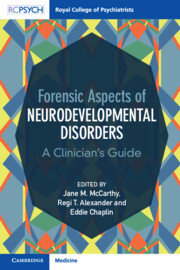
- About the Cover Page
- Contents
- Contributors
- Foreword by the Rt Hon Lord Bradley
- Terminology Used in the Book
- Section 1An Overview: Definitions, Epidemiology and Policy Issues
- Section 2Assessment and Therapeutic Approach
- Section 3Criminal Justice Pathways and Legal Issues
- Chapter 16Criminal Justice Pathways and Neurodevelopmental Disorders
- Chapter 17The Mental Health Act and Other Relevant Legislation in Relation to Neurodevelopmental Disorders in the UK
- Chapter 18Fitness to Plead and Neurodevelopmental Disorders
- Chapter 19Fitness to Plead Procedures in Relation to Mental Health and Capacity Legislation
- Chapter 20Forensic Services for Neurodevelopmental Disorders: An English Perspective
- Chapter 21Offenders with Neurodevelopmental Disorders in Four Nordic Countries
- Chapter 22Forensic Neurodevelopmental Disabilities: A Perspective from Ontario, Canada on Pathways and Services
- Chapter 23Forensic Aspects of Neurodevelopmental Disorders: An Australasian Perspective
- Chapter 24Concluding Comments
- Index
- References
Chapter 22 - Forensic Neurodevelopmental Disabilities: A Perspective from Ontario, Canada on Pathways and Services
from Section 3 - Criminal Justice Pathways and Legal Issues
Published online by Cambridge University Press: 18 May 2023

Book contents
- Forensic Aspects of Neurodevelopmental Disorders
- Forensic Aspects of Neurodevelopmental Disorders
- Copyright page
- About the Cover Page
- Contents
- Contributors
- Foreword by the Rt Hon Lord Bradley
- Terminology Used in the Book
- Section 1An Overview: Definitions, Epidemiology and Policy Issues
- Section 2Assessment and Therapeutic Approach
- Section 3Criminal Justice Pathways and Legal Issues
- Chapter 16Criminal Justice Pathways and Neurodevelopmental Disorders
- Chapter 17The Mental Health Act and Other Relevant Legislation in Relation to Neurodevelopmental Disorders in the UK
- Chapter 18Fitness to Plead and Neurodevelopmental Disorders
- Chapter 19Fitness to Plead Procedures in Relation to Mental Health and Capacity Legislation
- Chapter 20Forensic Services for Neurodevelopmental Disorders: An English Perspective
- Chapter 21Offenders with Neurodevelopmental Disorders in Four Nordic Countries
- Chapter 22Forensic Neurodevelopmental Disabilities: A Perspective from Ontario, Canada on Pathways and Services
- Chapter 23Forensic Aspects of Neurodevelopmental Disorders: An Australasian Perspective
- Chapter 24Concluding Comments
- Index
- References
Summary
Using two composite case studies the following chapter outlines the intersection of legal and forensic pathways to justice for persons with developmental disabilities in Ontario, Canada. Their pathways include a number of junctures where decision making by different stakeholders across sectors is required pertaining to legal determinations of either criminal fitness to stand trial and culpability as well as the health care presence of a contributory mental illness or disorder. Despite having similar profiles, people with developmental disabilities can have vastly different access, processes, and outcomes depending upon a number of variables including legal factors such as the severity of the offence and offence history; and extralegal factors including support network, discretion of multiple decision makers, legal resources and jurisdiction. The pathways recognise the importance and need for ensuring equitable and therapeutic justice for such individuals.
Keywords
Information
- Type
- Chapter
- Information
- Forensic Aspects of Neurodevelopmental DisordersA Clinician's Guide, pp. 265 - 276Publisher: Cambridge University PressPrint publication year: 2023
References
Services and Supports to Promote the Social Inclusion of Persons with Developmental Disabilities Act, 2008, S.O. 2008, c. 14. Available from: www.ontario.ca/laws/statute/08s14.Google Scholar
American Psychiatric Association. Diagnostic and Statistical Manual of Mental Disorders, 5th edition: DSM-5. American Psychiatric Association, 2013.Google Scholar
Brown, I, Radford, JP. The growth and decline of institutions for people with developmental disabilities in Ontario: 1876–2009. Journal of Developmental Disabilities 2015; 21(2): 7–27.Google Scholar
Griffiths, D, Owen, F, Condillac, R, eds. A Difficult Dream: Ending, Institutionalization for Persons with Intellectual Disabilities with Complex Needs. NADD Press, 2016.Google Scholar
Dubé, P. Nowhere to turn: investigation into the Ministry of Community and Social Services’ responses to situations of crisis involving adults with developmental disabilities. 2016. Available at: www.ombudsman.on.ca/resources/reports-and-case-summaries/reports-on-investigations/2016/nowhere-to-turn.Google Scholar
Legislative Assembly of Ontario. Inclusion and opportunity: a new plan for developmental services in Ontario. 2014. Available at: https://connectability.ca/wp-content/uploads/2014/06/5.2-GO-Select-Committee-Development-Services-Final-Report-2014.pdf.Google Scholar
Jones, J. Persons with intellectual disabilities in the criminal justice system: review of issues. International Journal of Offender Therapy and Comparative Criminology 2007; 51(6): 723–33.Google Scholar
Lunsky, Y, Raina, P, Jones, J. Relationship between prior legal involvement and current crisis for adults with intellectual disability. Journal of Intellectual and Developmental Disability 2012; 37(2): 163–8.Google Scholar
UN General Assembly. Convention on the Rights of Persons with Disabilities: resolution adopted by the General Assembly, 24 January 2007, A/RES/61/106. Available at: www.refworld.org/docid/45f973632.html.Google Scholar
Accessible Canada Act(S.C. 2019, c. 10). Available at: https://laws-lois.justice.gc.ca/PDF/A-0.6.pdf.Google Scholar
Accessibility for Ontarians with Disabilities Act, 2005, S.O. 2005, c. 11. Available at: www.ontario.ca/laws/statute/05a11.Google Scholar
Criminal Code(R.S.C., 1985, c. C-46) (Can). Available at: https://laws-lois.justice.gc.ca/PDF/C-46.pdf.Google Scholar
Human Services and Justice Coordinating Committee. Mental health courts in Ontario: a review of the initiation and operation of mental health courts across the province. Available at: https://ontario.cmha.ca/wp-content/uploads/2017/11/Mental-Health-Courts-in-Ontario-1.pdf.Google Scholar
Prokop, J, Huisman, T, Marr, G. Understanding the offender with a dual diagnosis. Available at: www.community-networks.ca/wp-content/uploads/2015/11/understanding_the_offender_w_dd-jan.2010.pdf.Google Scholar
Canadian Charter of Rights and Freedoms, Part I of the Constitution Act, 1982, being Schedule B to the Canada Act 1982 (UK), 1982, c 11, s 91(24). Available at: https://laws-lois.justice.gc.ca/eng/const/page-15.html.Google Scholar
Wexler, DB, Winick, BJ. Therapeutic jurisprudence as a new approach to mental health law policy analysis and research. University of Miami Law Review 1991; 45: 981–1004.Google Scholar
Ministry of the Attorney General. Crown Prosecution manual. Available at: www.ontario.ca/document/crown-prosecution-manual.Google Scholar
R. v. Antic [2017] 1 SCR 509. Available at: https://scc-csc.lexum.com/scc-csc/scc-csc/en/item/16649/index.do.Google Scholar
Southern Network of Specialized Care. Understanding special needs offenders who have dual diagnosis. Available at: www.community-networks.ca/wp-content/uploads/2015/11/understanding_the_offender_w_dd-jan.2010.pdf.Google Scholar
Ministry of Children, Community and Social Services. Policy directives for application entities. 2013. Available at: www.ontario.ca/page/ministry-children-community-and-social-services.Google Scholar
Ministry of Education. Special education in Ontario: Kindergarten to grade 12. Available at: www.ontario.ca/edu.Google Scholar
Human Services and Justice Coordinating Committee. Mental health courts in Ontario: a review of the initiation and operation of mental health courts across the province. 2017. Available at: https://ontario.cmha.ca/wp-content/uploads/2017/11/Mental-Health-Courts-in-Ontario-1.pdf.Google Scholar
R v. Taylor 1992 CanLII 7412 (ON CA), [1992] OJ 2394 (ON CA). Available at: https://scc-csc.lexum.com/scc-csc/scc-csc/en/item/14276/index.do.Google Scholar
R v. Whittle [1994] 2 SCR 914. Available at: https://scc-csc.lexum.com/scc-csc/scc-csc/en/item/1165/index.do.Google Scholar
Ontario Review Board. About us. Available at: www.orb.on.ca/scripts/en/about.asp#history.Google Scholar
R v. Demers [2004] 2 SCR 489. Available at: https://scc-csc.lexum.com/scc-csc/scc-csc/en/item/2160/index.do?site_preference=normal.Google Scholar
Marinos, V, Stromski, S, Whittingham, L, Griffiths, D. Intellectual and Developmental Disabilities and the Criminal Justice System. NADD Press, 2020.Google Scholar
Whittingham, L, Durbin, A, Lin, E, Matheson, FI, Volpe, T, Dastoori, P, et al. The prevalence and health status of people with developmental disabilities in provincial prisons in Ontario, Canada: a prospective cohort study. Journal of Applied Research in Intellectual Disabilities 2020; 33(6): 1368–79.Google Scholar
Accessibility standard: Unknown
Why this information is here
This section outlines the accessibility features of this content - including support for screen readers, full keyboard navigation and high-contrast display options. This may not be relevant for you.Accessibility Information
Accessibility compliance for the HTML of this chapter is currently unknown and may be updated in the future.