Book contents
- Frontmatter
- Contents
- Contributors
- 1Molecular tools in palaeobiology: divergence and mechanisms
- PART IDivergence
- 2Genomics and the lost world: palaeontological insights into genome evolution
- 3Rocking clocks and clocking rocks: a critical look at divergence time estimation in mammals
- 4Morphological largess: can morphology offer more and be modelled as a stochastic evolutionary process?
- 5Species selection in the molecular age
- PART IIMechanisms
- 6Reconstructing the molecular underpinnings of morphological diversification: a case study of the Triassic fish Saurichthys
- 7A molecular guide to regulation of morphological pattern in the vertebrate dentition and the evolution of dental development
- 8Molecular biology of the mammalian dentary: insights into how complex skeletal elements can be shaped during development and evolution
- 9Flexibility and constraint: patterning the axial skeleton in mammals
- 10Molecular determinants of marsupial limb integration and constraint
- 11A developmental basis for innovative evolution of the turtle shell
- 12A molecular–morphological study of a peculiar limb morphology: the development and evolution of the mole's ‘thumb’
- 13Manus horribilis: the chicken wing skeleton
- Index
- Plate-section
- References
1 - Molecular tools in palaeobiology: divergence and mechanisms
Published online by Cambridge University Press: 05 November 2012

Book contents
- Frontmatter
- Contents
- Contributors
- 1Molecular tools in palaeobiology: divergence and mechanisms
- PART IDivergence
- 2Genomics and the lost world: palaeontological insights into genome evolution
- 3Rocking clocks and clocking rocks: a critical look at divergence time estimation in mammals
- 4Morphological largess: can morphology offer more and be modelled as a stochastic evolutionary process?
- 5Species selection in the molecular age
- PART IIMechanisms
- 6Reconstructing the molecular underpinnings of morphological diversification: a case study of the Triassic fish Saurichthys
- 7A molecular guide to regulation of morphological pattern in the vertebrate dentition and the evolution of dental development
- 8Molecular biology of the mammalian dentary: insights into how complex skeletal elements can be shaped during development and evolution
- 9Flexibility and constraint: patterning the axial skeleton in mammals
- 10Molecular determinants of marsupial limb integration and constraint
- 11A developmental basis for innovative evolution of the turtle shell
- 12A molecular–morphological study of a peculiar limb morphology: the development and evolution of the mole's ‘thumb’
- 13Manus horribilis: the chicken wing skeleton
- Index
- Plate-section
- References
Summary
In 1987, Cambridge University Press published a volume entitled Molecules and Morphology in Evolution: Conflict or Compromise? edited by the esteemed British palaeobiologist Colin Patterson. Since the 1980s, we have witnessed a great deal of incorporation of the tools and data of molecular biology into palaeontological hypothesis building and testing. The degree of integration is substantial enough so as to rule out the rather pejorative subtitle of the 1987 volume, ‘conflict or compromise’. We believe a new designation is appropriate: ‘synergy’. Stated differently, our ability to address major questions in biological history requires the integration of molecular methods and data into the palaeobiologist's toolkit. The antagonism implicit in the notion of ‘conflict or compromise’ is more an artefact of disciplinary boundaries and analytical traditions, and is not firmly rooted in the data of biology. Palaeobiologists today routinely consider data from molecular biology in their research on the shape and antiquity of the tree of life (‘divergence’), and in understanding the genetic and developmental mechanisms behind morphological change (‘mechanisms’).
This book documents aspects of this synergy, focusing on these two general categories: divergence and mechanisms. It derives from the symposium ‘molecular tools in palaeobiology’ that took place during the 2009 meetings of the Society of Vertebrate Paleontology in Bristol, UK. In retrospect, we realize that the ‘vertebrate’ orientation of that conference has resulted in a level of taxonomic focus in this book that excludes many important contributions regarding evolutionary divergence and mechanisms. Nevertheless, this is no small taxonomic category, and there has been much to say about it since 1987.
Information
- Type
- Chapter
- Information
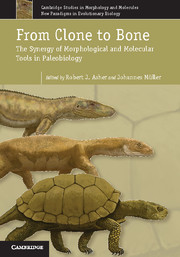
- From Clone to BoneThe Synergy of Morphological and Molecular Tools in Palaeobiology, pp. 1 - 15Publisher: Cambridge University PressPrint publication year: 2012
References
1987 Aspects of hominoid phylogenyMolecules and Morphology in Evolution: Conflict or Compromise?Cambridge, UKCambridge University Press23Google Scholar
2004 Mitogenomic analyses of deep gnathostome divergences: a fish is a fishGene 333 61CrossRefGoogle ScholarPubMed
2009 The new framework for understanding placental mammal evolutionBioEssays 31 853CrossRefGoogle ScholarPubMed
2009 Calibrating and constraining molecular clocksThe Timetree of LifeOxford, UKOxford University Press,35Google Scholar
1987 Tetrapod relationships: the molecular evidenceMolecules and Morphology in Evolution: Conflict or Compromise?Cambridge, UKCambridge University Press123Google Scholar
1997 Developmental patterns and the identification of homologies in the avian handScience 278 666CrossRefGoogle Scholar
1999 Developmental basis of limblessness and axial patterning in snakesNature 399 474CrossRefGoogle ScholarPubMed
2008 Additional molecular support for the new chordate phylogenyGenesis 46 592CrossRefGoogle ScholarPubMed
2009 Distinguishing heat from light in debate over controversial fossilsBioEssays 31 178CrossRefGoogle ScholarPubMed
2007 Pattern pluralism and the Tree of Life hypothesisProceedings of the National Academy of Sciences of the United States of America 104 2043CrossRefGoogle ScholarPubMed
2012
1999 Evolutionary and preservational constraints on origins of biologic groups: divergence times of eutherian mammalsScience 283 1310CrossRefGoogle ScholarPubMed
1993 Haematothermia – warm-blooded amniotesCladistics–the International Journal of the Willi Hennig Society 9 369CrossRefGoogle Scholar
1987 Pattern and process in vertebrate phylogeny revealed by coevolution of molecules and morphologiesMolecules and Morphology in Evolution: Conflict or Compromise?Cambridge, UKCambridge University PressGoogle Scholar
2004 Reading the entrails of chickens: molecular timescales of evolution and the illusion of precisionTrends in Genetics 20 80CrossRefGoogle ScholarPubMed
1874 Natürliche Schöpfungsgeschichte: Gemeinverständliche wissenschaftliche Vorträge über die Entwickelungslehre im Allgemeinen und diejenige von Darwin, Goethe und Lamarck im BesonderenBerlinG. ReimerGoogle Scholar
2002 Palaeontology and evolutionary developmental biology: a science of the nineteenth and twenty-first centuriesPalaeontology 45 647CrossRefGoogle Scholar
2009 Gnathostome phylogenomics utilizing lungfish EST sequencesMolecular Biology and Evolution 26 463CrossRefGoogle ScholarPubMed
2010 Mammalian evolution may not be strictly bifurcatingMolecular Biology and Evolution 27 2804CrossRefGoogle Scholar
2010 Skeletal development in sloths and the evolution of mammalian vertebral patterningProceedings of the National Academy of Sciences of the United States of America 107 18 903CrossRefGoogle ScholarPubMed
1994 Molecular evidence for the origin of birdsProceedings of the National Academy of Sciences of the United States of America 91 2621CrossRefGoogle Scholar
1990 Tetrapod phylogeny inferred from 18S and 28S ribosomal RNA sequences and a review of the evidence for amniote relationshipsMolecular Biology and Evolution 7 607Google Scholar
2007 Calibration choice, rate smoothing, and the pattern of tetrapod diversification according to the long nuclear gene RAG-1Systematic Biology 56 543CrossRefGoogle Scholar
2006 Spiny Norman in the Garden of Eden? Dispersal and early biogeography of PlacentaliaJournal of Mammalian Evolution 13 89CrossRefGoogle Scholar
1868 On the animals which are most nearly intermediate between birds and reptilesGeological Magazine 5 357Google Scholar
1978 Evolution of the therian mammals in the Late Cretaceous of Asia. III. Postcranial skeleton in ZalambdalestidaePalaeontologia Polonica 38 3Google Scholar
2007 Robust time estimation reconciles views of the antiquity of placental mammalsPLoS One 2CrossRefGoogle ScholarPubMed
2002 Pentadactyl ground state of the avian wingJournal of Experimental Zoology 294 146CrossRefGoogle ScholarPubMed
2008 An ancestral turtle from the Late Triassic of southwestern ChinaNature 456 497CrossRefGoogle ScholarPubMed
1982 The Growth of Biological Thought: Diversity, Evolution, and InheritanceCambridge, MABelknap PressGoogle Scholar
2001 Resolution of the early placental mammal radiation using Bayesian phylogeneticsScience 294 2348CrossRefGoogle ScholarPubMed
2009 Evolution of the turtle body plan by the folding and creation of new muscle connectionsScience 325 193CrossRefGoogle ScholarPubMed
2009 Genotypic sex determination enabled adaptive radiations of extinct marine reptilesNature 461 389CrossRefGoogle ScholarPubMed
2007 Origin of avian genome size and structure in non-avian dinosaursNature 446 180CrossRefGoogle ScholarPubMed
1989 Ancient DNA: extraction, characterization, molecular cloning, and enzymatic amplificationProceedings of the National Academy of Sciences of the United States of America 86 1939CrossRefGoogle ScholarPubMed
1987 Molecules and Morphology in Evolution: Conflict or Compromise?Cambridge, UKCambridge University PressGoogle Scholar
1982 Testing the theory of evolution by comparing phylogenetic trees constructed from five different protein sequencesNature 297 197CrossRefGoogle ScholarPubMed
2001 On morphological clocks and paleophylogeography: towards a timescale for hybrid zonesGenetica 112 339CrossRefGoogle ScholarPubMed
2004 Molecular timescales and the fossil record: a paleontological perspectiveTrends in Genetics 20 237CrossRefGoogle ScholarPubMed
2007 Evolutionary diversification of clades of squamate reptilesJournal of Evolutionary Biology 20 1751CrossRefGoogle ScholarPubMed
2010 Developmental palaeontology in synapsids: the fossil record of ontogeny in mammals and their closest relativesProceedings of the Royal Society B–Biological Sciences 277 1139CrossRefGoogle ScholarPubMed
1997 Diversity and evolution of the marsupial mandibular angular processJournal of Mammalian Evolution 4 119CrossRefGoogle Scholar
2010 Potential genetic bases of morphological evolution in the triassic fish Journal of Experimental Zoology B–Molecular and Developmental Evolution 314B 519CrossRefGoogle Scholar
2003 Developmental basis of evolutionary digit loss in the Australian lizard Journal of Experimental Zoology B–Molecular and Developmental Evolution 297B 48CrossRefGoogle Scholar
2009 Deep homology and the origins of evolutionary noveltyNature 457 818CrossRefGoogle ScholarPubMed
2003 Vertebrate dentitions at the origin of jaws: when and how pattern evolvedEvolution and Development 5 394CrossRefGoogle ScholarPubMed
1990 Developmental and evolutionary origins of vertebrate skeletogenic and odontogenic tissuesBiological Reviews of the Cambridge Philosophical Society 65 277CrossRefGoogle ScholarPubMed
2010 History of studies on mammalian middle ear evolution: a comparative morphological and developmental biology perspectiveJournal of Experimental Zoology B–Molecular and Developmental Evolution 314 417CrossRefGoogle ScholarPubMed
1999 1,2,3 = 2,3,4: a solution to the problem of the homology of the digits in the avian handProceedings of the National Academy of Sciences of the United States of America 96 5111CrossRefGoogle ScholarPubMed
2007 Cretaceous eutherians and Laurasian origin for placental mammals near the K/T boundaryNature 447 1003CrossRefGoogle ScholarPubMed
2009 The eutherian mammal from the Late Cretaceous of Mongolia and the phylogeny of Cretaceous EutheriaBulletin of the American Museum of Natural History 327 1CrossRefGoogle Scholar
1987 Macroevolution in the microscopic worldMolecules and Morphology in Evolution: Conflict or Compromise?Cambridge, UKCambridge University PressGoogle Scholar
1962 Molecular disease, evolution, and genetic heterogeneityHorizons in BiochemistryNew YorkAcademic PressGoogle Scholar
Accessibility standard: Unknown
Why this information is here
This section outlines the accessibility features of this content - including support for screen readers, full keyboard navigation and high-contrast display options. This may not be relevant for you.Accessibility Information
Accessibility compliance for the PDF of this chapter is currently unknown and may be updated in the future.