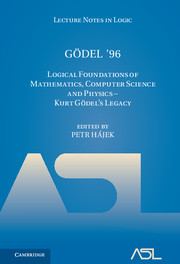
Book contents
- Frontmatter
- Contents
- Preface
- Part IInvited Papers
- Gödel's program for new axioms: Why, where, how and what?
- Infinite-valued G?del Logics with 0-1-Projections and Relativizations
- Contributions of K. Gödel to Relativity and Cosmology
- Kurt Gödel and the constructive Mathematics of A.A. Markov
- Hao Wang as Philosopher
- A bottom-up approach to foundations of mathematics
- K-graph Machines: generalizing Turing's machines and arguments
- Forcing on Bounded Arithmetic
- Uniform Interpolation and Layered Bisimulation
- Part IIContributed Papers
- References
Gödel's program for new axioms: Why, where, how and what?
from Part I - Invited Papers
Published online by Cambridge University Press: 23 March 2017

Book contents
- Frontmatter
- Contents
- Preface
- Part IInvited Papers
- Gödel's program for new axioms: Why, where, how and what?
- Infinite-valued G?del Logics with 0-1-Projections and Relativizations
- Contributions of K. Gödel to Relativity and Cosmology
- Kurt Gödel and the constructive Mathematics of A.A. Markov
- Hao Wang as Philosopher
- A bottom-up approach to foundations of mathematics
- K-graph Machines: generalizing Turing's machines and arguments
- Forcing on Bounded Arithmetic
- Uniform Interpolation and Layered Bisimulation
- Part IIContributed Papers
- References
Summary
Summary. From 1931 until late in his life (at least 1970) Gödel called for the pursuit of new axioms for mathematics to settle both undecided number-theoretical propositions (of the form obtained in his incompleteness results) and undecided set-theoretical propositions (in particular CH). As to the nature of these, Gödel made a variety of suggestions, but most frequently he emphasized the route of introducing ever higher axioms of infinity. In particular, he speculated (in his 1946 Princeton remarks) that there might be a uniform (though non-decidable) rationale for the choice of the latter. Despite the intense exploration of the “higher infinite” in the last 30-odd years, no single rationale of that character has emerged. Moreover, CH still remains undecided by such axioms, though they have been demonstrated to have many other interesting set-theoretical consequences.
In this paper, I present a new very general notion of the “unfolding” closure of schematically axiomatized formal systems S which provides a uniform systematic means of expanding in an essential way both the language and axioms (and hence theorems) of such systems S. Reporting joint work with T. Strahm, a characterization is given in more familiar terms in the case that S is a basic system of non-finitist arithmetic. When reflective closure is applied to suitable systems of set theory, one is able to derive cardinal axioms as theorems. It is an open question how these may be characterized in terms of current notions in that subject.
Why new axioms?
Gödel's published statements over the years (from 1931 to 1972) pointing to the need for new axioms to settle both undecided number-theoretic and set-theoretic propositions are rather well known. They are most easily cited by reference to the first two volumes of the edition of his Collected Works. A number of less familiar statements of a similar character from his unpublished essays and lectures are now available in the third volume of that edition.
Given the ready accessibility of these sources, there is no need for extensive quotation, though several representative passages are singled out below for special attention.
Information
- Type
- Chapter
- Information
- Gödel '96Logical Foundations of Mathematics, Computer Science and Physics - Kurt Gödel's Legacy, pp. 3 - 22Publisher: Cambridge University PressPrint publication year: 2017
References
[1980], Prege structures and the notions of proposition, truth and set, in (, et al, eds.) The Kleene Symposium,
North-Holland, Amsterdam. 31–59.
[1985], Foundations of Constructive Mathematics,
Springer-Verlag, Berlin.
[1961], Zur Prage der Unendlichkeitsschemata in der axiomatischen Mengenlehre, in (, et al, eds.) Essays on the Foundations of Mathematics,
Magnes Press, Jerusalem, 3–49. (See also Bernays [1976].)
[1976], On the problem of schema of infinity in axiomatic set theory, in (, ed.) Sets and Classes,
North-Holland, Amsterdam, 121–172. (English translation of Bernays [1961].)
[1962], Transfinite recursive progressions of axiomatic theories, J. Symbolic Logic
27, 259–316.Google Scholar
[1968], Systems of predicative analysis, II: Representations of ordinals, J. Symbolic Logic
33, 193–220.Google Scholar
[1979], A more perspicuous formal system for predicativity, in (, ed.) Konstruktionen vs. Positionen. Vol. I, Walter de Gruyter, Berlin, 68–93.
[1988], Turing in the land of O(z), in (, ed.) The Universal Turing Machine. A Half-century Survey,
Oxford Univ. Press, Oxford, 113–147.
[1991a], A new approach to abstract data types, II. Computation on ADTs as ordinary computation, in (, et al, eds.) Computer Science Logic,
Lecture Notes in Computer Science 626, 79–95.
[1996], Computation on abstract data types. The extensional approach, with an application to streams, to appear in Annals of Pure and Applied Logic.
[1986], Collected Works, Vol. I. Publications 1929–1936,
Oxford Univ. Press, New York.
[1990], Collected Works, Vol. II. Publications 1938–1974,
Oxford Univ. Press, New York.
[1995], Collected Works, Vol. III. Unpublished Essays and Lectures,
Oxford Univ. Press, New York.
[1964], Incompactness in languages with infinitely long expressions, Fundamenta Mathematicae
53, 309–324.Google Scholar
[1994], The Higher Infinite,
Springer-Verlag, Berlin.
and [1964], Prom accessible to inaccessible cardinals, Fundamenta Mathematicae
53, 225–308. Corrections ibid. 57 (1965) 119.Google Scholar
[1958], Ordinal logics and the characterization of informal concepts of proof, Proc. International Congress of Mathematicians (Edinburgh 1958),
Cambridge Univ. Press, New York, 289–299.
[1970], Principles of proof and ordinals implicit in given concepts, in (, et al, eds.) Intuitionism and Proof Theory,
North-Holland, Amsterdam, 489–516.
[1960], Axiom schemata of strong infinity in axiomatic set theory, Pacific Journal of Mathematics
10, 223–238.Google Scholar
[1976], Hilbert's first problem: The continuum hypothesis, in (, ed.) Mathematical Developments Arising from Hilbert's Problems, Proc. Symposia in Pure Math. 28, A.M.S., Providence, 81–92.
[1995], Recent advances in ordinal analysis: Π1
1
-CA and beyond, Bull. Symbolic Logic
1, 468–485.Google Scholar
[1965], Eine Grenze für die Beweisbarkeit der transfiniten Induktion in der verzweigten Typenlogik, Archiv für Math. Logik und Grandlagenforschung
7, 45–60.Google Scholar
[1961], Measurable cardinals and constructible sets, Bull, de l'Acad. Polonaise des Sciences
9, 521–524.Google Scholar
[1990], The iterative hierarchy of sets, Iyyun, A Jerusalem Philosophical Quarterly
39, 65–79.Google Scholar
[1962], Some problems and results relevant to the foundations of set theory, in (, et al, eds.) Logic, Methodology and the Philosophy of Science (Proc. of the 1960 International Congress, Stanford), Stanford Univ. Press, Stanford, 125–135.
[1939], Systems of logic based on ordinals, Proc. London Math. Soc., ser. 2, 45, 161–228.Google Scholar
Accessibility standard: Unknown
Why this information is here
This section outlines the accessibility features of this content - including support for screen readers, full keyboard navigation and high-contrast display options. This may not be relevant for you.Accessibility Information
Accessibility compliance for the PDF of this chapter is currently unknown and may be updated in the future.