Book contents
- Frontmatter
- Contents
- Figures
- Tables
- Contributors
- 1New instruments of monetary policy
- 2Liquidity and monetary policy
- 3Interest rate policies and stability of banking systems
- 4Handling liquidity shocks
- 5Asset purchase policies and portfolio balance effects
- 6Financial intermediaries in an estimated DSGE model for the UK
- 7Central bank balance sheets and long-term forward rates
- 8Non-standard monetary policy measures and monetary developments
- 9QE – one year on
- 10What saved the banks
- 11Non-conventional monetary policies
- Index
- References
8 - Non-standard monetary policy measures and monetary developments
Published online by Cambridge University Press: 05 November 2011

Book contents
- Frontmatter
- Contents
- Figures
- Tables
- Contributors
- 1New instruments of monetary policy
- 2Liquidity and monetary policy
- 3Interest rate policies and stability of banking systems
- 4Handling liquidity shocks
- 5Asset purchase policies and portfolio balance effects
- 6Financial intermediaries in an estimated DSGE model for the UK
- 7Central bank balance sheets and long-term forward rates
- 8Non-standard monetary policy measures and monetary developments
- 9QE – one year on
- 10What saved the banks
- 11Non-conventional monetary policies
- Index
- References
Summary
Introduction
Standard accounts of the Great Depression (notably the seminal offering of Friedman and Schwartz, 1963) attribute an important causal role to monetary policy errors in accounting for the catastrophic collapse in economic activity observed in the early 1930s. In particular, the Federal Reserve’s failure to halt the collapse in the money stock following the banking crisis of 1931 is seen as a crucial mistake (Meltzer, 2007). While views vary on the relative importance of money versus credit contraction in the propagation of this policy error to the wider economy and ultimately price developments (see, e.g., Bernanke, 1983), a broad consensus exists in the economics profession around the view that the collapse in financial intermediation was a crucial intermediary step.
What lessons have monetary policy makers taken from this episode? And how have they informed the conduct of monetary policy by leading central banks in recent times? Using the frameworks developed by Giannone et al. (2010) and Lenza et al. (2010), this chapter sets out to address these questions, in the context of the financial crisis of 2008–9 and with application to the euro area. In doing so, the chapter draws together two strands of literature: one that explores the nature and rationale of non-standard monetary policy measures, understood as those relying on instruments other than changes to short-term official interest rates, and another which investigates the evolution of bank balance sheets, as reflected in monetary and credit developments, and their impact on monetary policy transmission.
Information
- Type
- Chapter
- Information
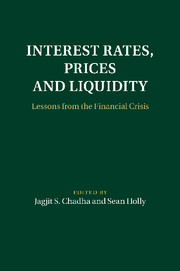
- Interest Rates, Prices and LiquidityLessons from the Financial Crisis, pp. 195 - 221Publisher: Cambridge University PressPrint publication year: 2011
References
1983 Non-monetary effects of the financial crisis in the propagation of the Great DepressionAmerican Economic Review 73 257Google Scholar
2009
2003 The Great Depression and the Friedman–Schwartz hypothesisJournal of Money, Credit and Banking 35 1119CrossRefGoogle Scholar
2011 The central bank balance sheet as an instrument of monetary policyJournal of Monetary Economics 58 54CrossRefGoogle Scholar
2008 Forecasting using a large number of predictors: is Bayesian regression a valid alternative to principal componentsJournal of Econometrics 146 318CrossRefGoogle Scholar
2009 Monetary analysis and monetary policy in the euro areaJournal of International Money and Finance 28 1138CrossRefGoogle Scholar
2010
2009 www.econ.nyu.edu/user/gertlerm/gertlerkaradiapril2010conference.pdf
2010 www.ecb.int/events/conferences/html/moneymechanism.en.html
2010 Money, credit and bank behaviour: need for a new approachNational Institute Economic Review 214 73CrossRefGoogle Scholar
2009
2009
2010
2010 Enhancing Monetary AnalysisFrankfurtEuropean Central Bank
1987 9
2009 www.ecb.europa.eu/press/key/date/2009/html/sp090713.en.html
Accessibility standard: Unknown
Why this information is here
This section outlines the accessibility features of this content - including support for screen readers, full keyboard navigation and high-contrast display options. This may not be relevant for you.Accessibility Information
Accessibility compliance for the PDF of this chapter is currently unknown and may be updated in the future.
- 22
- Cited by