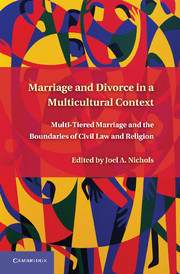
 Marriage and Divorce in a Multi-Cultural Context
Multi-Tiered Marriage and the Boundaries of Civil Law and Religion
Book contents
- Frontmatter
- Contents
- Detail Contents
- About the Editor
- List of Contributors
- Preface
- Permissions
- Introduction
- 1Multi-Tiered Marriage
- 2Pluralism and Decentralization in Marriage Regulation
- 3Marriage and the Law
- 4Unofficial Family Law
- 5Covenant Marriage Laws
- 6New York’s Regulation of Jewish Marriage
- 7Political Liberalism, Islamic Family Law, and Family Law Pluralism
- 8Multi-Tiered Marriages in South Africa
- 9Ancient and Modern Boundary Crossings Between Personal Laws and Civil Law in Composite India
- 10The Perils of Privatized Marriage
- 11Canadian Conjugal Mosaic
- 12Marriage Pluralism in the United States
- 13Faith in Law? Diffusing Tensions Between Diversity and Equality
- 14The Frontiers of Marital Pluralism
- Index
- References
13 - Faith in Law? Diffusing Tensions Between Diversity and Equality
Published online by Cambridge University Press: 05 November 2011

Book contents
- Frontmatter
- Contents
- Detail Contents
- About the Editor
- List of Contributors
- Preface
- Permissions
- Introduction
- 1Multi-Tiered Marriage
- 2Pluralism and Decentralization in Marriage Regulation
- 3Marriage and the Law
- 4Unofficial Family Law
- 5Covenant Marriage Laws
- 6New York’s Regulation of Jewish Marriage
- 7Political Liberalism, Islamic Family Law, and Family Law Pluralism
- 8Multi-Tiered Marriages in South Africa
- 9Ancient and Modern Boundary Crossings Between Personal Laws and Civil Law in Composite India
- 10The Perils of Privatized Marriage
- 11Canadian Conjugal Mosaic
- 12Marriage Pluralism in the United States
- 13Faith in Law? Diffusing Tensions Between Diversity and Equality
- 14The Frontiers of Marital Pluralism
- Index
- References
Summary
How should a democratic state and its public law system respond to claims by members of religious minorities seeking to establish private faith-based arbitration tribunals to resolve family disputes? Classic liberals and civic republicans would have had a quick response to such a query. They favored a strict separation between state and religion, as part of their support for drawing a plain and clean line between the public and private spheres. Be a citizen in public, a Jew (or a Catholic or a Muslim, and so on) in private, remains the favored mantra, dating back to as early as the 1791 French National Assembly’s decree admitting Jews as individuals to the rights of citizenship, after they had “freed” themselves from any communal semiautonomous governance institutions.
But the world now is a very different place. My aim in this chapter is to highlight the centrality of women, gender, and the family in renewed state and religion contestations that inject new meanings into the traditional categories of “private” and “public.” This chapter focuses exclusively on the situation of members of minority religions living in otherwise secularized societies. My interest, more specifically, lies in exploring how different legal arrangements between secular and religious jurisdictions shape and affect women’s rights to religious freedom and equality. Of special interest here are those situations in which renegotiated relations between state and religion intersect and interact with public concerns about power disparities between men and women in the resolution of family law disputes.
Information
- Type
- Chapter
- Information
- Marriage and Divorce in a Multi-Cultural ContextMulti-Tiered Marriage and the Boundaries of Civil Law and Religion, pp. 341 - 356Publisher: Cambridge University PressPrint publication year: 2011
References
Can Islam Be French? Pluralism and Pragmatism in a Secularist StatePrinceton, NJPrinceton University Press 2009Google Scholar
‘Mistresses of Their Own Destiny’: Group Rights, Gender, and Realistic Rights of Exit,Ethics 112 2002 205CrossRefGoogle Scholar
Muslim Women and ‘Islamic Divorce’ in EnglandJournal of Muslim Minority Affairs 17 1997 97CrossRefGoogle Scholar
The Claims of Culture: Equality and Diversity in the Global EraPrinceton, NJPrinceton University Press 2002Google Scholar
Building the Future: A Time for ReconciliationQuebecCommission de Consultation surles Pratiques d’Accommodement reliées aux Différences Culturelles 2008Google Scholar
The New Wall of Separation: Respecting Diversity, Prohibiting CompetitionCardozo Law Review 30 2009 2535Google Scholar
Multicultural Jurisdictions: Cultural Differences and Women’s RightsCambridgeCambridge University Press 2001CrossRefGoogle Scholar
In Pursuit of Religious and Legal Diversity: A Response to the Archbishop of Canterbury and the ‘Sharia Debate’ in Britain,Ecclesiastical Law Journal 10 2008 283CrossRefGoogle Scholar
Privatizing Diversity: A Cautionary Tale from Religious Arbitration in Family Law,Theoretical Inquiries in Law 9(2) 2008 573Google Scholar
Accessibility standard: Unknown
Why this information is here
This section outlines the accessibility features of this content - including support for screen readers, full keyboard navigation and high-contrast display options. This may not be relevant for you.Accessibility Information
Accessibility compliance for the PDF of this chapter is currently unknown and may be updated in the future.