Book contents
- Frontmatter
- Contents
- List of contributors
- Acknowledgments
- 1Introduction: Social primary goods and capabilities as metrics of justice
- PART ITHEORY
- PART IIAPPLICATIONS
- 6Capabilities, opportunity, and health
- 7What metric of justice for disabled people? Capability and disability
- 8Primary goods, capabilities, and children
- 9Education for primary goods or for capabilities?
- 10Gender and the metric of justice
- PART IIICONCLUDING ESSAY
- Index
- References
8 - Primary goods, capabilities, and children
Published online by Cambridge University Press: 05 June 2012

Book contents
- Frontmatter
- Contents
- List of contributors
- Acknowledgments
- 1Introduction: Social primary goods and capabilities as metrics of justice
- PART ITHEORY
- PART IIAPPLICATIONS
- 6Capabilities, opportunity, and health
- 7What metric of justice for disabled people? Capability and disability
- 8Primary goods, capabilities, and children
- 9Education for primary goods or for capabilities?
- 10Gender and the metric of justice
- PART IIICONCLUDING ESSAY
- Index
- References
Summary
The debate between advocates of a primary-goods focused approach to justice and advocates of a capabilities focused approach has been conducted without much explicit attention to how the perspective of children should be represented and interpreted. The objective of this paper is to make some modest progress toward remedying this neglect. The principal conclusion I reach is that neither the Rawlsian primary goods approach nor the capabilities approach provides a fully satisfactory theoretical framework for addressing the full range of children's interests with which justice should be concerned. Moreover, the shortcomings of both approaches are located, I suggest, in a common implicit assumption, namely that the human beings with whom justice is concerned are to be conceived primarily as either mature agents capable of assuming responsibility for the ends they adopt and pursue or as potential mature agents. I will argue that children do not comfortably fit the paradigm of agency that plays an animating role in both theories. Although my main aim is to provide a diagnosis of the theoretical limitations of both approaches, I will offer some tentative remarks about what fuller sensitivity to all the relevant interests of children might involve.
The analysis I develop highlights limitations that I believe can be detected in both views but I do not want the critical focus of the paper to be interpreted as entailing a wholesale rejection of either Rawlsian theory or the capabilities approach.
Keywords
Information
- Type
- Chapter
- Information
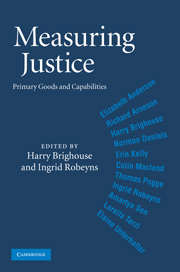
- Measuring JusticePrimary Goods and Capabilities, pp. 174 - 192Publisher: Cambridge University PressPrint publication year: 2010
References
1989. “Equality and Equal Opportunity for Welfare,” Philosophical Studies 56: 77–93.CrossRefGoogle Scholar
, , , and 2006. “Children Conceptualizing their Capabilities: Results of a Survey Conducted during the First Children's World Congress on Child Labour,” Journal of Human Development 7, 1: 59–83.CrossRefGoogle Scholar
2005. “Social Justice and the Rights of Children,” in (ed.), Studies in Modern Childhood. Basingstoke: Palgrave Macmillan, pp. 221–30.Google Scholar
and 1998. “Rawls's Neglected Childhood: Reflections on the Original Position, Stability and the Child's Sense of Justice”, in and (eds.), The Philosopher's Child. Rochester, NY: University of Rochester Press.Google Scholar
1980. “Children, Paternalism, and Education: A Liberal Argument,” Philosophy and Public Affairs 9, 4: 338–58.Google Scholar
2002. “Special Agents: Children's Autonomy and Parental Authority,” in and (eds.), The Moral and Political Status of Children. Oxford University Press, pp. 97–117.Google Scholar
2000. Women and Human Development: The Capabilities Approach. Cambridge University Press.CrossRefGoogle Scholar
2006. Frontiers of Justice: Disability, Nationality, Species Membership. Cambridge MA: Harvard University Press.Google Scholar
2005. “The Capability Approach: A Theoretical Survey,” Journal of Human Development 6, 1: 93–114.CrossRefGoogle Scholar
2006. “The Capability Approach in Practice,” Journal of Political Philosophy 14, 3: 351–76.CrossRefGoogle Scholar
2007. “Children and Dangerous Sport and Recreation,” Journal of the Philosophy of Sport 34: 176–93.CrossRefGoogle Scholar
2003. “Amartya Sen's Capability Approach to Education: A Critical Exploration,” Journal of Philosophy of Education 37, 1: 17–33.CrossRefGoogle Scholar
2005. “Debate: Capabilities versus Opportunities for Well-being,” Journal of Political Philosophy 13, 3: 359–71.CrossRefGoogle Scholar
Accessibility standard: Unknown
Why this information is here
This section outlines the accessibility features of this content - including support for screen readers, full keyboard navigation and high-contrast display options. This may not be relevant for you.Accessibility Information
Accessibility compliance for the PDF of this chapter is currently unknown and may be updated in the future.
- 82
- Cited by