Book contents
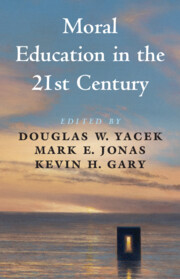
- Moral Education in the 21st Century
- Moral Education in the 21st Century
- Copyright page
- Contents
- Contributors
- Acknowledgments
- Chapter 1Why Does Moral Education Matter in the 21st Century?
- Part IHistorical Insights for Contemporary Moral Education
- Chapter 2Plato’s Significance for Moral Education
- Chapter 3Neo-Aristotelianism and Moral Education
- Chapter 4Neoskepticism and Moral Education
- Chapter 5Nietzsche and Moral Education
- Chapter 6Neo-Kantianism and Moral Education
- Part IINew Approaches to Moral Education
- Part IIIResponses to Contemporary Moral Problems
- Index
- References
Chapter 4 - Neoskepticism and Moral Education
from Part I - Historical Insights for Contemporary Moral Education
Published online by Cambridge University Press: 01 June 2023

Book contents
- Moral Education in the 21st Century
- Moral Education in the 21st Century
- Copyright page
- Contents
- Contributors
- Acknowledgments
- Chapter 1Why Does Moral Education Matter in the 21st Century?
- Part IHistorical Insights for Contemporary Moral Education
- Chapter 2Plato’s Significance for Moral Education
- Chapter 3Neo-Aristotelianism and Moral Education
- Chapter 4Neoskepticism and Moral Education
- Chapter 5Nietzsche and Moral Education
- Chapter 6Neo-Kantianism and Moral Education
- Part IINew Approaches to Moral Education
- Part IIIResponses to Contemporary Moral Problems
- Index
- References
Summary
Contemporary moral education could learn a thing or two from the ancient Greco-Romans. This essay introduces the two major varieties of ancient Skepticism: Pyrrhonism and the New Academy, situating them within the current resurgence of interest in virtue ethics that includes, for instance, Stoicism. I then make an argument that the Academic Skeptics – authors like Carneades and Cicero – pursued two major intertwined interests: ethics and natural philosophy. “Ethics,” in the Greco-Roman conception, had a far wider scope than the field of study that we now identify by that label, having to do with how to best live one’s life. In turn, a crucial component of good living was thought to be the ability to understand, through natural philosophy, how the world actually works, in order to avoid taking refuge in psychologically reassuring fantasies of the kind that we refer to nowadays as pseudoscience.
Information
- Type
- Chapter
- Information
- Moral Education in the 21st Century , pp. 49 - 68Publisher: Cambridge University PressPrint publication year: 2023
References
Aristotle (2003). Nicomachean Ethics. Available at: https://www.gutenberg.org/files/8438/8438-h/8438-h.htm.Google Scholar
Athanassoulis, N. (2021). Virtue ethics. Internet Encyclopedia of Philosophy. Available at: https://iep.utm.edu/virtue.Google Scholar
Beckwith, C. I. (2015). Greek Buddha: Pyrrho’s encounter with early Buddhism in Central Asia. Princeton, NJ: Princeton University Press.CrossRefGoogle Scholar
Benbaji, Y., & Fisch, M. (2004). Through thick and thin: A new defense of cultural relativism. Southern Journal of Philosophy, 42, 1–24.Google Scholar
Bentham, J. (1780). An introduction to the principles of morals and legislation. Available at: https://www.earlymoderntexts.com/assets/pdfs/bentham1780.pdf.Google Scholar
Bett, R. (Ed.) (2010). The Cambridge companion to ancient skepticism. Cambridge: Cambridge University Press.CrossRefGoogle Scholar
Boyd, R. (1988). How to be a moral realist. In Sayre-McCord, G. (Ed.), Essays on moral realism (pp. 181–228). Ithaca, NY: Cornell University Press.Google Scholar
Clifford, W. (1886). Lectures and essays. Eds. Stephen, L. & Pollock, F., New York, NY: Macmillan.Google Scholar
Descartes, R. (1641). Meditations on first philosophy. Available at: http://www.classicallibrary.org/descartes/meditations.Google Scholar
Diogenes Laertius. (2018). Lives of the eminent philosophers. Available at: https://www.gutenberg.org/files/57342/57342-h/57342-h.htm.Google Scholar
Douven, I. (2021). Abduction (inference to the best explanation). Stanford Encyclopedia of Philosophy. Available at: https://plato.stanford.edu/entries/abduction/Google Scholar
Hadot, P. (1995). Philosophy as a way of life: Spiritual exercises from Socrates to Foucault. Malden, MA: Blackwell.Google Scholar
Hard, R. (Trans.) (2012). Diogenes the cynic: Sayings and anecdotes, with other popular moralists. Oxford: Oxford University Press.Google Scholar
Hasan, A., & Fumerton, R. (2016). Foundationalist theories of epistemic justification. Stanford Encyclopedia of Philosophy. Available at: https://plato.stanford.edu/entries/justep-foundational.Google Scholar
Henderson, L. (2018). The problem of induction. Stanford Encyclopedia of Philosophy. Available at: https://plato.stanford.edu/entries/induction-problem/.Google Scholar
Hetherington, S. (2021). Fallibilism, Internet Encyclopedia of Philosophy. Available at: https://iep.utm.edu/fallibil.Google Scholar
Hume, D. (1739). A treatise of human nature. Available at: https://www.gutenberg.org/files/4705/4705-h/4705-h.htm.Google Scholar
Irvine, W. B. (2008). A guide to the good life: The ancient art of stoic joy. Oxford: Oxford University Press.CrossRefGoogle Scholar
Joyce, R. (2001). The myth of morality. Cambridge: Cambridge University Press.CrossRefGoogle Scholar
Kant, I. (1785). Groundwork of the metaphysic of morals. Available at: https://www.gutenberg.org/ebooks/5682.Google Scholar
Kurtz, P. (1992). The new skepticism: Inquiry and reliable knowledge. Amherst, NY: Prometheus.Google Scholar
Mill, J. S. (1863). Utilitarianism. Available at: https://www.gutenberg.org/ebooks/11224.Google Scholar
Moberger, V. (2020). Bullshit, pseudoscience and pseudophilosophy. Theoria, 86(5), 595–611.CrossRefGoogle Scholar
Murphy, P. (2021). Coherentism. Internet Encyclopedia of Philosophy. Available at: https://iep.utm.edu/coherent/.Google Scholar
Pigliucci, M. (2017). How to be a stoic: Using ancient philosophy to live a modern life. New York: Basic Books.Google Scholar
Plato (1992). Laches and Charmides. Trans. Sprague, R. Kent, Indianapolis, IN: Hackett.Google Scholar
Quine, W. V., & Ullian, J. S. (1978). The web of belief. 2nd ed. New York, NY: McGraw-Hill Education.Google Scholar
Robertson, D. (2018). Stoicism and the art of happiness: Practical wisdom for everyday life – Embrace perseverance, strength and happiness with stoic philosophy. 2nd ed. London: Teach Yourself.Google Scholar
Talbott, W. (2008). Bayesian epistemology, Stanford Encyclopedia of Philosophy, Available at: https://plato.stanford.edu/entries/epistemology-bayesian/.Google Scholar
Thorsrud, H. (2018). Carneades In Machuga, D. E. & Reed, B. (Eds.), Skepticism: From antiquity to the present (pp. 51–67). London: BloomsburyGoogle Scholar
Turri, J., Alfano, M., & Grego, J. (2021). Virtue epistemology, Stanford Encyclopedia of Philosophy. Available at: https://plato.stanford.edu/entries/epistemology-virtue; for some of the quotes, see also archived version at https://stanford.library.sydney.edu.au/archives/fall1999/entries/epistemology-virtue.Google Scholar
Wilson, C. (2019). How to be an Epicurean: The ancient art of living well. New York, NY: Basic Books.Google Scholar
Accessibility standard: Unknown
Why this information is here
This section outlines the accessibility features of this content - including support for screen readers, full keyboard navigation and high-contrast display options. This may not be relevant for you.Accessibility Information
Accessibility compliance for the HTML of this chapter is currently unknown and may be updated in the future.