Book contents
- Onomatopoeia
- Onomatopoeia
- Copyright page
- Dedication
- Contents
- Figures
- Tables
- Acknowledgments
- Abbreviations
- 1Introduction
- 2Defining Onomatopoeia
- 3Onomatopoeias as Linguistic Signs
- 4Prototypical Features of Onomatopoeia
- 5Onomatopoeia and Sound Symbolism
- 6Cross-Linguistic Onomatopoeic Patterns
- 7Richness of Languages in Onomatopoeias by Sound Type and Source
- 8Onomatopoeias versus Ideophones
- 9Conclusion
- Book part
- References
- Author Index
- Language Index
- Subject Index
3 - Onomatopoeias as Linguistic Signs
Published online by Cambridge University Press: 18 December 2025

Book contents
- Onomatopoeia
- Onomatopoeia
- Copyright page
- Dedication
- Contents
- Figures
- Tables
- Acknowledgments
- Abbreviations
- 1Introduction
- 2Defining Onomatopoeia
- 3Onomatopoeias as Linguistic Signs
- 4Prototypical Features of Onomatopoeia
- 5Onomatopoeia and Sound Symbolism
- 6Cross-Linguistic Onomatopoeic Patterns
- 7Richness of Languages in Onomatopoeias by Sound Type and Source
- 8Onomatopoeias versus Ideophones
- 9Conclusion
- Book part
- References
- Author Index
- Language Index
- Subject Index
Summary
Chapter 3 concentrates on the semiotics of onomatopoeia, mainly the frequently discussed issues of iconicity, arbitrariness, and motivation. It is claimed that rather than opposing terms, arbitrariness and motivation are complementary notions. It introduces the concept of causality into the discussion of the nature of onomatopoeia as linguistic signs. The chapter discusses five basic oppositions: causality versus noncausality; arbitrariness versus nonarbitrariness; iconicity versus non-iconicity; motivation versus lexicalization; and conventionalization versus nonconventionalization. Considerable attention is paid to the views that criticize Saussure’s comprehension of onomatopoeia and his concept of arbitrariness. Arguments are presented in support of Saussure’s position. In addition, Peirce’s triad of hypo-icons (image, diagram, metaphor) is discussed in terms of their relevance to the characterization of onomatopoeias.
Information
- Type
- Chapter
- Information
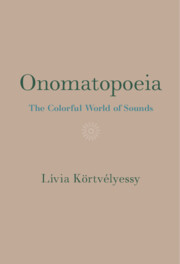
- OnomatopoeiaThe Colorful World of Sounds, pp. 47 - 85Publisher: Cambridge University PressPrint publication year: 2025
Accessibility standard: Unknown
Why this information is here
This section outlines the accessibility features of this content - including support for screen readers, full keyboard navigation and high-contrast display options. This may not be relevant for you.Accessibility Information
Accessibility compliance for the HTML of this chapter is currently unknown and may be updated in the future.