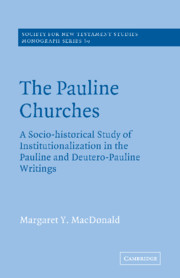
 The Pauline Churches
A Socio-Historical Study of Institutionalization in the Pauline and Deutrero-Pauline Writings
Book contents
- Frontmatter
- Contents
- Preface
- Abbreviations
- INTRODUCTION
- 1The project
- 2The social sciences and New Testament interpretation
- 3Methodological limits and possibilities
- 4Where from here?
- PART 1PAUL: COMMUNITY-BUILDING INSTITUTIONALIZATION
- 1Attitudes to the world/ethics
- 2Ministry
- 3Ritual
- 4Belief
- 5General conclusion
- PART 2COLOSSIANS AND EPHESIANS: COMMUNITY-STABILIZING INSTITUTIONALIZATION
- PART 3THE PASTORAL EPISTLES: COMMUNITY-PROTECTING-INSTITUTIONALIZATION
- CONCLUSION
- Notes
- Biblography
- Index of Biblical passages discussed
- Subject index
Summary
The social life of the Pauline sect cannot adequately be explained by describing a simple shaping of societal development by doctrines. Although it is true that doctrines influence social reality, it is also clear that social experience affects the construction of doctrines. The tensions between the group and those on the outside, the conflict between leaders over the distribution of authority, and the mystical experiences in ritual are all connected to the process of symbolization. In this section specific attention will be given to the nature of beliefs in the Pauline sect. Correlations will be drawn between beliefs and the social contexts where they are articulated.
Sect, society and symbolic universe
Whether one speaks of a religious system, a symbolic universe or an ideology, it is evident that the Pauline communities are in possession of such a body of sacred symbols. Shils argues that in contrast to other patterns of beliefs, ideologies are usually integrated around one or a few pre-eminent symbols. In the case of the Pauline communities, it is the symbol of the crucified and resurrected Messiah that stands out most sharply. This symbol is an example of what Mary Douglas has described as a ‘condensed symbol’; it encompasses a wide range of references. The symbol of the crucified and resurrected Messiah encompasses a story and calls for a certain life-style; it stands at the centre of the effort to build communities.
Information
- Type
- Chapter
- Information
- The Pauline ChurchesA Socio-Historical Study of Institutionalization in the Pauline and Deutrero-Pauline Writings, pp. 72 - 83Publisher: Cambridge University PressPrint publication year: 1988
Accessibility standard: Unknown
Why this information is here
This section outlines the accessibility features of this content - including support for screen readers, full keyboard navigation and high-contrast display options. This may not be relevant for you.Accessibility Information
Accessibility compliance for the PDF of this chapter is currently unknown and may be updated in the future.