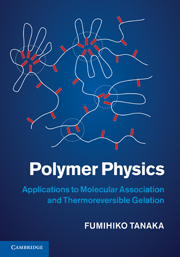
Book contents
- Frontmatter
- Contents
- Preface
- 1Statistical properties of polymer chains
- 2Polymer solutions
- 3Classical theory of gelation
- 4Elasticity of polymer networks
- 5Associating polymer solutions and thermoreversible gelation
- 6Nongelling associating polymers
- 7Thermoreversible gelation
- 8Structure of polymer networks
- 9Rheology of thermoreversible gels
- 10Some important thermoreversible gels
- Index
- References
10 - Some important thermoreversible gels
Published online by Cambridge University Press: 16 May 2011

Book contents
- Frontmatter
- Contents
- Preface
- 1Statistical properties of polymer chains
- 2Polymer solutions
- 3Classical theory of gelation
- 4Elasticity of polymer networks
- 5Associating polymer solutions and thermoreversible gelation
- 6Nongelling associating polymers
- 7Thermoreversible gelation
- 8Structure of polymer networks
- 9Rheology of thermoreversible gels
- 10Some important thermoreversible gels
- Index
- References
Summary
This chapter applies the thermodynamic and rheological theories developed so far to the specific important network-forming associating polymer solutions. The topics include modification of the phase separation and gelation of associating polymers by added surfactants, transition from intramolecular association to intermolecular association, competitive and coexisting hydration and hydrophobic association, and thermoreversible gelation strongly coupled to the polymer conformational change. With an increase in the number of components, or the degree of freedom in the system, phase transitions and flow properties become complex. However, the basic ideas to treat them stay within the fundamental theoretical framework presented in the preceding chapters. All systems are modeled from a unified point of view.
Polymer–surfactant interaction
The problem of the interaction between polymers and surfactants was laid initially in the study of proteins associated with natural lipids, and later extended to their association with synthetic surfactants [1, 2]. More recently, the interaction of water-soluble synthetic polymers such as poly(ethylene oxide) with ionic and non-ionic surfactants [3–7] has attracted the interest of researchers because of its scientific and technological implications.
Adding surfactants to polymer solutions, or vice versa, followed by the formation of a polymer/surfactant complex, can substantially alter the original physical properties substances involved.
Information
- Type
- Chapter
- Information
- Polymer PhysicsApplications to Molecular Association and Thermoreversible Gelation, pp. 331 - 382Publisher: Cambridge University PressPrint publication year: 2011
References
[2] ; , Interactions of Surfactants with Polymers and Proteins. CRC Press: Boca Raton, CA, 1993.Google Scholar
[31] , Scaling Concepts in Polymer Physics. Cornell University Press: Ithaca, NY, 1979.Google Scholar
[34] , Thermoreversible Gelation of Polymers and Biopolymers. Academic Press: London, 1992.Google Scholar
[41] ; , Physics of Amphiphiles: Micelles, Vesicles and Microemulsions, Chap. V. North-Holland: Amsterdam, 1985.Google Scholar
Accessibility standard: Unknown
Why this information is here
This section outlines the accessibility features of this content - including support for screen readers, full keyboard navigation and high-contrast display options. This may not be relevant for you.Accessibility Information
Accessibility compliance for the PDF of this chapter is currently unknown and may be updated in the future.