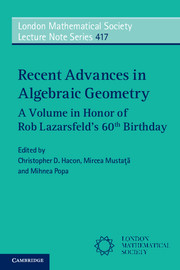
Book contents
- Frontmatter
- Contents
- List of contributors
- Preface
- 1The effect of points fattening in dimension three
- 2Some remarks on surface moduli and determinants
- 3Valuation spaces and multiplier ideals on singular varieties
- 4Line arrangements modeling curves of high degree: Equations, syzygies, and secants
- 5Rationally connected manifolds and semipositivity of the Ricci curvature
- 6Subcanonical graded rings which are not Cohen–Macaulay
- 7Threefold divisorial contractions to singularities of cE type
- 8Special prime Fano fourfolds of degree 10 and index 2
- 9Configuration spaces of complex and real spheres
- 10Twenty points in ℙ3
- 11The Betti table of a high-degree curve is asymptotically pure
- 12Partial positivity: Geometry and cohomology of q-ample line bundles
- 13Generic vanishing fails for singular varieties and in characteristic p > 0
- 14Deformations of elliptic Calabi–Yau manifolds
- 15Derived equivalence and non-vanishing loci II
- 16The automorphism groups of Enriques surfaces covered by symmetric quartic surfaces
- 17Lower-order asymptotics for Szegö and Toeplitz kernels under Hamiltonian circle actions
- 18Gaussian maps and generic vanishing I: Subvarieties of abelian varieties
- 19Torsion points on cohomology support loci: From D-modules to Simpson's theorem
- 20Rational equivalence of 0-cycles on K3 surfaces and conjectures of Huybrechts and O'Grady
- References
15 - Derived equivalence and non-vanishing loci II
Published online by Cambridge University Press: 05 January 2015

Book contents
- Frontmatter
- Contents
- List of contributors
- Preface
- 1The effect of points fattening in dimension three
- 2Some remarks on surface moduli and determinants
- 3Valuation spaces and multiplier ideals on singular varieties
- 4Line arrangements modeling curves of high degree: Equations, syzygies, and secants
- 5Rationally connected manifolds and semipositivity of the Ricci curvature
- 6Subcanonical graded rings which are not Cohen–Macaulay
- 7Threefold divisorial contractions to singularities of cE type
- 8Special prime Fano fourfolds of degree 10 and index 2
- 9Configuration spaces of complex and real spheres
- 10Twenty points in ℙ3
- 11The Betti table of a high-degree curve is asymptotically pure
- 12Partial positivity: Geometry and cohomology of q-ample line bundles
- 13Generic vanishing fails for singular varieties and in characteristic p > 0
- 14Deformations of elliptic Calabi–Yau manifolds
- 15Derived equivalence and non-vanishing loci II
- 16The automorphism groups of Enriques surfaces covered by symmetric quartic surfaces
- 17Lower-order asymptotics for Szegö and Toeplitz kernels under Hamiltonian circle actions
- 18Gaussian maps and generic vanishing I: Subvarieties of abelian varieties
- 19Torsion points on cohomology support loci: From D-modules to Simpson's theorem
- 20Rational equivalence of 0-cycles on K3 surfaces and conjectures of Huybrechts and O'Grady
- References
Summary
Abstract
We prove a few cases of a conjecture on the invariance of cohomological support loci under derived equivalence by establishing a concrete connection with the related problem of the invariance of Hodge numbers. We use the main case in order to study the derived behavior of fibrations over curves.
Dedicated to Rob Lazarsfeld on the occasion of his 60th birthday, with warmth and gratitude
1 Introduction
This paper is concerned with the following conjecture made in [11] on the behavior of the non-vanishing loci for the cohomology of deformations of the canonical bundle under derived equivalence. We recall that given a smooth projective X these loci, more commonly called cohomological support loci, are the closed algebraic subsets of the Picard variety defined as
Vi(ωX) := {α | Hi(X, ωX ⊗ α) ≠ 0} ⊆ Pic0(X).
All varieties we consider are defined over the complex numbers. We denote by D(X) the bounded derived category of coherent sheaves Db(Coh(X)).
Conjecture 1 ([11]) Let X and Y be smooth projective varieties with D(X) ≃ D(Y) as triangulated categories. Then
Vi(ωX)0 ≃ Vi(ωY)0 for all i ≥ 0,
where Vi(ωX)0 denotes the union of the irreducible components of Vi(ωX) passing through the origin, and similarly for Y.
We refer to [10] and [11] for a general discussion of this conjecture and its applications, and of the cases in which it has been known to hold (recovered below as well). The main point of this paper is to relate Conjecture 1 directly to part of the well-known problem of the invariance of Hodge numbers under derived equivalence; we state only the special case we need.
Conjecture 2Let X and Y be smooth projective varieties withD(X) ≃ D(Y).
Then
h0,i(X) = h0,i(Y) for all i ≥ 0.
Our main result is the following:
Theorem 3Conjecture 2 implies Conjecture 1. More precisely, Conjecture 1 for a given i is implied by Conjecture 2 for n − i, where n = dim X.
Information
- Type
- Chapter
- Information
- Recent Advances in Algebraic GeometryA Volume in Honor of Rob Lazarsfeld’s 60th Birthday, pp. 291 - 306Publisher: Cambridge University PressPrint publication year: 2015
References
[1] 2009. The spectral construction for a (1, 8)-polarized family of abelian varieties. arXiv:0903.5488.
[2] 1992. Annulation du H1 pour les fibrés en droites plats. In Complex Algebraic Varieties (Bayreuth, 1990), pp. 1–15. Lectures Notes in Mathematics, Vol. 1507. Berlin: Springer-Verlag.
[3] and 1998. Fourier–Mukai transforms for quotient varieties. arXiv:9811101.
[4] and 2001. Complex surfaces with equivalent derived categories. Math. Z., 236(4), 677–697.Google Scholar
[5] 2009. Some basic results on actions of non-affine algebraic groups. In Symmetry and Spaces: In honor of Gerry Schwarz, pp. 1–20. Progress in Mathematics, Vol. 278, Boston: Birkhäuser.
[6] 1991. Moduli and classification of irregular Kaehler manifolds (and algebraic varieties) with Albanese general type fibrations. Invent. Math., 104(2), 389–407.Google Scholar
[7] and 1991. Higher obstructions to deforming cohomology groups of line bundles. J. Amer. Math. Soc., 1(4), 87–103.Google Scholar
[8] 2006. Fourier–Mukai Transforms in Algebraic Geometry. Oxford Mathematical Monographs. Oxford: The Clarendon Press.
[10] 2014. Derived invariants of irregular varieties and Hochschild homology. Algebra and Number Theory, 8(3), 513–542.Google Scholar
[11] 2013. Derived equivalence and non-vanishing loci. “A celebration of Algebraic Geometry”, Clay Math. Proc. 18, 567–575, Amer. Math. Soc., Providence, RI.
[12] and 2011. Derived invariance of the number of holomorphic 1-forms and vector fields. Ann. Sci. ENS, 44(3), 527–536.Google Scholar
[13] 2011. Automorphismes, graduations et catégories triangulees. J. Inst. Math. Jussieu, 10(3), 713–751.Google Scholar
[14] 2012. The fundamental group is not a derived invariant. In Derived Categories in Algebraic Geometry, pp. 279–285. EMS Series of Congress Reports. Zürich: European Mathematical Society.
[15] 1993. Subspaces of moduli spaces of rank one local systems. Ann. Sci. ENS, 26(3), 361–401.Google Scholar
[16] 2006. Fourier-Mukai transforms and canonical divisors. Compos. Math., 142(4), 962–982.Google Scholar
[17] 1996. On projective manifolds with nef anticanonical bundles. J. Reine Angew. Math., 478, 57–60.Google Scholar
Accessibility standard: Unknown
Why this information is here
This section outlines the accessibility features of this content - including support for screen readers, full keyboard navigation and high-contrast display options. This may not be relevant for you.Accessibility Information
Accessibility compliance for the PDF of this chapter is currently unknown and may be updated in the future.