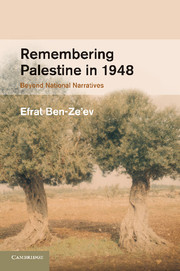
Book contents
- Frontmatter
- Contents
- List of illustrations
- Maps
- Preface
- Map of Palestine prior to 1948
- Introduction
- Part IConstructing Palestine: National Projects
- 1The Framework
- 2The British Cartographic Imagination and Palestine
- 3Cartographic Practices in Palestine
- Part IIPalestinian-Arab Memories in the Making
- Part IIIJewish-Israeli Memories in the Making
- Part IVBritish Mandatory Memories in the Making
- Conclusions and Implications
- Bibliography
- Notes
- Index
- Studies in the Social and Cultural History of Modern Warfare
2 - The British Cartographic Imagination and Palestine
Published online by Cambridge University Press: 07 October 2011

Book contents
- Frontmatter
- Contents
- List of illustrations
- Maps
- Preface
- Map of Palestine prior to 1948
- Introduction
- Part IConstructing Palestine: National Projects
- 1The Framework
- 2The British Cartographic Imagination and Palestine
- 3Cartographic Practices in Palestine
- Part IIPalestinian-Arab Memories in the Making
- Part IIIJewish-Israeli Memories in the Making
- Part IVBritish Mandatory Memories in the Making
- Conclusions and Implications
- Bibliography
- Notes
- Index
- Studies in the Social and Cultural History of Modern Warfare
Summary
Maps are a way of conceiving, articulating, and structuring the human world.
Brian Harley 2001:53All the state simplifications … have the character of maps. That is, they are designed to summarize precisely those aspects of a complex world that are of immediate interest to the map-maker and to ignore the rest.
James C. Scott 1998:87In this chapter we take a detour into the world of cartography, to follow the underlying principles behind the British Mandatory administration's use of maps prior to the emergence of a state in Palestine. In Seeing like a State James C. Scott explains why and how states strive to simplify and make legible their domain. The same logic applies to imperial and mandatory powers, perhaps with even greater force. At the heart of this process, which he names “high modernism,” “was a supreme self-confidence about continued linear progress, the development of scientific and technical knowledge, the expansion of production, the rational design of social order, the growing satisfaction of human needs, and, not least, an increasing control over nature (including human nature) commensurate with scientific understanding of natural laws” (1998:90). High-modernist states adopted a synoptic, interest-oriented view, which reached a peak with projects such as the Soviet collectivization scheme and Nyerere's compulsory villagization in Tanzania. The taming of forests in Europe and the move to commercial monoculture was also part of this process: measurements were standardized, minimum diversity was a target, plants were understood as either crops or weeds, and trees meant timber.
Information
- Type
- Chapter
- Information
- Remembering Palestine in 1948Beyond National Narratives, pp. 26 - 44Publisher: Cambridge University PressPrint publication year: 2011
Accessibility standard: Unknown
Why this information is here
This section outlines the accessibility features of this content - including support for screen readers, full keyboard navigation and high-contrast display options. This may not be relevant for you.Accessibility Information
Accessibility compliance for the PDF of this chapter is currently unknown and may be updated in the future.