Book contents
- Frontmatter
- Contents
- Contributors
- Preface: International Institutions: Why Constitutionalize?
- Acknowledgments
- PART IWHAT IS CONSTITUTIONALIZATION BEYOND THE STATE?
- 1A Functional Approach to International Constitutionalization
- 2The Mystery of Global Governance
- 3The International Legal System as a Constitution
- PART IITHE CONSTITUTIONAL DIMENSIONS OF SPECIFIC INTERNATIONAL REGIMES
- PART IIICROSSCUTTING ISSUES
- Index
- References
3 - The International Legal System as a Constitution
Published online by Cambridge University Press: 05 June 2012

Book contents
- Frontmatter
- Contents
- Contributors
- Preface: International Institutions: Why Constitutionalize?
- Acknowledgments
- PART IWHAT IS CONSTITUTIONALIZATION BEYOND THE STATE?
- 1A Functional Approach to International Constitutionalization
- 2The Mystery of Global Governance
- 3The International Legal System as a Constitution
- PART IITHE CONSTITUTIONAL DIMENSIONS OF SPECIFIC INTERNATIONAL REGIMES
- PART IIICROSSCUTTING ISSUES
- Index
- References
Summary
Introduction
Constitutionalism and Fragmentation of the International Legal System
International lawyers have often construed international constitutionalism as an offspring of the institutionalization of international law. An international constitutionalism would be able to draw the conclusion of the increasing institutionalization of the international realm by applying principles known from domestic constitutional law to the international system, resulting in a universal Kantian “state of law,” away from the “state of nature” or anarchy of international relations. In the same vein in which a constitution unifies the domestic polity in one legal superstructure, a developed, institutional reading of international law would unify the international community in a single coherent constitutional structure.
Today, this institutionalist reading of international law has fallen prey, in a certain regard, to its own success. While an increasing institutionalization and organization of international organization can hardly be doubted, the general impression is one of fragmentation rather than constitutionalization of the international legal system. In other words, the diverse and divergent institutions fail to come under a single scheme; rather, the systemic character of international law seems threatened by a multiplicity of international régimes without obvious coherence. The constitutionalization of partial régimes appears as antidote rather than confirmation of the constitutionalization of the international legal system as a whole. Calls for a true constitutionalism that would put the different subsystem into order confirm this intuition.
Information
- Type
- Chapter
- Information
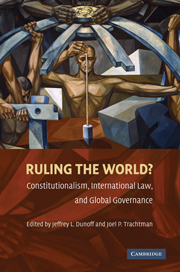
- Ruling the World?Constitutionalism, International Law, and Global Governance, pp. 69 - 110Publisher: Cambridge University PressPrint publication year: 2009
References
, Anarchy Is What States Make of It: The Social Construction of Power Politics 46 Int'l Org.391 (1992)CrossRefGoogle Scholar
& , Fragmentation of International Law: Postmodern Anxieties?, 15 Leiden J. Int'l L.553 (2002)CrossRefGoogle Scholar
& , Of Planets and the Universe: Self-Contained Regimes in International Law, 17 Eur. J. Int'l L.483, 494–506 (2006)CrossRefGoogle Scholar
Diversity of Cacophony? New Sources of Norms in International Law, 25 Mich. J. Int'l L.845 (2004)
, Constitutionalism as Mindset: Reflections on Kantian Themes about International Law and Globalization, 8 Theoretical Inquiries in Law9 (2007)Google Scholar
& , The Structure of Change in International Law or Is There a Hierarchy of Norms in International Law? 8 Eur. J. Int'l L.545, 547 (1997)CrossRefGoogle Scholar
, Le droit international: bric-à-brac ou système? 31 Archives de philosophie du droit85, 102–05 (1986)Google Scholar
, Towards Relative Normativity in International Law? 77 Am. J. Int'l L.413, 422–23 (1989)CrossRefGoogle Scholar
, How to Reform the UN System? Constitutionalism, International Law, and International Organizations, 10 Leiden J. Int'l L.421 (1997)CrossRefGoogle Scholar
, The United Nations Charter as Constitution of the International Community, 36 Colum. J. Transnat'l L.529 (1998)Google Scholar
, From Bilateralism to Community Interest in International Law, 250 Recueil des Cours217, 258et seq. (1994)Google Scholar
& , International Law: A Constitution for Mankind? An Attempt at a Re-appraisal with an Analysis of Constitutional Principles, 50 German Y.B. Int'l L.303, 319 (2008)Google Scholar
, Comments on Global Governance, the United Nations, and the Place of Law, 9 Finnish Y.B. Int'l L.61, 65 (1998)Google Scholar
, The War against Iraq and the Future of International Law: Hegemony or Pluralism? 25 Mich. J. Int'l L.691 (2004)Google Scholar
, What's Wrong with Chinese Rights? Toward a Theory of Rights with Chinese Characteristics, 6 Harv. Hum. Rts. J.29 (1993)Google Scholar
& , Regime-Collisions: The Vain Search for Legal Unity in the Fragmentation of Global Law, 25 Mich J. Int'l L.999, 1045 (2004)Google Scholar
et al., Legalization and World Politics: A Special Issue of International Organization, 54 Int'l Org.385et seq. (2000)CrossRefGoogle Scholar
, The Geology of International Law, 64 Zeitschrift für ausländisches öffentliches Recht und Völkerrecht547 (2004)Google Scholar
, The Ottawa Convention Banning Landmines, the Role of International Non-Governmental Organizations and the Idea of International Civil Society, 11 Eur. J. Int'l L.91 (2000)CrossRefGoogle Scholar
, Implementation of LaGrand and Avena in Germany and the United States: Exploring a Transatlantic Divide in Search of a Uniform Interpretation of Consular Rights, 18 Eur. J. Int'l L.317 (2007)CrossRefGoogle Scholar
, Comment to Andreas Fischer-Lescano & Gunther Teubner: The Legitimacy of International Law and the Role of the State, 25 Mich. J. Int'l L.1047, 1053 (2004)Google Scholar
(ed.), The Proliferation of International Tribunals: Piecing Together the Puzzle, 31 N.Y.U J. Int'l L. & Pol.679 (1999)
, Jus Cogens in a Time of Hegemony and Fragmentation – An Attempt at a Re-appraisal, 74 (3–4) Nordic J. Int'i L.297 (2005)CrossRefGoogle Scholar
, Book Review (Orakelashvili, Peremptory Norms in International Law), 101 Am. J. Int'l L.913 (2007)Google Scholar
, Constitutionalizing (Inter)national Governance: Possibilities for and Limits to the Development of an International Constitutional Law, 44 German Y.B. Int'l L.170 (2001)Google Scholar
, Compensatory Constitutionalism: The Function and Potential of Fundamental International Norms and Structures, 19 Leiden J. Int'l L.579 (2006)CrossRefGoogle Scholar
, Reclaiming Democracy: The Strategic Uses of Foreign and International Law by National Courts, 102 Am. J. Int'l L.241 (2008)CrossRefGoogle Scholar
, The Future of International Law Scholarship in Germany: The Tension between Interpretation and Change, 67 Zeitschrift für ausländisches öffentliches Recht und Völkerrecht585, 590–91 (2007)Google Scholar
, Soziales Völkerrecht für eine solidarische Völkergemeinschaft? 63 Juristenzeitung265 (2008)CrossRefGoogle Scholar
& , Why States Create International Tribunals: A Response to Professors Posner and Yoo, 93 Cal. L. Rev.899, 905 (2005)Google Scholar
, Legislation and Adjudication in the UN Security Council: Bringing Down the Deliberative Deficit, 102 Am. J. Int'l L.275 (2008)CrossRefGoogle Scholar
, The Police in the Temple. Order, Justice and the UN: A Dialectical View, 6 Eur. J. Int'l L.325 (1995)CrossRefGoogle Scholar
& , Grenzen der Legislativbefugnisse des Sicherheitsrats, 52 Vereinte Nationen71 (2004)CrossRefGoogle Scholar
, Targeted Sanctions Imposed by the UN Security Council and Due Process Rights 3 Int'l Org. L. Rev.437 (2006)Google Scholar
The Role of Domestic Law in Treaty Enforcement: A Comparative Study ( & eds., Cambridge Univ. Press, 2009)
& , As Bad as It Gets: The European Court of Human Rights Behrami and Saramati Decision and General International Law, 58 Int'l Comp. L.Q. (2008)Google Scholar
Accessibility standard: Unknown
Why this information is here
This section outlines the accessibility features of this content - including support for screen readers, full keyboard navigation and high-contrast display options. This may not be relevant for you.Accessibility Information
Accessibility compliance for the PDF of this chapter is currently unknown and may be updated in the future.
- 49
- Cited by