Book contents
- Frontmatter
- Dedication
- Contents
- List of Tables and Maps
- Acknowledgments
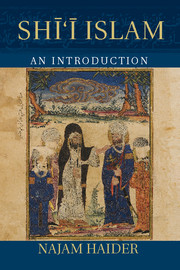
- Note on the Cover Image
- A Note on Transliteration and Dating
- Maps
- Introduction
- Section 1Theology
- Section 2Origins
- Section 3Constructing Shī‘ism
- Section 4Shī‘ism in the Modern World
- 8Zaydism at the Crossroads
- 9(Nizārī) Ismā‘īlism Reconstituted
- 10The Politicization of the Twelver Shī‘a
- ConclusionSunnī–Shī‘ī Relations
- AppendixVerses Mentioned in the Argument from Qur’ānic Expectations in Chapter 3
- Index
- References
9 - (Nizārī) Ismā‘īlism Reconstituted
Published online by Cambridge University Press: 05 August 2014

Book contents
- Frontmatter
- Dedication
- Contents
- List of Tables and Maps
- Acknowledgments
- Note on the Cover Image
- A Note on Transliteration and Dating
- Maps
- Introduction
- Section 1Theology
- Section 2Origins
- Section 3Constructing Shī‘ism
- Section 4Shī‘ism in the Modern World
- 8Zaydism at the Crossroads
- 9(Nizārī) Ismā‘īlism Reconstituted
- 10The Politicization of the Twelver Shī‘a
- ConclusionSunnī–Shī‘ī Relations
- AppendixVerses Mentioned in the Argument from Qur’ānic Expectations in Chapter 3
- Index
- References
Summary
This chapter focuses on the mobilization of Nizārī Ismā‘īlī communities by the Aga Khans from the nineteenth through the twenty-first centuries. The first section traces the Aga Khans’ efforts to reinscribe and consolidate their authority over the Khojas and other historically Ismā‘īlī communities. These efforts, which benefited from British colonial policies, had to overcome a Khoja communal identity that was grounded in caste as opposed to religious considerations. The second section documents the Aga Khans’ embrace of transnationalism through the creation of a network of nongovernmental organizations. These served both to extend the scope of their authority to disparate and isolated Ismā‘īlī populations and to establish them as powerful nonstate players with broad international influence. In the contemporary period, the Aga Khans play dual and perhaps contradictory roles as (i) political heads of a nonterritorial community advocating European values and (ii) authoritative Imāms of a religious community whose members are largely non-European.
The Rise of the Aga Khans
Reinscribing Authority
When the Aga Khan arrived in India in the 1840s, he encountered a Khoja community firmly entrenched in local religious and political structures. In terms of religion, the Khojas adhered to the Satpanth (True Path) tradition that “employed terms and ideas from a variety of Indic religious and philosophical currents, such as the Bhakti, Sant, Sufi, Vaishnavite, and yogic traditions to articulate its core concepts.” They straddled the lines among a variety of identities without conforming to the Muslim–Hindu dichotomy that would come to dominate India under British colonial rule.
Information
- Type
- Chapter
- Information
- Shi'i IslamAn Introduction, pp. 182 - 199Publisher: Cambridge University PressPrint publication year: 2014
References
, “From Satpanthi to Ismaili Muslim: The Articulation of Ismaili Khoja Identity in South Asia,” in A Modern History of the Ismailis, ed. (London: I. B. Tauris, 2011), 95–128.Google Scholar
, “The Khojas of South Asia: Defining a Space of Their Own,” Cultural Dynamics 13 (2001): 155–68.CrossRefGoogle Scholar
, The Ismā‘īlīs: Their History and Doctrines (Cambridge: Cambridge University Press, 1990), 504–48.Google Scholar
, Bombay Islam (Cambridge: Cambridge University Press, 2011), especially 155–78.CrossRefGoogle Scholar
For an analysis of the diplomatic correspondence between the Aga Khans and the British government from the colonial perspective, see , The Ismailis in the Colonial Era (London: Hurst, 2009).Google Scholar
For the perspective of Aga Khan III on most of the subjects discussed in this chapter, see Aga Khan III: Selected Speeches and Writings of Sir Sultan Muhammod Shah, ed. (New York: Kegan Paul, 1991).
, “Caring for the Built Environment,” in A Modern History of the Ismailis, ed. (London: I. B. Tauris, 2011), 221–46.Google Scholar
, “The Gender Policies of Aga Khan III and Aga Khan IV,” in A Modern History of the Ismailis, ed. (London: I. B. Tauris, 2011), 247–64.Google Scholar
, “The Aga Khan Development Network and Institutions,” in A Modern History of the Ismailis, ed. (London: I. B. Tauris, 2011), 189–220.Google Scholar
For a broad analysis of the gender policies of Aga Khan III, see , “Redefining Muslim Women,” South Asia Graduate Research Journal 20 (2011): 69–94.Google Scholar
The text of the Nizārī Ismā‘īlī Constitution of 1986 is accessible at .
Accessibility standard: Unknown
Why this information is here
This section outlines the accessibility features of this content - including support for screen readers, full keyboard navigation and high-contrast display options. This may not be relevant for you.Accessibility Information
Accessibility compliance for the PDF of this chapter is currently unknown and may be updated in the future.