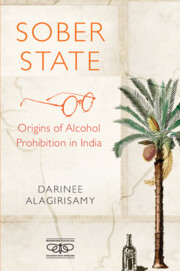
Book contents
- Frontmatter
- Dedication
- Contents
- List of Figures
- Acknowledgments
- List of Abbreviations
- Note on Translation
- Introduction: Setting the Stage – Sober State
- 1The Madras Abkari Act of 1886
- 2Congress Nationalism, Provincial Politics and Prohibitioning
- 3The Development of a Prohibition Culture and Ideal
- 4The Prose of Subaltern Alcoholism
- 5Liquor Businesses and the Business of Prohibition
- 6Enforcing Prohibition
- 7Prohibition in Independent India
- Conclusion
- Glossary
- Bibliography
- Index
3 - The Development of a Prohibition Culture and Ideal
Published online by Cambridge University Press: 09 January 2026

Book contents
- Frontmatter
- Dedication
- Contents
- List of Figures
- Acknowledgments
- List of Abbreviations
- Note on Translation
- Introduction: Setting the Stage – Sober State
- 1The Madras Abkari Act of 1886
- 2Congress Nationalism, Provincial Politics and Prohibitioning
- 3The Development of a Prohibition Culture and Ideal
- 4The Prose of Subaltern Alcoholism
- 5Liquor Businesses and the Business of Prohibition
- 6Enforcing Prohibition
- 7Prohibition in Independent India
- Conclusion
- Glossary
- Bibliography
- Index
Summary
Civil Society and Prohibition
While politics at the national and provincial levels converged to produce prohibition as a political idea and demand, thereby influencing its policy features along the way, it was the concurrent development of a vibrant prohibition culture that imbued the policy with moral force as the demand of the Indian people. Prohibition become an ideal as it filtered through society before crystallising in the provinces as a policy. Indeed, civil society activism reinforced the Congress's demand for the policy as it took shape, bringing a distinct casteist and gendered worldview into alignment with teetotalism-as-patriotism.
Reflecting ‘a convergence of modern science with a synthesis of Victorian morality and established merchant/Bania and Brahman pious norms’, social movements across India had surfaced certain elitist values that gradually became cultural norms between the late nineteenth and mid-twentieth centuries. As they often included the threat of social exclusion, movements that originated and developed within caste communities proved remarkably effective in persuading large numbers of people to turn away from drink – more so, arguably, than state-led prohibition subsequently was. However, there was a key difference between earlier movements and the distinct culture of prohibition that took root between 1920 and 1937. Although the latter was overtly political in its orientation and outlook, it was embedded in a discourse that elevated it above the domain of politics. As an influential Tamil newspaper put it, ‘the political issue need not be mixed up with this. Go to your villages and organise compacts so that there may not be any drunkard therein.’
Information
- Type
- Chapter
- Information
- Sober StateOrigins of Alcohol Prohibition in India, pp. 82 - 117Publisher: Cambridge University PressPrint publication year: 2026
Accessibility standard: Unknown
Why this information is here
This section outlines the accessibility features of this content - including support for screen readers, full keyboard navigation and high-contrast display options. This may not be relevant for you.Accessibility Information
Accessibility compliance for the PDF of this chapter is currently unknown and may be updated in the future.