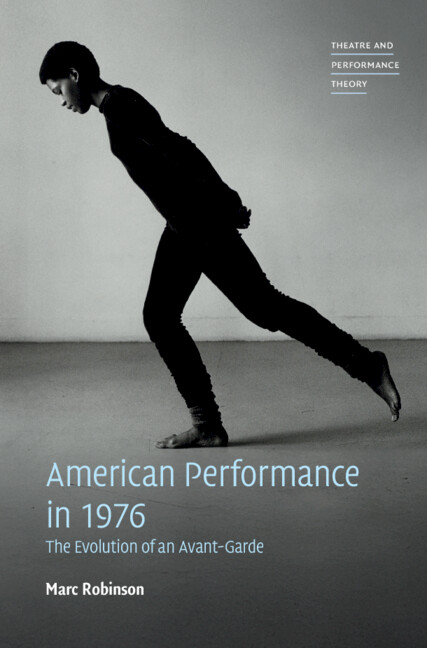
American Performance in 1976

-
Select format
-
- Publisher:
- Cambridge University Press
- Publication date:
- 27 November 2025
- 11 December 2025
- ISBN:
- 9781009490375
- 9781009490382
- 9781009490368
- Dimensions:
- (229 x 152 mm)
- Weight & Pages:
- 0.667kg, 344 Pages
- Dimensions:
- (229 x 152 mm)
- Weight & Pages:
- 0.499kg, 344 Pages
You may already have access via personal or institutional login
Show more authors 
You may already have access via personal or institutional login
Book description
1976 was a febrile, transitional year in cultural history, coming after Watergate and Vietnam and before the AIDS epidemic and the rise of the Conservative movement. Bicentennial triumphalism sounded dissonant against a violent past and uncertain future. Marc Robinson here explores how innovative artists across disciplines – drama, dance, music, film, visual art – responded to this period, before zeroing in on avant-garde theater. Over 1976, five landmark productions could be seen within months of one another: Cecil Taylor's A Rat's Mass / Procession in Shout, Meredith Monk's Quarry, the Robert Wilson / Philip Glass opera Einstein on the Beach, Joseph Chaikin's production of Adrienne Kennedy's A Movie Star Has to Star in Black and White, and, finally, the Wooster Group's first open rehearsal of Spalding Gray and Elizabeth LeCompte's Rumstick Road. In close readings of these five works, Robinson reveals the poetics of a transformative moment in American culture.
Contents
Contents
Metrics
Altmetric attention score
Full text views
Full text views helpTotal number of HTML views: 0
Total number of PDF views: 0 *
 Loading metrics...
* Views captured on Cambridge Core between #date#. This data will be updated every 24 hours.
Usage data cannot currently be displayed.
Accessibility standard: WCAG 2.0 A
Why this information is here
This section outlines the accessibility features of this content - including support for screen readers, full keyboard navigation and high-contrast display options. This may not be relevant for you.
Accessibility Information
The HTML of this book conforms to version 2.0 of the Web Content Accessibility Guidelines (WCAG), ensuring core accessibility principles are addressed and meets the basic (A) level of WCAG compliance, addressing essential accessibility barriers.
Content Navigation
Table of contents navigation
Allows you to navigate directly to chapters, sections, or non‐text items through a linked table of contents, reducing the need for extensive scrolling.
Index navigation
Provides an interactive index, letting you go straight to where a term or subject appears in the text without manual searching.
Reading Order and Textual Equivalents
Single logical reading order
You will encounter all content (including footnotes, captions, etc.) in a clear, sequential flow, making it easier to follow with assistive tools like screen readers.
Short alternative textual descriptions
You get concise descriptions (for images, charts, or media clips), ensuring you do not miss crucial information when visual or audio elements are not accessible.
Structural and Technical Features
ARIA roles provided
You gain clarity from ARIA (Accessible Rich Internet Applications) roles and attributes, as they help assistive technologies interpret how each part of the content functions.