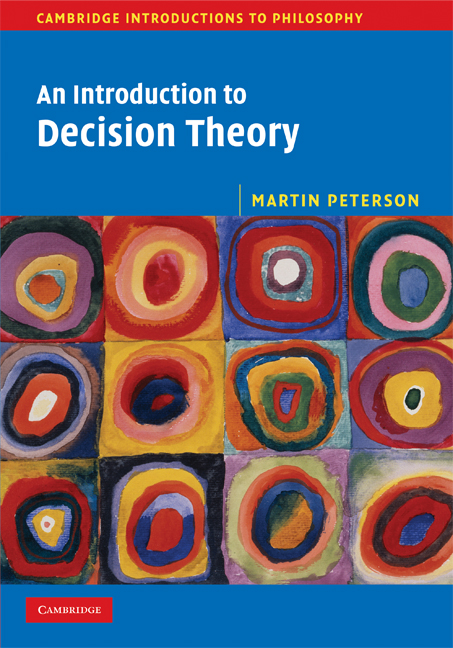
An Introduction to Decision Theory

-
The digital format of this book is no longer available to purchase from Cambridge Core. Other formats may be available.
-
Select format
-
- Publisher:
- Cambridge University Press
- Publication date:
- 05 June 2013
- 14 May 2009
- ISBN:
- 9780511800917
- Dimensions:
- Weight & Pages:
- Dimensions:
- Weight & Pages:
You may already have access via personal or institutional login
Show more authors 
You may already have access via personal or institutional login
Book description
This introduction to decision theory offers comprehensive and accessible discussions of decision-making under ignorance and risk, the foundations of utility theory, the debate over subjective and objective probability, Bayesianism, causal decision theory, game theory, and social choice theory. No mathematical skills are assumed, and all concepts and results are explained in non-technical and intuitive as well as more formal ways. There are over 100 exercises with solutions, and a glossary of key terms and concepts. An emphasis on foundational aspects of normative decision theory (rather than descriptive decision theory) makes the book particularly useful for philosophy students, but it will appeal to readers in a range of disciplines including economics, psychology, political science and computer science.
Reviews
"This up-to-date introduction to decision theory offers comprehensive and accessible discussions of decision-making under ignorance and risk, the foundations of utility theory, the debate over subjective and objective probability, Bayesianism, causal decision theory, game theory, and social choice theory.... all concepts and results are explained in non-technical and intuitive as well as more formal ways. There are over 100 exercises with solutions, and a glossary of key terms and concepts. An emphasis on foundational aspects of normative decision theory (rather than descriptive decision theory) makes the book particularly useful for philosophy students, but it will appeal to readers in a range of disciplines including economics, psychology, political science and computer science."
-- Mathematical Reviews
Contents
Contents
Metrics
Altmetric attention score
Full text views
Full text views helpTotal number of HTML views: 0
Total number of PDF views: 0 *
 Loading metrics...
* Views captured on Cambridge Core between #date#. This data will be updated every 24 hours.
Usage data cannot currently be displayed.
Accessibility standard: Unknown
Why this information is here
This section outlines the accessibility features of this content - including support for screen readers, full keyboard navigation and high-contrast display options. This may not be relevant for you.
Accessibility Information
Accessibility compliance for the PDF of this book is currently unknown and may be updated in the future.