An Introduction to Space Plasma Complexity

-
Select format
-
- Publisher:
- Cambridge University Press
- Publication date:
- 05 March 2015
- 09 March 2015
- ISBN:
- 9780511980251
- 9780521642620
- Dimensions:
- (253 x 177 mm)
- Weight & Pages:
- 0.66kg, 192 Pages
- Dimensions:
- Weight & Pages:
You may already have access via personal or institutional login
Show more authors 
You may already have access via personal or institutional login
Book description
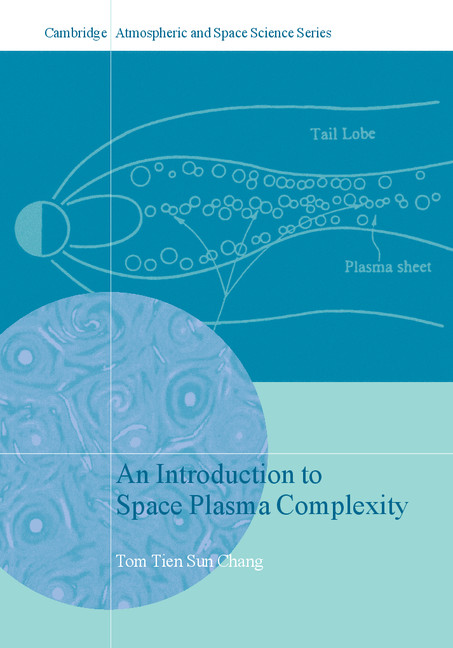
An Introduction to Space Plasma Complexity considers select examples of complexity phenomena related to observed plasma processes in the space environment, such as those pertaining to the solar corona, the interplanetary medium, and Earth's magnetosphere and ionosphere. This book provides a guided tour of the ideas behind forced and/or self-organized criticality, intermittency, multifractals, and the theory of the dynamic renormalization group, with applications to space plasma complexity. There is much to be explored and studied in this relatively new and developing field. Readers will be able to apply the concepts and methodologies espoused in this introduction to their own research interests and activities.
Reviews
'… the book is both readable and authoritative. It is written by an expert practitioner and provides a challenging and rewarding read for students as well as for professionals …'
Terry Robinson Source: The Observatory
'[An Introduction to Space Plasma Complexity] will be primarily of special interest to students and researchers in the field of space plasma to learn how ideas coming from the theory of complexity can be applied and explain some complex phenomena occurring in the space plasma environment. Nevertheless, I believe it can be also useful for theoretical physicists and applied mathematicians interested in the applications of ideas of non-linear dynamics, statistical physics and complex systems to a field which is not sufficiently well known.'
Miguel A. F. Sanjuán Source: Contemporary Physics
Contents
Contents
Metrics
Full text views
Full text views helpTotal number of HTML views: 0
Total number of PDF views: 0 *
 Loading metrics...
* Views captured on Cambridge Core between #date#. This data will be updated every 24 hours.
Usage data cannot currently be displayed.
Accessibility standard: Unknown
Why this information is here
This section outlines the accessibility features of this content - including support for screen readers, full keyboard navigation and high-contrast display options. This may not be relevant for you.
Accessibility Information
Accessibility compliance for the HTML of this book is currently unknown and may be updated in the future.