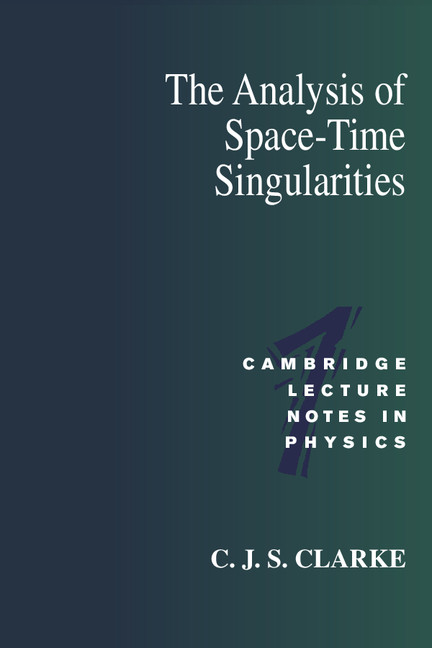
The Analysis of Space-Time Singularities

-
Select format
-
- Publisher:
- Cambridge University Press
- Publication date:
- 05 August 2012
- 12 May 1994
- ISBN:
- 9780511608155
- 9780521437967
- Dimensions:
- Weight & Pages:
- Dimensions:
- (228 x 152 mm)
- Weight & Pages:
- 0.33kg, 192 Pages
You may already have access via personal or institutional login
Show more authors 
You may already have access via personal or institutional login
Book description
The theorems of Hawking and Penrose show that space-times are likely to contain incomplete geodesics. Such geodesics are said to end at a singularity if it is impossible to continue the space-time and geodesic without violating the usual topological and smoothness conditions on the space-time. In this book the different possible singularities are defined, and the mathematical methods needed to extend the space-time are described in detail. The results obtained (many appearing here for the first time) show that singularities are associated with a lack of smoothness in the Riemann tensor. While the Friedmann singularity is analysed as an example, the emphasis is on general theorems and techniques rather than on the classification of particular exact solutions.
Reviews
‘...an elegant and useful account of our present state of understanding.’
William C. Saslaw Source: The Observatory
Contents
Contents
Metrics
Full text views
Full text views helpTotal number of HTML views: 0
Total number of PDF views: 0 *
 Loading metrics...
* Views captured on Cambridge Core between #date#. This data will be updated every 24 hours.
Usage data cannot currently be displayed.
Accessibility standard: Unknown
Why this information is here
This section outlines the accessibility features of this content - including support for screen readers, full keyboard navigation and high-contrast display options. This may not be relevant for you.
Accessibility Information
Accessibility compliance for the PDF of this book is currently unknown and may be updated in the future.