Atomic and Molecular Spectroscopy

-
Select format
-
- Publisher:
- Cambridge University Press
- Publication date:
- 05 June 2015
- 14 May 2015
- ISBN:
- 9781107479999
- 9781107063884
- Dimensions:
- (244 x 170 mm)
- Weight & Pages:
- 0.97kg, 434 Pages
- Dimensions:
- Weight & Pages:
You may already have access via personal or institutional login
Show more authors 
You may already have access via personal or institutional login
Book description
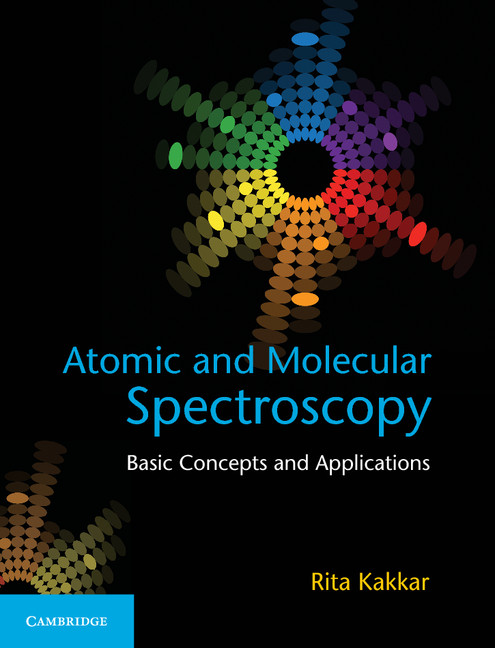
Spectroscopy is the study of electromagnetic radiation and its interaction with solid, liquid, gas and plasma. It is one of the widely used analytical techniques to study the structure of atoms and molecules. The technique is also employed to obtain information about atoms and molecules as a result of their distinctive spectra. The fast-spreading field of spectroscopic applications has made a noteworthy influence on many disciplines, including energy research, chemical processing, environmental protection and medicine. This book aims to introduce students to the topic of spectroscopy. The author has avoided the mathematical aspects of the subject as far as possible; they appear in the text only when inevitable. Including topics such as time-dependent perturbation theory, laser action and applications of Group Theory in interpretation of spectra, the book offers a detailed coverage of the basic concepts and applications of spectroscopy.
Contents
Contents
Metrics
Full text views
Full text views helpTotal number of HTML views: 0
Total number of PDF views: 0 *
 Loading metrics...
* Views captured on Cambridge Core between #date#. This data will be updated every 24 hours.
Usage data cannot currently be displayed.
Accessibility standard: Unknown
Why this information is here
This section outlines the accessibility features of this content - including support for screen readers, full keyboard navigation and high-contrast display options. This may not be relevant for you.
Accessibility Information
Accessibility compliance for the PDF of this book is currently unknown and may be updated in the future.