Attitudes to Language
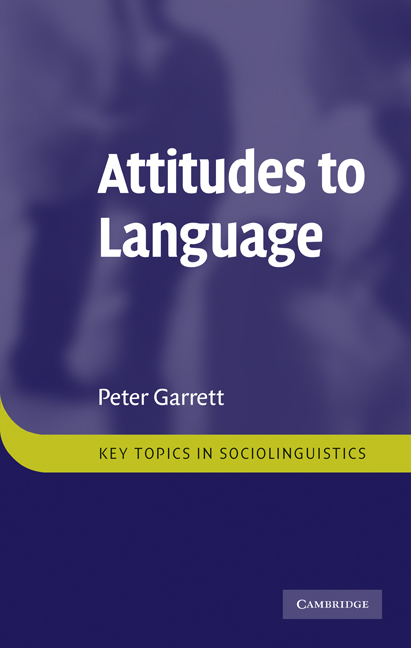

-
Select format
-
- Publisher:
- Cambridge University Press
- Publication date:
- 05 June 2012
- 08 April 2010
- ISBN:
- 9780511844713
- 9780521766043
- 9780521759175
- Dimensions:
- (216 x 138 mm)
- Weight & Pages:
- 0.46kg, 268 Pages
- Dimensions:
- (216 x 138 mm)
- Weight & Pages:
- 0.32kg, 268 Pages
- Series:
- Key Topics in Sociolinguistics
- Subjects:
- Sociology: General Interest, Sociolinguistics, Language and Linguistics
You may already have access via personal or institutional login- Series:
- Key Topics in Sociolinguistics
- Subjects:
- Sociology: General Interest, Sociolinguistics, Language and Linguistics
Show more authors 
You may already have access via personal or institutional login
Book description
Just about everyone seems to have views about language. Language attitudes and language ideologies permeate our daily lives. Our competence, intelligence, friendliness, trustworthiness, social status, group memberships, and so on, are often judged from the way we communicate. Even the speed at which we speak can evoke reactions. And we often try to anticipate such judgements as we communicate. In this lively introduction, Peter Garrett draws upon research carried out over recent decades in order to discuss such attitudes and the implications they have for our use of language, for social advantage or discrimination, and for social identity. Using a range of examples that includes punctuation, words, grammar, pronunciation, accents, dialects and languages, this book explores the intricate and fascinating ways in which language influences our everyday thoughts, feelings and behaviour.
Reviews
‘… essential reading for all those concerned with the ‘social life of language’.’
John Edwards - St Francis Xavier University
‘… likely to be the standard text for students in the field for many years to come.’
Tore Kristiansen - Copenhagen University
Contents
Contents
Metrics
Altmetric attention score
Full text views
Full text views helpTotal number of HTML views: 0
Total number of PDF views: 0 *
 Loading metrics...
* Views captured on Cambridge Core between #date#. This data will be updated every 24 hours.
Usage data cannot currently be displayed.
Accessibility standard: Unknown
Why this information is here
This section outlines the accessibility features of this content - including support for screen readers, full keyboard navigation and high-contrast display options. This may not be relevant for you.
Accessibility Information
Accessibility compliance for the PDF of this book is currently unknown and may be updated in the future.