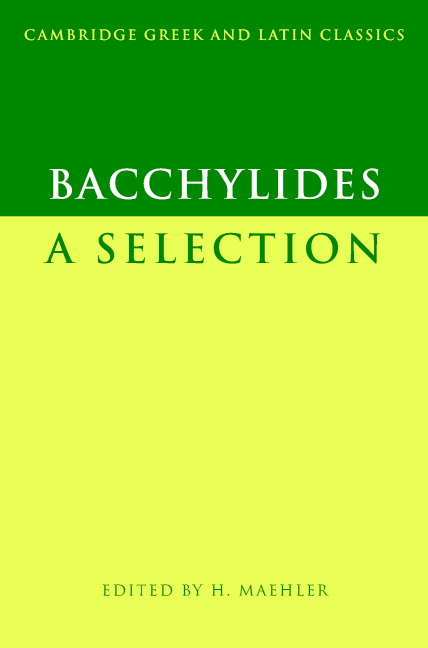
Bacchylides

-
Select format
-
- Publisher:
- Cambridge University Press
- Publication date:
- 05 June 2012
- 17 June 2004
- ISBN:
- 9780511802386
- 9780521599771
- Dimensions:
- Weight & Pages:
- Dimensions:
- (186 x 123 mm)
- Weight & Pages:
- 0.311kg, 292 Pages
- Subjects:
- Classical Studies, Classical Literature
You may already have access via personal or institutional login- Subjects:
- Classical Studies, Classical Literature
Show more authors 
You may already have access via personal or institutional login
Book description
Bacchylides (c. 520–450 BC) was one of the nine Greek lyric poets selected as models of this genre by the Alexandrian scholars who first collected and edited their songs in the 3rd century BC. Bacchylides' songs did not survive the end of antiquity, but substantial portions of at least three books have been recovered from papyri found in Egypt. This 2004 book was the first commentary in English since R. C. Jebb's Bacchylides (1905). It aims to introduce the reader to two important areas of Greek choral lyric poetry in which Bacchylides was pre-eminent: songs in praise of individuals (victory odes 3–6 and 11, and enkomia frr. 20A–D), and songs composed for religious festivals (dithyrambs, procession songs, and paeans). Among the most attractive features of his style are the well-balanced formal structure of his poems, and his vivid narrative which is capable of creating scenes of high drama and deep passion.
Reviews
'The introduction and notes treat fully, clearly and illuminatingly, and with immense learning, all that can be known of the poems' context in Greek life and literature … this book will be an indispensable boon.'
Source: The Journal of Classics Teaching
'Less specialist readers will be grateful to M. and to the Editors of the Cambridge Greek and Latin Classics Series for this new Bacchylides … presents a rich selection of Bacchylides' poems … an excellent introduction to Bacchylides poetry …'
Source: Journal of Hellenistic Studies
Contents
Contents
Metrics
Altmetric attention score
Full text views
Full text views helpTotal number of HTML views: 0
Total number of PDF views: 0 *
 Loading metrics...
* Views captured on Cambridge Core between #date#. This data will be updated every 24 hours.
Usage data cannot currently be displayed.
Accessibility standard: Unknown
Why this information is here
This section outlines the accessibility features of this content - including support for screen readers, full keyboard navigation and high-contrast display options. This may not be relevant for you.
Accessibility Information
Accessibility compliance for the PDF of this book is currently unknown and may be updated in the future.