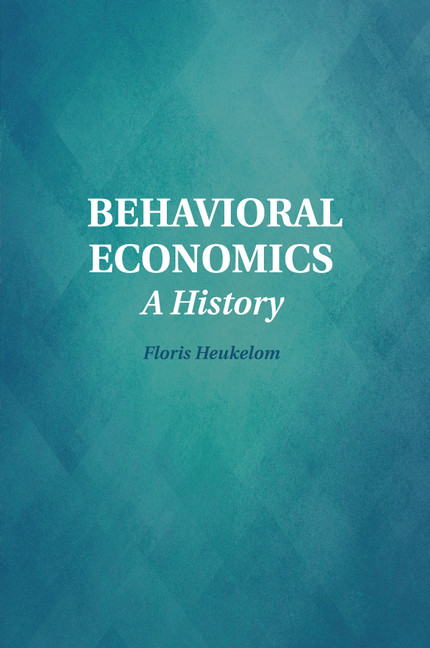
Behavioral Economics

-
Select format
-
- Publisher:
- Cambridge University Press
- Publication date:
- 05 February 2014
- 17 February 2014
- ISBN:
- 9781139600224
- 9781107039346
- 9781107569546
- Dimensions:
- (228 x 152 mm)
- Weight & Pages:
- 0.45kg, 238 Pages
- Dimensions:
- (229 x 152 mm)
- Weight & Pages:
- 0.35kg, 238 Pages
You may already have access via personal or institutional login
Show more authors 
You may already have access via personal or institutional login
Book description
This book presents a history of behavioral economics. The recurring theme is that behavioral economics reflects and contributes to a fundamental reorientation of the epistemological foundations upon which economics had been based since the days of Smith, Ricardo, and Mill. With behavioral economics, the discipline has shifted from grounding its theories in generalized characterizations to building theories from behavioral assumptions directly amenable to empirical validation and refutation. The book proceeds chronologically and takes the reader from von Neumann and Morgenstern's axioms of rational behavior, through the incorporation of rational decision theory in psychology in the 1950s–70s, to the creation and rise of behavioral economics in the 1980s and 1990s at the Sloan and Russell Sage Foundations.
Reviews
'This superb book gives the reader a unique and fascinating window into the historical and intellectual origins of behavioral economics, a movement that is rebuilding economics on a new, more realistic foundation.'
George Loewenstein - Herbert A. Simon Professor of Economics and Psychology, Carnegie Mellon University
'The author provides a balanced treatment of diverging views with a light hand on interpretation … Summing up: highly recommended.'
M. H. Lesser Source: Choice
‘Together, the two narratives make for a richer fabric that can undergird future debates and serve as a basis for much-needed further work on the history, philosophy, and methodology of behavioral economics.’
Erik Angner Source: Journal of the History of Economic Thought
Contents
Contents
Metrics
Altmetric attention score
Full text views
Full text views helpTotal number of HTML views: 0
Total number of PDF views: 0 *
 Loading metrics...
* Views captured on Cambridge Core between #date#. This data will be updated every 24 hours.
Usage data cannot currently be displayed.
Accessibility standard: Unknown
Why this information is here
This section outlines the accessibility features of this content - including support for screen readers, full keyboard navigation and high-contrast display options. This may not be relevant for you.
Accessibility Information
Accessibility compliance for the HTML of this book is currently unknown and may be updated in the future.