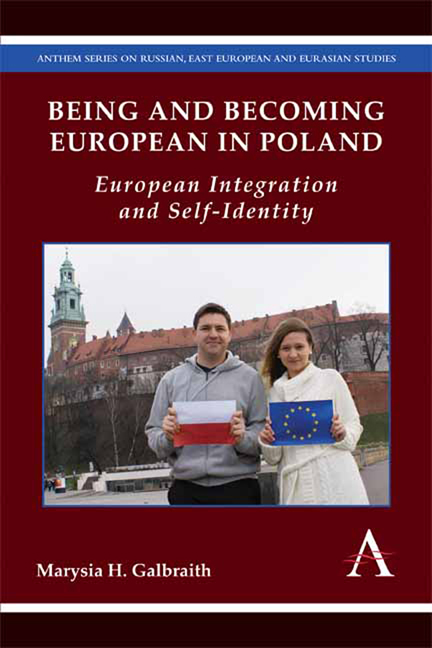
Being and Becoming European in Poland

-
Select format
-
- Publisher:
- Anthem Press
- Publication date:
- 03 November 2017
- 01 June 2014
- ISBN:
- 9781783082346
- 9781783082308
- Dimensions:
- Weight & Pages:
- 00kg,
- Dimensions:
- Weight & Pages:
You may already have access via personal or institutional login
Show more authors 
You may already have access via personal or institutional login
Book description
Overthrowing communism in 1989 and joining the European Union in 2004, the Polish people hold loyalties to region, country and now continent - even as the definition of what it means to be 'European' remains unclear. Paying particular attention to those who came of age in the earliest years of the neoliberal and democratic transformations, this book uses the life-story narratives of rural and urban southern Poles to reveal how 'being European' is considered a fundamental component of 'being Polish' while participants are simultaneously 'becoming European'. Ultimately, this study demonstrates how the EU is regarded as both an idea and an instrument, and how ordinary citizens make choices that influence the shape of European identity and the legitimacy of its institutions.
Contents
Contents
Metrics
Full text views
Full text views helpTotal number of HTML views: 0
Total number of PDF views: 0 *
 Loading metrics...
* Views captured on Cambridge Core between #date#. This data will be updated every 24 hours.
Usage data cannot currently be displayed.
Accessibility standard: Unknown
Why this information is here
This section outlines the accessibility features of this content - including support for screen readers, full keyboard navigation and high-contrast display options. This may not be relevant for you.
Accessibility Information
Accessibility compliance for the PDF of this book is currently unknown and may be updated in the future.