Bilingual Grammar
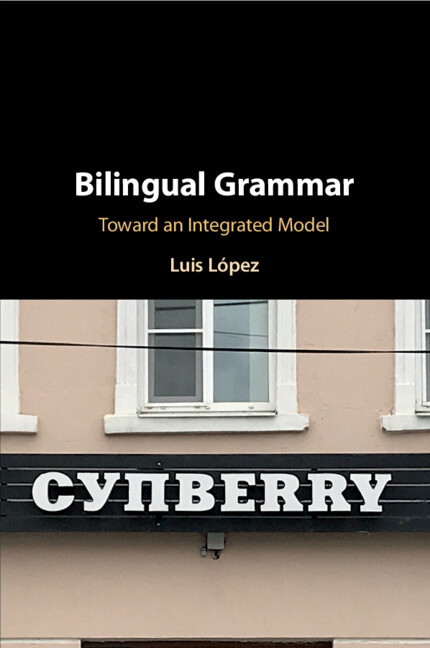

-
Select format
-
- Publisher:
- Cambridge University Press
- Publication date:
- 02 May 2020
- 30 April 2020
- ISBN:
- 9781108756181
- 9781108485302
- 9781108706773
- Dimensions:
- (228 x 152 mm)
- Weight & Pages:
- 0.44kg, 236 Pages
- Dimensions:
- (229 x 152 mm)
- Weight & Pages:
- 0.36kg, 238 Pages
You may already have access via personal or institutional login
Show more authors 
You may already have access via personal or institutional login
Book description
Does a bilingual person have two separate lexicons and two separate grammatical systems? Or should the bilingual linguistic competence be regarded as an integrated system? This book explores this issue, which is central to current debate in the study of bilingualism, and argues for an integrated hypothesis: the linguistic competence of an individual is a single cognitive faculty, and the bilingual mind should not be regarded as fundamentally different from the monolingual one. This conclusion is backed up with a variety of empirical data, in particular code-switching, drawn from a variety of bilingual pairs. The book introduces key notions in minimalism and distributed morphology, making them accessible to readers with different scholarly foci. This book is of interest to those working in linguistics and psycholinguistics, especially bilingualism, code-switching, and the lexicon.
Contents
Contents
Metrics
Altmetric attention score
Full text views
Full text views helpTotal number of HTML views: 0
Total number of PDF views: 0 *
 Loading metrics...
* Views captured on Cambridge Core between #date#. This data will be updated every 24 hours.
Usage data cannot currently be displayed.
Accessibility standard: Unknown
Why this information is here
This section outlines the accessibility features of this content - including support for screen readers, full keyboard navigation and high-contrast display options. This may not be relevant for you.
Accessibility Information
Accessibility compliance for the HTML of this book is currently unknown and may be updated in the future.