Bilingual Language Acquisition

-
Select format
-
- Publisher:
- Cambridge University Press
- Publication date:
- 18 December 2014
- 06 February 2014
- ISBN:
- 9781139162531
- 9781107024267
- 9781107673151
- Dimensions:
- (228 x 152 mm)
- Weight & Pages:
- 0.75kg, 436 Pages
- Dimensions:
- (228 x 152 mm)
- Weight & Pages:
- 0.71kg, 431 Pages
You may already have access via personal or institutional login
Show more authors 
You may already have access via personal or institutional login
Book description
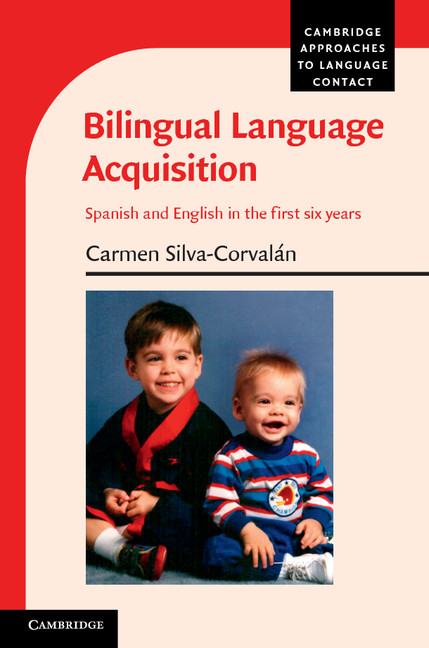
How do children develop bilingual competence? Do bilingual children develop language in the same way as monolinguals? Set in the context of findings on language development, this book examines the acquisition of English and Spanish by two brothers in the first six years of their lives. Based on in-depth and meticulous analyses of naturalistic data, it explores how the systems of both languages affect each other as the children develop, and how different levels of exposure to each language influence the nature of acquisition. The author demonstrates that the children's grammars and lexicons follow a developmental path similar to that of monolinguals, but that cross-linguistic interactions affecting lexical, semantic and discourse-pragmatic aspects arise in Spanish when exposure to it diminishes around the age of four. The first of its kind, this original study is a must-read for students and researchers in bilingualism, child development, language acquisition and language contact.
Reviews
‘Written with love, sophistication and erudition, this impressively informative longitudinal study of Silva-Corvalán's two grandchildren will become a crucial link in our current understanding of early bilingual acquisition, of key features of Spanish and of the acquisition of Spanish as a heritage language in the United States.'
Silvina Montrul - University of Illinois, Urbana-Champaign
‘The case study approach is a real success in bringing together theory and empirical data. The richness of the findings comes alive in Silva-Corvalán's painstakingly detailed analysis.'
Ludovica Serratrice - University of Manchester
'The author provides a truly comprehensive description of how the two youngsters fair in their bilingual language development … this description should prove extremely valuable to researchers in the field.'
Source: Studies in Second Language Acquisition
'Silva-Corvalán has produced a labor of love that is chock-full of precious data, analyses, and clearly articulated hypotheses to be tested in future research. Those of us who investigate child language, bilingualism, language contact, and linguistic complexity will read this volume many times over, and will use it as a starting point for our own projects. The book is also useful for graduate seminars on bilingualism, bilingual language acquisition, Spanish in the US, and numerous other topics. Silva-Corvalán has yet again produced seminal work that will serve as a benchmark for future research for many years to come.'
Naomi L. Shin Source: Heritage Language Journal
Contents
Contents
Metrics
Altmetric attention score
Full text views
Full text views helpTotal number of HTML views: 0
Total number of PDF views: 0 *
 Loading metrics...
* Views captured on Cambridge Core between #date#. This data will be updated every 24 hours.
Usage data cannot currently be displayed.
Accessibility standard: Unknown
Why this information is here
This section outlines the accessibility features of this content - including support for screen readers, full keyboard navigation and high-contrast display options. This may not be relevant for you.
Accessibility Information
Accessibility compliance for the PDF of this book is currently unknown and may be updated in the future.