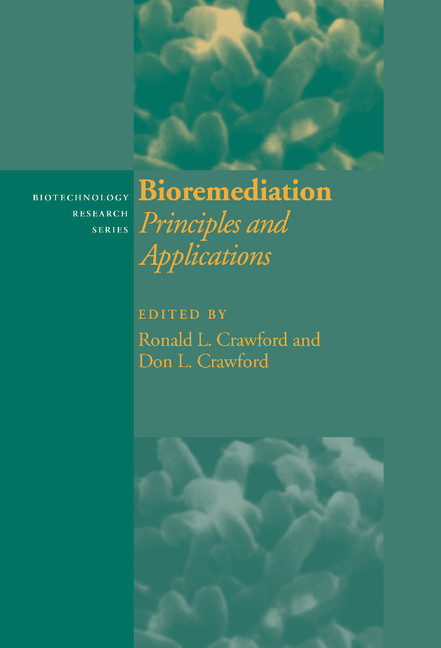
Bioremediation

-
Select format
-
- Publisher:
- Cambridge University Press
- Publication date:
- 28 October 2009
- 21 November 1996
- ISBN:
- 9780511608414
- 9780521470414
- 9780521019156
- Dimensions:
- (228 x 152 mm)
- Weight & Pages:
- 0.8kg, 414 Pages
- Dimensions:
- (228 x 152 mm)
- Weight & Pages:
- 0.622kg, 416 Pages
- Series:
- Biotechnology Research (6)
Show more authors 
You may already have access via personal or institutional login
Book description
Increased industrial and agricultural activity this century has led to vast quantities of the earth's soil and groundwater resources becoming contaminated with hazardous chemicals. Bioremediation provides a technology based on the use of living organisms, usually bacteria and fungi, to remove pollutants from soil and water, preferably in situ. This approach, which is potentially more cost-effective than traditional techniques such as incineration of soils and carbon filtration of water, requires an understanding of how organisms transform chemicals, how they survive in polluted environments and how they should be employed in the field. This book examines these issues for many of the most serious and common environmental contaminants, resulting in a volume which presents the most recent position on the application of bioremediation to the cleanup of polluted soil and water.
Reviews
‘The editors of this book and the contributing authors should be congratulated in providing an up to date review of this rapidly developing subject and it should be of use to many scientists interested in Bioremediation.’
Source: The Association of Applied Biologists News
Contents
Contents
Metrics
Altmetric attention score
Full text views
Full text views helpTotal number of HTML views: 0
Total number of PDF views: 0 *
 Loading metrics...
* Views captured on Cambridge Core between #date#. This data will be updated every 24 hours.
Usage data cannot currently be displayed.
Accessibility standard: Unknown
Why this information is here
This section outlines the accessibility features of this content - including support for screen readers, full keyboard navigation and high-contrast display options. This may not be relevant for you.
Accessibility Information
Accessibility compliance for the PDF of this book is currently unknown and may be updated in the future.