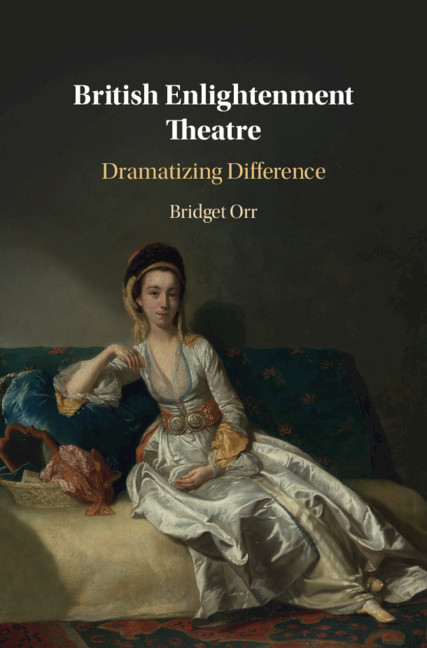
British Enlightenment Theatre

-
Select format
-
- Publisher:
- Cambridge University Press
- Publication date:
- 21 December 2019
- 02 January 2020
- ISBN:
- 9781108584494
- 9781108499712
- 9781108731188
- Dimensions:
- (228 x 152 mm)
- Weight & Pages:
- 0.61kg, 294 Pages
- Dimensions:
- (229 x 152 mm)
- Weight & Pages:
- 0.4kg, 296 Pages
You may already have access via personal or institutional login
Show more authors 
You may already have access via personal or institutional login
Book description
In this ground-breaking work, Bridget Orr shows that popular eighteenth-century theatre was about much more than fashion, manners and party politics. Using the theatre as a means of circulating and publicizing radical Enlightenment ideas, many plays made passionate arguments for religious and cultural toleration, and voiced protests against imperial invasion and forced conversion of indigenous peoples by colonial Europeans. Irish and labouring-class dramatists wrote plays, often set in the countryside, attacking social and political hierarchy in Britain itself. Another crucial but as yet unexplored aspect of early eighteenth-century theatre is its connection to freemasonry. Freemasons were pervasive as actors, managers, prompters, scene-painters, dancers and musicians, with their own lodges, benefit performances and particular audiences. In addition to promoting the Enlightened agenda of toleration and cosmopolitanism, freemason dramatists invented the new genre of domestic tragedy, a genre that criticized the effects of commercial and colonial capitalism.
Reviews
‘Bridget Orr’s British Enlightenment Theatre opens up an exciting research field full of radically important questions about British religious and social attitudes, their relationship to regional diversity, and the multiple ways these issues were debated on the eighteenth-century stage.’
David Worrall Source: Restoration and Eighteenth-Century Theatre Research
‘… will make you rethink your preconceived notions of every word in its title. … Orr’s perspective yields authoritative local readings upon which she builds rich and new accounts of generic change.’
Marcie Frank Source: The Scriblerian and the Kit-Cat
Contents
Contents
Metrics
Altmetric attention score
Full text views
Full text views helpTotal number of HTML views: 0
Total number of PDF views: 0 *
 Loading metrics...
* Views captured on Cambridge Core between #date#. This data will be updated every 24 hours.
Usage data cannot currently be displayed.
Accessibility standard: Unknown
Why this information is here
This section outlines the accessibility features of this content - including support for screen readers, full keyboard navigation and high-contrast display options. This may not be relevant for you.
Accessibility Information
Accessibility compliance for the HTML of this book is currently unknown and may be updated in the future.