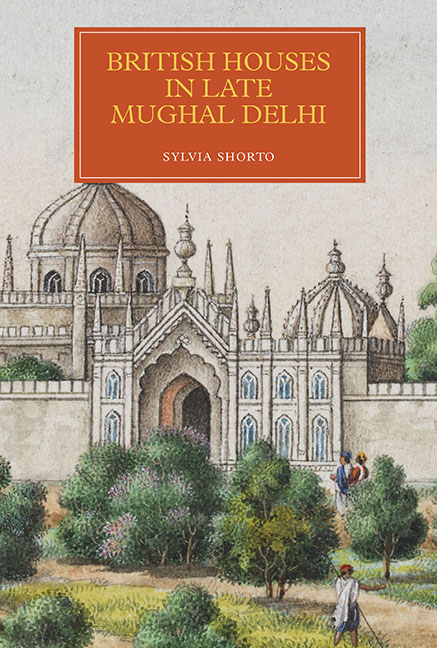
British Houses in Late Mughal Delhi

-
Select format
-
- Publisher:
- Boydell & Brewer
- Publication date:
- 07 July 2018
- 01 May 2018
- ISBN:
- 9781787443044
- 9781783272082
- Dimensions:
- Weight & Pages:
- Dimensions:
- Weight & Pages:
- Subjects:
- Art, Architecture
- Series:
- Worlds of the East India Company
You may already have access via personal or institutional login- Subjects:
- Art, Architecture
- Series:
- Worlds of the East India Company
Show more authors 
You may already have access via personal or institutional login
Book description
This book explores ambivalence in the domestic building activities of a group of East India Company officials in Delhi in the fifty years following British occupation in 1803. Arguing that houses, their location and their contents directly or subliminally reveal the values and beliefs of the individuals who commissioned and lived in them, it uses houses to examine the changing ways the British manipulated power, both relating to and resisting the pre-existing spatial layout of the city. The re-use of palaces and of monumental religious structures as dwellings, as well as new houses that appeared formally classical but concealed adaptations to local ways of living, show that despite an apparent desire to maintain cultural separation, there was both complexity and contradiction in the interrelationship of the British authority and the failing Mughal polity. The book also shows how room sequencing and function demonstrate a lack of rigid distinction between the official and individual roles played by Company officials. Household objects have multiple meanings depending on their use and context. As the taste and choices made in these houses were primarily those of men, the book also contributes to our understanding of competing models of manhood in British India. SYLVIA SHORTO is an Associate Professor in the Department of Architecture and Design at the American University of Beirut, Lebanon.
Contents
Contents
Metrics
Full text views
Full text views helpTotal number of HTML views: 0
Total number of PDF views: 0 *
 Loading metrics...
* Views captured on Cambridge Core between #date#. This data will be updated every 24 hours.
Usage data cannot currently be displayed.
Accessibility standard: Unknown
Why this information is here
This section outlines the accessibility features of this content - including support for screen readers, full keyboard navigation and high-contrast display options. This may not be relevant for you.
Accessibility Information
Accessibility compliance for the PDF of this book is currently unknown and may be updated in the future.