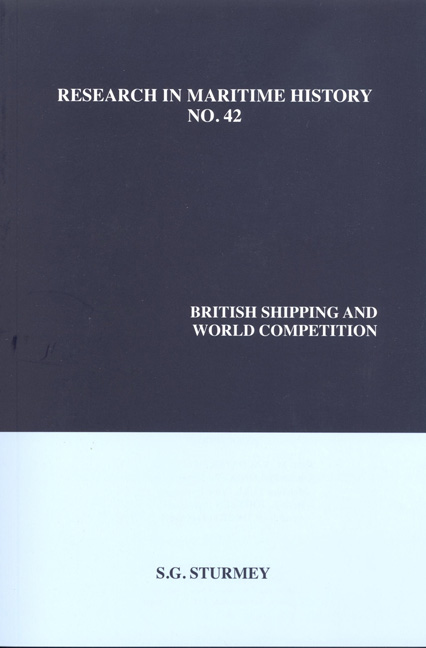
British Shipping and World Competition

-
The digital format of this book is no longer available to purchase from Cambridge Core. Other formats may be available.
-
Select format
-
- Publisher:
- Liverpool University Press
- Publication date:
- 05 May 2018
- 01 December 2009
- ISBN:
- 9781786948939
- 9780986497322
- Dimensions:
- Weight & Pages:
- Dimensions:
- Weight & Pages:
- Series:
- Research in Maritime History
You may already have access via personal or institutional login- Series:
- Research in Maritime History
Show more authors 
You may already have access via personal or institutional login
Book description
This work is a reprint of a 1962 book, British Shipping and World Competition, by maritime economist Dr S. G. Sturmey. It seeks to explain why the tonnage of ships registered in the United Kingdom declined from forty-five percent of the world total in 1900, to sixteen percent by 1960. It presents four possible answers and proceeds to examine them in detail: changes in approaches to competition resulting in changes to the economic structure of the industry; international interference in competitive structures; unrelated factors, such as government policies that didn’t directly concern shipping but still caused an impact; and the internal actions within British shipping relating to changes in industrial circumstances. It is comprised of fifteen chapters, an appendix tabling the contribution of British shipping to the balance of payments, a bibliography, comprehensive index, epilogue, and a foreword from the series editor which states that the Sturmey’s arguments remain resonant in the field of maritime history in the present day. Sturmey makes a particular effort to place the activity in the British shipping industry into an international context for the sake of comparative analysis. It concludes that the decline of the industry was primarily due to internal decision-making rather than external factors - a conclusion that was considered divisive and provocative upon initial release, but has stood the test of time. The epilogue attempts to predict the future of British shipping post-1960, suggesting shipowners could improve the industry’s prospects: however, few of these predictions came to be.
Contents
Contents
Metrics
Full text views
Full text views helpTotal number of HTML views: 0
Total number of PDF views: 0 *
 Loading metrics...
* Views captured on Cambridge Core between #date#. This data will be updated every 24 hours.
Usage data cannot currently be displayed.
Accessibility standard: Unknown
Why this information is here
This section outlines the accessibility features of this content - including support for screen readers, full keyboard navigation and high-contrast display options. This may not be relevant for you.
Accessibility Information
Accessibility compliance for the PDF of this book is currently unknown and may be updated in the future.