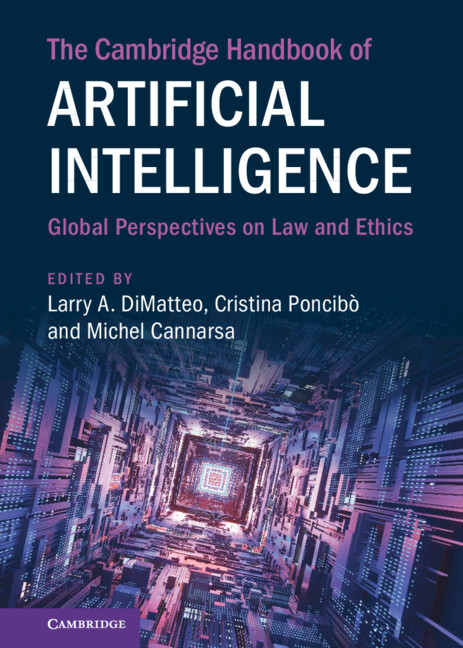
The Cambridge Handbook of Artificial Intelligence

-
Select format
-
- Publisher:
- Cambridge University Press
- Publication date:
- 28 July 2022
- 11 August 2022
- ISBN:
- 9781009072168
- 9781316512807
- Dimensions:
- (254 x 178 mm)
- Weight & Pages:
- 1.03kg, 400 Pages
- Dimensions:
- Weight & Pages:
- Series:
- Cambridge Law Handbooks
- Subjects:
- Intellectual Property, Law: General Interest, Law, Law and technology, science, communication
- Collection:
- Cambridge Law Handbooks
You may already have access via personal or institutional login- Series:
- Cambridge Law Handbooks
- Subjects:
- Intellectual Property, Law: General Interest, Law, Law and technology, science, communication
- Collection:
- Cambridge Law Handbooks
Show more authors 
You may already have access via personal or institutional login
Book description
The technology and application of artificial intelligence (AI) throughout society continues to grow at unprecedented rates, which raises numerous legal questions that to date have been largely unexamined. Although AI now plays a role in almost all areas of society, the need for a better understanding of its impact, from legal and ethical perspectives, is pressing, and regulatory proposals are urgently needed. This book responds to these needs, identifying the issues raised by AI and providing practical recommendations for regulatory, technical, and theoretical frameworks aimed at making AI compatible with existing legal rules, principles, and democratic values. An international roster of authors including professors of specialized areas of law, technologists, and practitioners bring their expertise to the interdisciplinary nature of AI.
Reviews
‘What should lawyers make of the rapid insinuation of AI into our everyday dealings and decisions, including its reshaping of legal practices? In this impressive Handbook, a team of leading scholars and practitioners showcase the breadth, detail, and depth of private law’s engagement with AI. It is a compelling read.’
Roger Brownsword - King’s College London and Bournemouth University
‘The Handbook provides a tour de force for the impact of AI from technical, legal-regulatory, societal, democratic and ethical perspectives, taking into account current developments and trends in the field, as much as that which we should reasonably expect in the future. Scholars and the public are warmly invited to take this tour.’
Ugo Pagallo - University of Turin
‘The editors are to be congratulated on this excellent work. … this is an outstanding book that provides much food for thought.’
Tania Sourdin Source: Prometheus
Contents
Contents
Metrics
Altmetric attention score
Full text views
Full text views helpTotal number of HTML views: 0
Total number of PDF views: 0 *
 Loading metrics...
* Views captured on Cambridge Core between #date#. This data will be updated every 24 hours.
Usage data cannot currently be displayed.
Accessibility standard: WCAG 2.2 AAA
Why this information is here
This section outlines the accessibility features of this content - including support for screen readers, full keyboard navigation and high-contrast display options. This may not be relevant for you.
Accessibility Information
The HTML of this book complies with version 2.2 of the Web Content Accessibility Guidelines (WCAG), offering more comprehensive accessibility measures for a broad range of users and attains the highest (AAA) level of WCAG compliance, optimising the user experience by meeting the most extensive accessibility guidelines.
Content Navigation
Table of contents navigation
Allows you to navigate directly to chapters, sections, or non‐text items through a linked table of contents, reducing the need for extensive scrolling.
Index navigation
Provides an interactive index, letting you go straight to where a term or subject appears in the text without manual searching.
Reading Order and Textual Equivalents
Single logical reading order
You will encounter all content (including footnotes, captions, etc.) in a clear, sequential flow, making it easier to follow with assistive tools like screen readers.
Short alternative textual descriptions
You get concise descriptions (for images, charts, or media clips), ensuring you do not miss crucial information when visual or audio elements are not accessible.
Full alternative textual descriptions
You get more than just short alt text: you have comprehensive text equivalents, transcripts, captions, or audio descriptions for substantial non‐text content, which is especially helpful for complex visuals or multimedia.
Visualised data also available as non‐graphical data
You can access graphs or charts in a text or tabular format, so you are not excluded if you cannot process visual displays.
Visual Accessibility
Use of high contrast between text and background colour
You benefit from high‐contrast text, which improves legibility if you have low vision or if you are reading in less‐than‐ideal lighting conditions.
Structural and Technical Features
ARIA roles provided
You gain clarity from ARIA (Accessible Rich Internet Applications) roles and attributes, as they help assistive technologies interpret how each part of the content functions.