The Cambridge History of Africa

-
Select format
-
- Publisher:
- Cambridge University Press
- Publication date:
- 28 March 2008
- 20 January 1977
- ISBN:
- 9781139054577
- 9780521209816
- Dimensions:
- (228 x 152 mm)
- Weight & Pages:
- 1.206kg, 818 Pages
- Dimensions:
- Weight & Pages:
- Subjects:
- History, Regional History Before 1500, African History
- Series:
- The Cambridge History of Africa
You may already have access via personal or institutional login- Subjects:
- History, Regional History Before 1500, African History
- Series:
- The Cambridge History of Africa
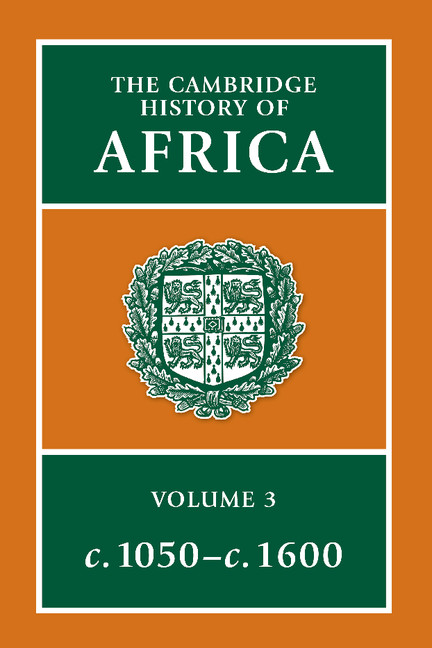
Volume 3: From c.1050 to c.1600
Show more authors 
You may already have access via personal or institutional login
Book description
The five and a half centuries described in this volume were those in which Iron Age cultures passed from their early and experimental phases into stages of maturity characterized by long-distance trade and complex, many-tiered political systems. In Egypt and North Africa it was a period of religious and cultural consolidation when the Arabic language and the faith of Islam were adopted by the majority of the indigenous Copts and Berbers. In the sub-Saharan Savanna it was a period rather of penetration when Muslim merchants and clerics built up small but significant minorities of Negro African converts. Muslim migrants conquered the Nilotic Sudan, encircled Christian Ethiopia and settled the coastline of eastern Africa. But throughout the period African states, large and small, were strong enough, relatively, to control their visitors from the outside world. The main significance of the outsiders, whether Muslim or Christian, was as literate observers of the African scene.
Reviews
‘… a tome that should occupy a prominent place in the library of every person concerned with world affairs both past and present.’
Source: International Journal of African Historical Studies
Contents
Contents
Metrics
Altmetric attention score
Full text views
Full text views helpTotal number of HTML views: 0
Total number of PDF views: 0 *
 Loading metrics...
* Views captured on Cambridge Core between #date#. This data will be updated every 24 hours.
Usage data cannot currently be displayed.
Accessibility standard: Unknown
Why this information is here
This section outlines the accessibility features of this content - including support for screen readers, full keyboard navigation and high-contrast display options. This may not be relevant for you.
Accessibility Information
Accessibility compliance for the PDF of this book is currently unknown and may be updated in the future.