The Cambridge Introduction to Postmodern Fiction

-
Select format
-
- Publisher:
- Cambridge University Press
- Publication date:
- 05 June 2012
- 08 October 2009
- ISBN:
- 9780511816949
- 9780521861571
- 9780521679572
- Dimensions:
- (228 x 152 mm)
- Weight & Pages:
- 0.51kg, 240 Pages
- Dimensions:
- (228 x 152 mm)
- Weight & Pages:
- 0.39kg, 240 Pages
You may already have access via personal or institutional login
Show more authors 
You may already have access via personal or institutional login
Book description
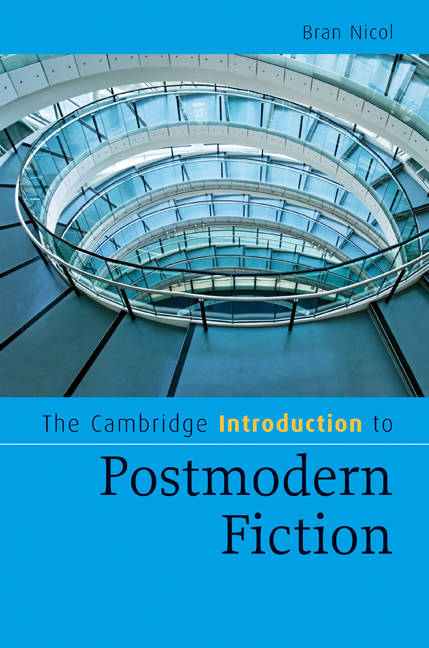
Postmodern fiction presents a challenge to the reader: instead of enjoying it passively, the reader has to work to understand its meanings, to think about what fiction is, and to question their own responses. Yet this very challenge makes postmodern writing so much fun to read and rewarding to study. Unlike most introductions to postmodernism and fiction, this book places the emphasis on literature rather than theory. It introduces the most prominent British and American novelists associated with postmodernism, from the 'pioneers', Beckett, Borges and Burroughs, to important post-war writers such as Pynchon, Carter, Atwood, Morrison, Gibson, Auster, DeLillo, and Ellis. Designed for students and clearly written, this Introduction explains the preoccupations, styles and techniques that unite postmodern authors. Their work is characterized by a self-reflexive acknowledgement of its status as fiction, and by the various ways in which it challenges readers to question common-sense and commonplace assumptions about literature.
Reviews
'Nicol’s continuously readable Introduction is a valuable work of reference and one which many students will find helpful.'
Source: Notes and Queries
Contents
Contents
Metrics
Altmetric attention score
Full text views
Full text views helpTotal number of HTML views: 0
Total number of PDF views: 0 *
 Loading metrics...
* Views captured on Cambridge Core between #date#. This data will be updated every 24 hours.
Usage data cannot currently be displayed.
Accessibility standard: Unknown
Why this information is here
This section outlines the accessibility features of this content - including support for screen readers, full keyboard navigation and high-contrast display options. This may not be relevant for you.
Accessibility Information
Accessibility compliance for the PDF of this book is currently unknown and may be updated in the future.