The Cambridge World History

-
Select format
-
- Publisher:
- Cambridge University Press
- Publication date:
- 05 March 2015
- 12 March 2015
- ISBN:
- 9781139035606
- 9780521190084
- 9781108407694
- Dimensions:
- (228 x 152 mm)
- Weight & Pages:
- 2.37kg, 595 Pages
- Dimensions:
- (228 x 152 mm)
- Weight & Pages:
- 0.89kg, 596 Pages
- Subjects:
- American History: General Interest, British History: General Interest, Regional and World History: General Interest, History, Regional History Before 1500, Global History
- Collections:
- Cambridge Histories - Global History, Cambridge Histories - Ancient History & Classics, Cambridge Histories - British & European History, Cambridge Histories - American History, Cambridge Histories - Asian History, Cambridge Histories - Middle East & African Studies
- Series:
- The Cambridge World History
You may already have access via personal or institutional login- Subjects:
- American History: General Interest, British History: General Interest, Regional and World History: General Interest, History, Regional History Before 1500, Global History
- Collections:
- Cambridge Histories - Global History, Cambridge Histories - Ancient History & Classics, Cambridge Histories - British & European History, Cambridge Histories - American History, Cambridge Histories - Asian History, Cambridge Histories - Middle East & African Studies
- Series:
- The Cambridge World History
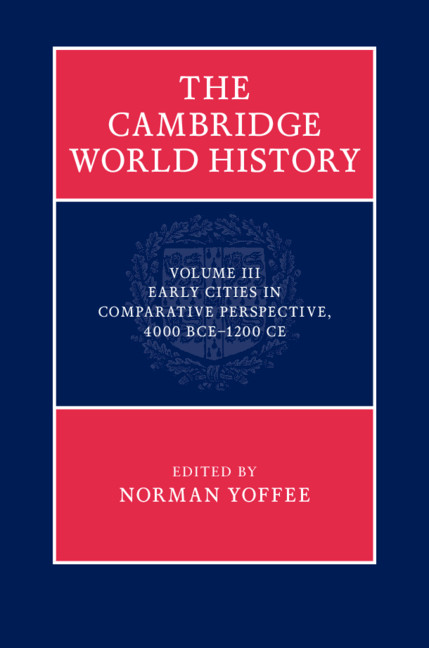
Volume 3: Early Cities in Comparative Perspective, 4000 BCE–1200 CE
Show more authors 
You may already have access via personal or institutional login
Book description
From the fourth millennium BCE to the early second millennium CE the world became a world of cities. This volume explores this critical transformation, from the appearance of the earliest cities in Mesopotamia and Egypt to the rise of cities in Asia and the Mediterranean world, Africa, and the Americas. Through case studies and comparative accounts of key cities across the world, leading scholars chart the ways in which these cities grew as nodal points of pilgrimages and ceremonies, exchange, storage and redistribution, and centres for defence and warfare. They show how in these cities, along with their associated and restructured countrysides, new rituals and ceremonies connected leaders with citizens and the gods, new identities as citizens were created, and new forms of power and sovereignty emerged. They also examine how this unprecedented concentration of people led to disease, violence, slavery and subjugations of unprecedented kinds and scales.
Contents
Contents
Metrics
Altmetric attention score
Full text views
Full text views helpTotal number of HTML views: 0
Total number of PDF views: 0 *
 Loading metrics...
* Views captured on Cambridge Core between #date#. This data will be updated every 24 hours.
Usage data cannot currently be displayed.
Accessibility standard: Unknown
Why this information is here
This section outlines the accessibility features of this content - including support for screen readers, full keyboard navigation and high-contrast display options. This may not be relevant for you.
Accessibility Information
Accessibility compliance for the HTML of this book is currently unknown and may be updated in the future.