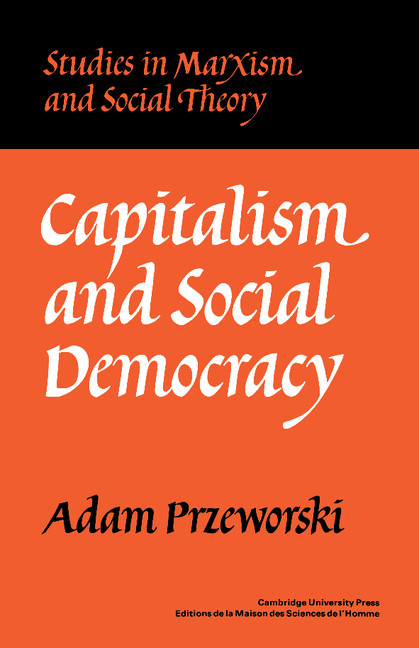
Capitalism and Social Democracy

-
Select format
-
- Publisher:
- Cambridge University Press
- Publication date:
- 05 June 2012
- 09 May 1985
- ISBN:
- 9781139171830
- 9780521336567
- Dimensions:
- Weight & Pages:
- Dimensions:
- (228 x 152 mm)
- Weight & Pages:
- 0.43kg, 280 Pages
You may already have access via personal or institutional login
Show more authors 
You may already have access via personal or institutional login
Book description
This is a study of the choices faced by socialist movements as they developed within capitalist societies. Professor Przeworski examines the three principal choices confronted by socialism: whether to work through elections; whether to rely exclusively on the working class; and whether to try to reform or abolish capitalism. He brings to his analysis a number of abstract models of political and economic structure, and illustrates the issues in the context of historical events, tracing the development of socialist strategies since the mid-nineteenth century. Several of the conclusions are novel and provocative. Professor Przeworski argues that economic issues cannot justify a socialist programme, and that the workers had good reasons to struggle for the improvement of capitalism. Therefore, the project of a socialist transformation, and the fight for economic advancement, were separate historical phenomena.
Contents
Contents
Metrics
Altmetric attention score
Full text views
Full text views helpTotal number of HTML views: 0
Total number of PDF views: 0 *
 Loading metrics...
* Views captured on Cambridge Core between #date#. This data will be updated every 24 hours.
Usage data cannot currently be displayed.
Accessibility standard: Unknown
Why this information is here
This section outlines the accessibility features of this content - including support for screen readers, full keyboard navigation and high-contrast display options. This may not be relevant for you.
Accessibility Information
Accessibility compliance for the PDF of this book is currently unknown and may be updated in the future.