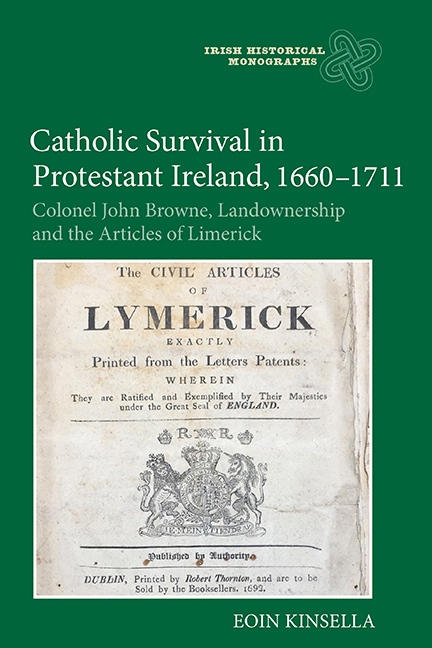

Traditional accounts of early modern Ireland have traced the seemingly inevitable decline of the Catholic landed interest following the Cromwellian and Williamite wars of the seventeenth century, portraying the Irish Catholic community as leaderless and politically moribund in the decades after the surrender of Limerick in 1691. This book demonstrates, however, that the picture was considerably more complex. By taking advantage of the upheavals in Irish landownership of the 1650s, many Catholics not only survived, but thrived. Having emerged as leaders of the Irish Catholic interest during the 1680s, these landowners refused to go into exile following the surrender of the Jacobites. They do not fit neatly into the archetype of the dispossessed and discontented Irish Catholic, offering instead an alternative perspective on Irish Jacobitism. Using the career of Colonel John Browne of Westport House as a focal point, this book casts new light on a wide range of subjects, including Catholic opposition to the repeal of the Restoration land settlement, the Irish Jacobite civil and military administration, estate management in late seventeenth-century Ireland, and the creation of lobbying networks in Dublin and London by Irish Catholics. The book also provides a detailed examination of the Williamite peace settlement in Ireland, and highlights the deeply interconnected nature of Irish society in the late seventeenth century. EOIN KINSELLA completed his doctorate at University College Dublin
Loading metrics...
* Views captured on Cambridge Core between #date#. This data will be updated every 24 hours.
Usage data cannot currently be displayed.
This section outlines the accessibility features of this content - including support for screen readers, full keyboard navigation and high-contrast display options. This may not be relevant for you.
Accessibility compliance for the PDF of this book is currently unknown and may be updated in the future.
