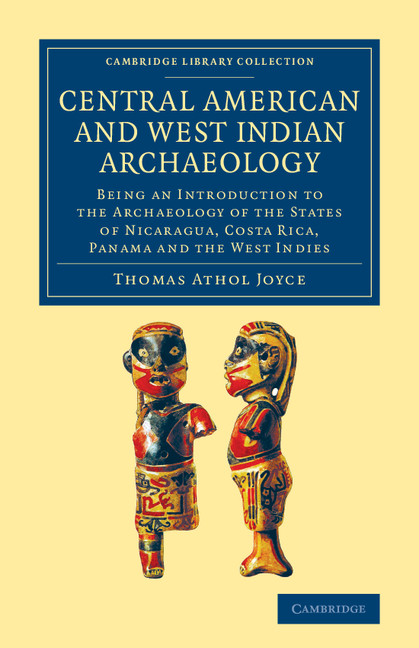

An anthropologist and archaeologist working for much of his life at the British Museum, Thomas Athol Joyce (1878–1942) succeeded in making American archaeology more accessible to non-specialists. Through careful analysis and presentation of the available evidence from South and Central America, he secured his reputation as an authority in this field, especially with regard to Mayan civilisation. Drawing on his wide reading of the published literature, he produced three pioneering and highly illustrated textbooks. The present work appeared in 1916 and focuses on Nicaragua, Costa Rica, Panama and the West Indies. The laws, religion, customs and daily life of the various indigenous peoples are discussed and compared, with thorough illustration and examination of a range of artefacts. Joyce intended his summary of the evidence to serve as 'a signpost for future investigators'. His South American Archaeology (1912) and Mexican Archaeology (1914) are also reissued in this series.
Loading metrics...
* Views captured on Cambridge Core between #date#. This data will be updated every 24 hours.
Usage data cannot currently be displayed.
This section outlines the accessibility features of this content - including support for screen readers, full keyboard navigation and high-contrast display options. This may not be relevant for you.
Accessibility compliance for the PDF of this book is currently unknown and may be updated in the future.
