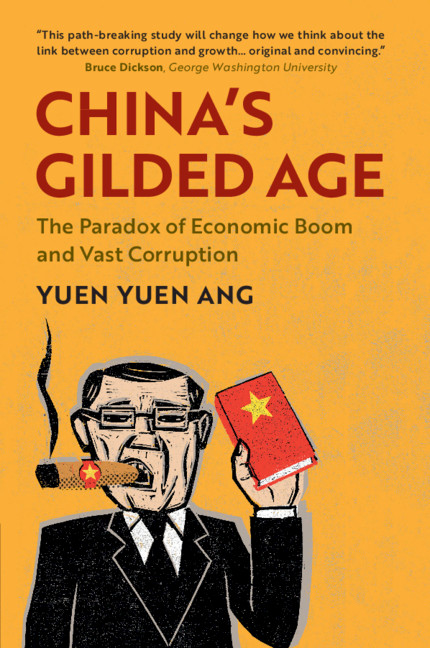
China's Gilded Age

-
Select format
-
- Publisher:
- Cambridge University Press
- Publication date:
- 08 May 2020
- 28 May 2020
- ISBN:
- 9781108778350
- 9781108478601
- 9781108745956
- Open access funder:
- SNF Agora Institute
- Creative Commons:
-
This content is Open Access and distributed under the terms of the Creative Commons Attribution licence CC-BY-NC-ND 4.0.


https://creativecommons.org/creativelicenses - Dimensions:
- (228 x 152 mm)
- Weight & Pages:
- 0.54kg, 274 Pages
- Dimensions:
- (229 x 152 mm)
- Weight & Pages:
- 0.45kg, 274 Pages
Open AccessYou have digital access to this book
Show more authors 
You have digital access to this book
Book description
Why has China grown so fast for so long despite vast corruption? In China's Gilded Age, Yuen Yuen Ang maintains that all corruption is harmful, but not all types of corruption hurt growth. Ang unbundles corruption into four varieties: petty theft, grand theft, speed money, and access money. While the first three types impede growth, access money - elite exchanges of power and profit - cuts both ways: it stimulates investment and growth but produces serious risks for the economy and political system. Since market opening, corruption in China has evolved toward access money. Using a range of data sources, the author explains the evolution of Chinese corruption, how it differs from the West and other developing countries, and how Xi's anti-corruption campaign could affect growth and governance. In this formidable yet accessible book, Ang challenges one-dimensional measures of corruption. By unbundling the problem and adopting a comparative-historical lens, she reveals that the rise of capitalism was not accompanied by the eradication of corruption, but rather by its evolution from thuggery and theft to access money. In doing so, she changes the way we think about corruption and capitalism, not only in China but around the world. This title is also available as open access on Cambridge Core.
Awards
Winner, 2022 Alice Amsden Award, Society for the Advancement of Socio-Economics
Honorable Mention, 2021 Barrington Moore Book Award, American Sociological Association
Winner, 2022 Douglass North Best Book Award, Society for Institutional & Organizational Economics
Reviews
'A thought-provoking new book... The book is not a defence of corruption. Like steroids, access money promotes unbalanced growth, it notes.'
David Rennie Source: The Economist
'This path-breaking study will change how we think about the link between corruption and growth … original and convincing.'
Bruce Dickson - George Washington University
'Yuen Yuen Ang has emerged as her generation’s leading analyst and public interpreter of China’s development experience, and the distinctive strategies underpinning it. Her latest offering is broadly important, intellectually solid, immensely interesting and uniquely accessible to scholars, lay readers and practitioners alike. It will be an academic blockbuster.'
Michael Woolcock - World Bank and Harvard University
'Skillfully unbundling forms of corruption and placing China’s 'Gilded Age' firmly in comparative and historical perspective, Yuen Yuen Ang brings a fresh and penetrating new perspective to one of the central puzzles of the current era - and reminds Americans of the deep-seated corruption of their own early period of rapid industrialization.'
Andrew G. Walder - Stanford University
'Both Xi Jinping and critics of the Chinese government agree corruption is bad for development. Transgressing this simplistic notion, Ang shows that not all corruption is equally bad for growth. Her brilliant analysis explains China’s hyper growth and warns of the troubles ahead.'
Ho-fung Hung - John Hopkins University
'This book will generate substantial debate. Ang stakes out a unique position in the debate over the role of corruption in China’s economic development and the effect it will have on China’s future. Ang makes a valuable contribution in unbundling corruption, methodically demonstrating the ways that both corruption and corrupt actors differ. After reading this book, no one should be able to maintain that corruption is a unitary phenomenon; it manifests itself in many ways.'
Philip Nichols - Wharton School of the University of Pennsylvania
'An important book not only for many who try to understand the roots of China’s success but for a much more sober and less Western-centric view of corruption.'
Branko Milanovic - Global Policy
'She’s incredibly thorough – digging into official stats, media reports, interviewing 400 people and building new databases from scratch to lift the veil on an elusive issue – how corruption works under autocracy.'
Duncan Green - author of From Poverty to Power
‘… Yuen Yuen Ang has produced an extraordinary piece of scholarly work that will significantly impact the way anticorruption research is done in the future.’
Joseph Pozsgai‐Alvarez Source: Governance
‘… Ang’s book provides a very rich basis for economists as well as for scholars interested in governance and corruption to embark on this path.’
Carolin Kautz Source: Journal of Chinese Political Science
‘China’s Gilded Age presents the most sophisticated analysis of corruption to date.’
Diego Castañeda Garza Source: London School of Economics Review of Books
‘... an extraordinary piece.’
Joseph Pozsgai-Alvarez Source: Governance
Contents
Contents
-
China’s Gilded Age
pp i-ii -
-
- You have access
- Open access
- HTML
- Export citation
-
-
China’s Gilded Age - Title page
pp iii-iii - The Paradox of Economic Boom and Vast Corruption
-
-
- You have access
- Open access
- HTML
- Export citation
-
-
Copyright page
pp iv-iv -
-
- You have access
- Open access
- HTML
- Export citation
-
-
Dedication
pp v-vi -
-
- You have access
- Open access
- HTML
- Export citation
-
-
Contents
pp vii-vii -
-
- You have access
- Open access
- HTML
- Export citation
-
-
Figures
pp viii-x -
-
- You have access
- Open access
- HTML
- Export citation
-
-
Tables
pp xi-xii -
-
- You have access
- Open access
- HTML
- Export citation
-
-
Acknowledgments
pp xiii-xvi -
-
- You have access
- Open access
- HTML
- Export citation
-
-
Chapter 1 - Introduction: China’s Gilded Age
pp 1-22 -
-
- You have access
- Open access
- HTML
- Export citation
-
-
Chapter 2 - Unbundling Corruption across Countries
pp 23-51 -
-
- You have access
- Open access
- HTML
- Export citation
-
-
Chapter 3 - Unbundling Corruption over Time
pp 52-84 -
-
- You have access
- Open access
- HTML
- Export citation
-
-
Chapter 4 - Profit-Sharing, Chinese-Style
pp 85-118 -
-
- You have access
- Open access
- HTML
- Export citation
-
-
Chapter 5 - Corrupt and Competent
pp 119-152 -
-
- You have access
- Open access
- HTML
- Export citation
-
-
Chapter 6 - All the King’s Men
pp 153-179 -
-
- You have access
- Open access
- HTML
- Export citation
-
-
Chapter 7 - Rethinking Nine Big Questions
pp 180-212 -
-
- You have access
- Open access
- HTML
- Export citation
-
-
Appendix
pp 213-231 -
-
- You have access
- Open access
- HTML
- Export citation
-
-
Appendix: Chapter 1 - Corruption and GDP Growth
pp 215-216 -
-
- You have access
- Open access
- HTML
- Export citation
-
-
Appendix: Chapter 2 - UCI Survey Methodology
pp 217-218 -
-
- You have access
- Open access
- HTML
- Export citation
-
-
Appendix: Chapter 3 - Definition of Three Main Corruption Terms
pp 219-221 -
-
- You have access
- Open access
- HTML
- Export citation
-
-
Appendix: Chapter 4 - Coding of Chinese Public Compensation
pp 222-224 -
-
- You have access
- Open access
- HTML
- Export citation
-
-
Appendix: Chapter 5 - Four Varieties of Officials
pp 225-228 -
-
- You have access
- Open access
- HTML
- Export citation
-
-
Appendix: Chapter 6 - Appendices
pp 229-229 -
-
- You have access
- Open access
- HTML
- Export citation
-
-
Appendix: Chapter 7 - Construction of Comparative Corruption Indices
pp 230-231 -
-
- You have access
- Open access
- HTML
- Export citation
-
-
References
pp 232-248 -
-
- You have access
- Open access
- HTML
- Export citation
-
-
Index
pp 249-258 -
-
- You have access
- Open access
- HTML
- Export citation
-
Metrics
Altmetric attention score
Full text views
Full text views helpTotal number of HTML views: 0
Total number of PDF views: 0 *
 Loading metrics...
* Views captured on Cambridge Core between #date#. This data will be updated every 24 hours.
Usage data cannot currently be displayed.
Accessibility standard: WCAG 2.2 AAA
Why this information is here
This section outlines the accessibility features of this content - including support for screen readers, full keyboard navigation and high-contrast display options. This may not be relevant for you.
Accessibility Information
The HTML of this book complies with version 2.2 of the Web Content Accessibility Guidelines (WCAG), offering more comprehensive accessibility measures for a broad range of users and attains the highest (AAA) level of WCAG compliance, optimising the user experience by meeting the most extensive accessibility guidelines.
Content Navigation
Table of contents navigation
Allows you to navigate directly to chapters, sections, or non‐text items through a linked table of contents, reducing the need for extensive scrolling.
Index navigation
Provides an interactive index, letting you go straight to where a term or subject appears in the text without manual searching.
Reading Order and Textual Equivalents
Single logical reading order
You will encounter all content (including footnotes, captions, etc.) in a clear, sequential flow, making it easier to follow with assistive tools like screen readers.
Full alternative textual descriptions
You get more than just short alt text: you have comprehensive text equivalents, transcripts, captions, or audio descriptions for substantial non‐text content, which is especially helpful for complex visuals or multimedia.
Visualised data also available as non‐graphical data
You can access graphs or charts in a text or tabular format, so you are not excluded if you cannot process visual displays.
Visual Accessibility
Use of high contrast between text and background colour
You benefit from high‐contrast text, which improves legibility if you have low vision or if you are reading in less‐than‐ideal lighting conditions.